KI-Beratung Beta

Produktbild: Nanofluid for Sustainable Heat Transfer and Energy Systems
Vorbesteller Neu

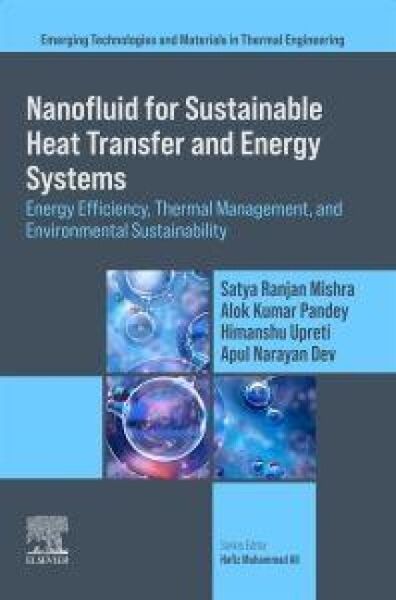
Nanofluid for Sustainable Heat Transfer and Energy Systems Energy Efficiency, Thermal Management, and Environmental Sustainability

231,99 €

inkl. gesetzl. MwSt., Versandkostenfrei


Beschreibung

Nanofluid for Sustainable Heat Transfer and Energy Systems: Energy Efficiency, Thermal Management, and Environmental Sustainability explores cutting-edge developments in nanofluid technology, emphasizing sustainable, eco-friendly, and energy-efficient solutions for modern industrial applications. This...

Beschreibung

Nanofluid for Sustainable Heat Transfer and Energy Systems: Energy Efficiency, Thermal Management, and Environmental Sustainability explores cutting-edge developments in nanofluid technology, emphasizing sustainable, eco-friendly, and energy-efficient solutions for modern industrial applications. This volume consolidates key scientific contributions, synthesis techniques, and characterization methods addressing the challenges facing traditional nanofluids, examining thermophysical properties, stability, and rheological behavior through experimental and numerical investigation.
This reference spans nanofluid fundamentals, thermophysical properties, and heat transfer mechanisms - convective, conductive, radiative, and phase-change. It addresses materials degradation and fouling, alongside applications in solar thermal systems and solar stills. Further chapters present modeling techniques such as hydromagnetic flow prediction, and machine learning-based optimization, supported by techno-economic and scalability assessments bridging laboratory research and industrial adoption.
This book is an essential resource for scientists, engineers, researchers, and students in thermal sciences, renewable energy, materials science, and environmental engineering. It offers valuable insight for professionals developing greener heat transfer fluids, and for policymakers and industry leaders pursuing environmentally responsible thermal management, supporting innovation in sustainable, low-carbon energy technologies.

Portrait

Prof. (Dr.) S.R. Mishra is a Professor in the Department of Mathematics at Siksha O Anusandhan Deemed to be University, Bhubaneswar, with 21 years of teaching at the undergraduate and postgraduate levels. He earned his Ph.D. in 2013 and has since focused on research in Heat Transfer, Magnetohydrodynamics, Porous Media, and Fluid Dynamics.
He has authored approximately 360 papers in reputable international journals and has been recognized as part of the Top 2% World Scientists by Stanford University for five consecutive years (2020–2024). He has delivered numerous lectures at national and international conferences and faculty development programs, covering topics like MATLAB, Scientific Computing with MAPLE, and Linear Algebra. Additionally, he served as a lead editor for a Springer Nature book series in 2020 and is involved as an editor in various international journals.

Dr. Alok Kumar Pandey is an Associate Professor in the Department of Mathematics, Graphic Era (Deemed to be University), Dehradun, Uttarakhand, India. He obtained his PH.D. from Govind Ballabh Pant University of Agriculture and Technology, Pantnagar, Uttarakhand, India. His area of research is Computational Fluid Dynamics. He serves in multiple leadership roles and is a certified reviewer of more than 135 international journals.

Dr. Himanshu Upreti, an Assistant Professor in the School of Engineering and Technology at BML Munjal University, Gurugram, India, earned his doctorate from Govind Ballabh Pant University of Agriculture and Technology, Pantnagar, India. His major research interest lies in computational fluid dynamics, with a focus on mathematical modelling and numerical solutions, and he also explores machine learning and deep learning. He has published numerous research articles in SCI/SCIE and SCOPUS-indexed journals, along with book chapters and conference papers, and is an active member of professional organizations such as the Indian Society of Theoretical and Applied Mechanics (ISTAM) and the National Society of Fluid Mechanics and Fluid Power (NSFMFP).

Apul Narayan Dev is an Associate Professor and Coordinator of the Centre for Data Science at Siksha O Anusandhan Deemed to be University, Bhubaneswar. With 12 years of teaching experience at both undergraduate and postgraduate levels, he holds M.Phil. and Ph.D. degrees from Gauhati University. His research focuses on theoretical and applied plasmas, fluid dynamics, and mathematical methods. He has published around 45 papers in reputable international journals and authored the book “Shock Wave Phenomena in Dusty Plasma.” Dr. Dev has organized two international conferences (AMSE-2019, 2022) and two webinars (Maple-2020, Mathematica-2020).
Produktdetails

Einband

Taschenbuch

Erscheinungsdatum

01.06.2027

Herausgeber Satya Ranjan Mishra + weitere
Verlag Elsevier

Produktdetails

Einband

Taschenbuch

Erscheinungsdatum

01.06.2027

Herausgeber
Verlag Elsevier
Seitenzahl

400

Maße (L/B)

22,9/15,2 cm

Gewicht

449 g

Sprache

Englisch

ISBN

978-0-443-33277-7

Herstelleradresse

Libri GmbH
Europaallee 1
36244 Bad Hersfeld
DE

Email: gpsr@libri.de

Noch keine Bewertungen vorhanden

Verfassen Sie die erste Bewertung zu diesem Artikel

Helfen Sie anderen Kundinnen und Kunden durch Ihre Meinung.

Kundinnen und Kunden meinen

Bewertungen (0)

  • Produktbild: Nanofluid for Sustainable Heat Transfer and Energy Systems
  • SECTION ONE: Fundamentals and Properties of Nanofluids
    1. Introduction to Nanofluids in Heat Transfer and Energy Systems
    2. Thermophysical Properties of Nanofluids
    3. Convective and Conductive Heat Transfer Mechanisms
    4. Radiative and Phase-Change Heat Transfer with Nanofluids
    5. Materials Degradation in Nanofluid-Enhanced Heat Transfer Systems

    SECTION TWO: Experimental Advances and Practical Applications
    6. Enhancing Heat and Mass Transfer in Solar Stills Using Nanofluids
    7. Role of Nanofluids in Performance of Solar Energy Systems
    8. Thermal Stability and Longevity of Nanofluid-Based Systems
    9. Erosion, Fouling, and Stability of Nanofluids
    10. Nanofluid-Based Corrosion Inhibitors for Heat Transfer Systems
    11. Nanofluids for Battery Thermal Management: Fundamentals and Emerging Applications
    12. Self-Healing Coatings and Smart Nanofluid Technologies
    13. Nanofluid-Based Solar Thermal Energy Systems

    SECTION THREE: Computational Modelling, Simulation and Optimization Techniques
    14. Simulating the Hydromagnetic Flow of Green Nanofluid in an Open C-shaped Cavity
    15. Forecasting the Flow Characteristics of Turbulent Flow of Nanofluid Flowing Past a Rotating Cylinder
    16. Entropy Analysis of Magnetically Driven Hybrid Nanofluid Flow inside a Hexagonal Chamber Fitted with Curved Fins
    17. Optimization Techniques in Heat Transfer and Fluid Dynamics
    18. AI and Machine Learning for Optimizing Nanofluid Heat Transfer
    19. Cost-Benefit Analysis of Nanofluid-Based Thermal Management
    20. Scalability and Industrial Adoption of Nanofluid Technologies
    21. Energy Efficiency and Carbon Footprint Reduction with Nanofluids

    SECTION FOUR: Challenges, Limitations and Future Directions
    22. Workplace Safety and Handling Guidelines for Nanofluids
    23. Regulatory Standards for Nanofluid-Based Energy Systems
    24. Toxicity and Environmental Sustainability of Nanofluids
    25. Future Trends and Challenges in Nanofluid Research