KI-Beratung Beta

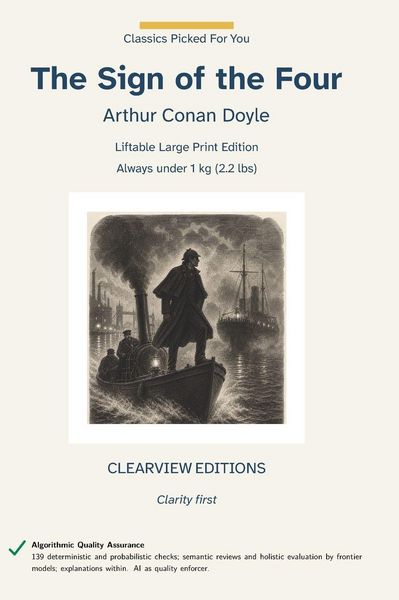
Produktbild: The Sign of the Four
Vorbesteller Neu

The Sign of the Four

Aus der Reihe Clearview Editions
1

45,99 €

inkl. gesetzl. MwSt., Versandkostenfrei


Beschreibung

The Sign of the Four by Arthur Conan Doyle, originally published 1890. Commissioned in 1889, the novel first appeared in the February 1890 issue of Lippincott's Monthly Magazine before its publication in book form later that year. Its pursuit of the stolen Agra treasure turns a London mystery into a...

Beschreibung

The Sign of the Four by Arthur Conan Doyle, originally published 1890. Commissioned in 1889, the novel first appeared in the February 1890 issue of Lippincott's Monthly Magazine before its publication in book form later that year. Its pursuit of the stolen Agra treasure turns a London mystery into a reckoning with greed, betrayal, and the violent afterlife of empire. The novel helped establish the Holmes investigation as a durable form while introducing Mary Morstan and deepening the partnership between Holmes and Watson.

This is a Liftable Edition: Clearview caps paper-plus-binding weight at 1 kilogram (2.2 pounds) for every Liftable title, so it stays comfortable to hold and read for extended periods -- a physical accessibility standard most large-print publishers do not set at all.

For collection development: this is a large-print edition intended for low-vision and aging patrons, and for any reader who finds standard trade print tiring over a long sitting. It suits large-print and accessibility collections, adult and young-adult general collections where the text is a standard, and reading-room copies where a durable case binding matters. Each volume is held under 1 kilogram (2.2 pounds) of paper and binding, so it can be read at a table or in a lap without a stand. The text is unabridged and reproduced from a public-domain source without modernisation.

Algorithmic Quality Assurance: 139 deterministic and probabilistic checks; semantic reviews and holistic evaluation by frontier models; explanations within. AI as quality enforcer.

This Clearview Editions hardcover is built on a production standard that significantly exceeds the industry norm for large-print publishing. The body text is set at 18-point Atkinson Hyperlegible Next on 27-point leading, 1.5 line spacing --- the minimum WCAG 2.2 Level AAA Success Criterion 1.4.8 sets for a block of text, and the figure UKAAF's large-print guidance gives as well. The leading North American large-print hardcover imprints typically set their body text at 16 point, and most large-print trade paperbacks release at 14 to 16 point. At 18 point, Clearview Editions offers text that is measurably larger than every other major large-print publisher, specifically for readers with low vision, macular degeneration, glaucoma, diabetic retinopathy, or any visual condition that makes standard trade print frustrating or impossible to read for long stretches. The trim size is equally generous. Clearview Editions is printed on a 7x10-inch page, substantially larger than the 6x9 hardcover that is standard in the large-print industry and roughly 50 percent larger by area than the 5x8 trade paperback trim most legacy large-print paperback imprints use.

The extra page area is deliberate: it allows the 18-point body to set at the 50-to-55 character line length that reading-fatigue research identifies as optimal, without the narrow text columns and cramped margins that plague smaller-trim large-print books. The body font, Atkinson Hyperlegible Next, was developed by the Braille Institute of America specifically to maximize letter recognition for readers with low vision, macular degeneration, and visual processing differences. It distinguishes between commonly-confused letter pairs - lowercase l versus uppercase I, the digit 0 versus uppercase O, b versus d, p versus q - using distinctive shape features that preserve readability even under eye strain. Text is set ragged right with no word division: WCAG 2.2 1.4.8 and UKAAF both advise against justifying large-print text, since the uneven word spacing it creates is harder to track, and against breaking a word across a line ending, since the reader then has to reassemble it.

Includes a Lagniappe on Conan Doyle's work as an eye specialist and the art of close observation.
Produktdetails

Einband

Gebundene Ausgabe

Erscheinungsdatum

20.11.2026

Verlag W. Frederick Zimmerman
Seitenzahl

292

Produktdetails

Einband

Gebundene Ausgabe

Erscheinungsdatum

20.11.2026

Verlag W. Frederick Zimmerman
Seitenzahl

292

Maße (L/B/H)

25,4/17,8/1,8 cm

Gewicht

725 g

Sprache

Englisch

EAN

9798259518377

Herstelleradresse

Libri GmbH
Europaallee 1
36244 Bad Hersfeld
DE

Email: gpsr@libri.de

Kundinnen und Kunden meinen

Informationen zu Bewertungen

Zur Abgabe einer Bewertung ist eine Anmeldung im Konto notwendig. Die Authentizität der Bewertungen wird von uns nicht überprüft. Wir behalten uns vor, Bewertungstexte, die unseren Richtlinien widersprechen, entsprechend zu kürzen oder zu löschen.

Die Bewertungen sind nach Format, Anzahl Sterne und Datum sortiert.

  • Callisto

    4/5

    07.01.2012

    Buch (Taschenbuch)

    Eliminate all other factors,…

    Eliminate all other factors, and the one which remains must be the truth London im September 1887. Sherlock Holmes und Dr. Watson bekommen Besuch von Miss Mary Morstan. Die junge Gouvernante bekommt seit einigen Jahren jährlich eine große Perle geschickt, diesmal jedoch bekam sie ebenfalls einen Hinweis auf den Tod ihres Vaters „Be at the third pillar from the left outside the Lyceum Theatre to-night at seven o'clock. If you are distrustful, bring two friends. You are a wronged woman, and shall have justice”. Sie beauftragt Holmes, ihr bei der Suche nach ihrem seit zehn Jahren verschollenen Vater zu helfen. Der Informant, Thaddeus Sholto ist der Sohn eines Militärkameraden der mit Mary Morstans Vater in Indien diente. Sholtos Vater versteckte einen Schatz, an dem Mary nun ein Anteil zusteht und er will ihr ihren Anteil aushändigen, der sich im Haus von Sholtos Bruder befindet. Als sie dort ankommen, ist Sholtos Zwillingsbruder Bartholomew jedoch tot und der Schatz verschwunden. Dies ist die zweite Geschichte um Sherlock Holmes, die 1890 erschien. Der Leser erfährt mehr über den exzentrischen Detektiv. Holmes ist nach heutigen Maßstäben kokainabhängig "It is cocaine," he said,—"a seven-per-cent. solution. Would you care to try it?" Aus damaliger Sicht jedoch, war Holmes Kokain Konsum eher eine Marotte, als Sucht, da dieses Mittel sogar Kindern gegen Zahnschmerzen verschrieben wurde, aus heutiger Sicht ist der dreimal tägliche Konsum jedoch äußerst bedenklich, genau wie Watson Empfehlung von Strychnin in hohen Dosen als Beruhigungsmittel. Insgesamt ist Holmes auf dem Stand der damaligen Technik, statt wie heutzutage zu telefonieren, werden permanent Telegramme verschickt, damals muss es wohl an jeder Ecke Telegrafenämter gegeben haben, so gesehen sind die Verwendung von Handys in den BBC Verfilmungen von 2011/12 durchaus adäquate Adaptionen. Wie schon in seinem ersten Roman, webt Conan Doyle auch in diesen Fall eine weitere Geschichte ein, die eine Exkursion in eine damals nur kurz zurückliegende Zeit unternimmt. Diesmal geht es um die East Indian Company und den indischen Aufstand von 1857. Der Fall an sich ist, wie man es von einem Holmes Roman erwartet, solide ermittelt und alle Hinweise werden auf den Tisch gelegt und nichts verschwiegen. Spannender jedoch in diesem Roman ist, dass Watson in diesem Fall seine zukünftige Frau kennenlernt mit welcher er sich auch schon nach wenigen Tagen verlobt.

Kundinnen und Kunden meinen

5

0

4

1

3

0

2

0

1

0

Bewertungen (1)

Weitere Artikel finden Sie in

Die Leseprobe wird geladen.
  • Produktbild: The Sign of the Four