KI-Beratung Beta

Gutscheinbedingungen

**Gültig bis 18.11.2026 auf englischsprachige Klassiker (klassiker-32728) online auf thaalia.live und in der Thalia App. Einzelne Artikel können ausgeschlossen sein. Ausgenommen sind preisgebundene Artikel & eBooks. Pro Einkauf einmal einlösbar. Click & Collect nur bei Onlinevorabzahlung möglich. Keine Barauszahlung. Nicht kombinierbar mit anderen Aktionen und Gutscheinen. Gutschein wird auf max. 500€ Bestellwert angerechnet. Nicht gültig für Geschenkkarten, Versandkosten und Services.

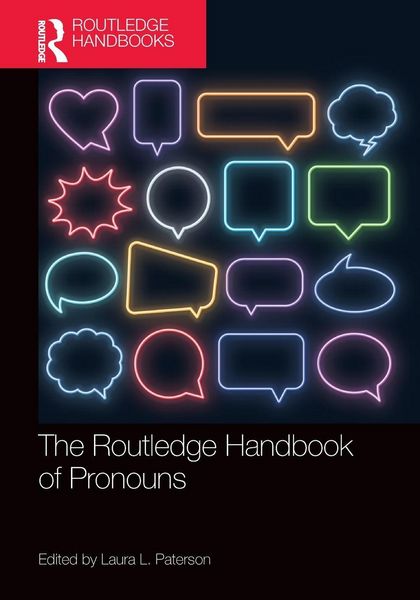
Produktbild: The Routledge Handbook of Pronouns
Vorbesteller Neu

The Routledge Handbook of Pronouns

79,99 €

inkl. gesetzl. MwSt., Versandkostenfrei


Beschreibung

This original volume provides the first state-of-the-art overview of research on pronouns in the 21st century. With its dedicated sections on grammar, history, and change, language learning/acquisition, cognition and comprehension, power, politics, and identity, The Routledge Handbook of Pronouns shows...

Beschreibung

This original volume provides the first state-of-the-art overview of research on pronouns in the 21st century. With its dedicated sections on grammar, history, and change, language learning/acquisition, cognition and comprehension, power, politics, and identity, The Routledge Handbook of Pronouns shows that contemporary interest in pronouns and gender represents just the tip of the iceberg.

Led by Laura Paterson, a transdisciplinary collection of experts discuss the global history of different pronoun systems, synthesize the literature, and contextualize the salient issues and current debates shaping research on pronouns across different spheres and via different theoretical-methodological traditions. The Handbook is designed to encourage readers to engage with a range of perspectives from within and beyond their immediate areas of interest, with the ultimate aim of shaping the future trajectory of interdisciplinary, multiingual research on pronouns.

Using data from multiple languages and engaging deeply with the social, cultural, political, technological, and psychological factors that can influence pronoun use, this innovative book will be an indispensable resource to scholars and advanced students of theoretical and applied linguistics, education, and the social and behavioural sciences.

Portrait

Laura L. Paterson is Senior Lecturer at The Open University, UK, and one of the founding editors of the Journal of Language and Discrimination.

Produktdetails

Einband

Taschenbuch

Erscheinungsdatum

24.11.2026

Abbildungen

schwarz-weiss Illustrationen, Raster,schwarz-weiss, Zeichnungen, schwarz-weiss

Herausgeber Laura L. Paterson

Produktdetails

Einband

Taschenbuch

Erscheinungsdatum

24.11.2026

Abbildungen

schwarz-weiss Illustrationen, Raster,schwarz-weiss, Zeichnungen, schwarz-weiss

Herausgeber Laura L. Paterson
Verlag Taylor and Francis
Seitenzahl

498

Maße (L/B/H)

25,4/17,8/2,7 cm

Gewicht

898 g

Sprache

Englisch

ISBN

978-1-03-239477-0

Herstelleradresse

Libri GmbH
Europaallee 1
36244 Bad Hersfeld
DE

Email: gpsr@libri.de

Noch keine Bewertungen vorhanden

Verfassen Sie die erste Bewertung zu diesem Artikel

Helfen Sie anderen Kundinnen und Kunden durch Ihre Meinung.

Kundinnen und Kunden meinen

Bewertungen (0)

Die Leseprobe wird geladen.
  • Produktbild: The Routledge Handbook of Pronouns
  • 1 The little words that mean a lot

    Laura L. Paterson

    PART 1: HISTORY AND CHANGE

    2 Variation in pronoun typologies

    Heather Bliss, Richard Compton, and Dennis Ryan Storoshenko

    3 A history of personal pronouns in Standard English

    Mikko Laitinen

    4 On the alleged stability of pronouns: The influence of language contact and social intervention

    Peter Siemund

    5 Grammaticalization as a process for pronoun change

    Gunther De Voglaer

    6 The future of pronouns in the online/offline nexus

    Brian W. King and Archie Crowley

    PART 2: PROCESSING AND CATEGORISATION

    7 Pronouns in the brain

    Joanna Porkert, Hanneke Loerts, Anja Schüppert and Merel Keijzer

    8 Pronouns and aphasia

    Eleni Peristeri

    9 Pronoun comprehension

    Jennifer E. Arnold

    10 Personal pronouns and noun phrases as shifters in Southeast Asian languages

    Dwi Noverini Djenar

    11 Alternative pronominal items: Noncanonical pronouns in Chinese, Vietnamese, and Afrikaans

    Chenchen Song, Li Nguyen and Theresa Biberauer

    PART 3: ACQUISITION AND LANGUAGE LEARNING

    12 How children acquire L1 pronouns

    Petra Hendriks

    13 Bilingual acquisition: More object pronouns at once

    Katrin Schmitz

    14 Deixis in the manual modality: Insights from diverse signing communication systems

    Jenny C. Lu and Diane Lillo-Martin

    15 Acquisition of Pronouns in Creole Languages

    Dany Adone and Tamirand De Lisser

    16 Use of anaphoric reference by second language writers: From empirical data to pedagogy in the classroom

    Masumi Narita and Mark Freiermuth

    PART 4: MAKING PRONOUNS PERSONAL

    17 T/V in the 21st century: A case study of French

    Kimberley Pager-McClymont, Sarah Eichhorn and Amélie Doche

    18 Pronouns as shibboleths: Prescriptive attitudes to case forms

    Linda Pillière

    19 Identifying who uses first person singular pronouns and the psychological impacts this language may have

    Nicholas S. Holtzman and Logan C. Delgado

    20 Strategic uses of pronoun drop in economic decision-making

    Tai-Sen He

    21 What does it mean when a computer says I?

    Andrew Gargett

    PART 5: POWER AND POLITICS

    22 The role of pronouns in the race debate: George Floyd and BLM protests

    Zeynep Cihan Koca-Helvaci

    23 'They really eat anything don't they?': Pronoun use in Covid-19-related anti-Asian racism

    Ursula Kania

    24 Pronoun use in cross-cultural therapy sessions

    Nahed Arafat

    25 Politicians' pronouns: Who is 'we'? Negotiating national collectivities in Taiwan's authoritarian period

    Jennifer M. Wei

    26 Strategic use of pronouns among lingua franca English users in a university project-based learning programme

    Satomi Ura and Hiromasa Tanaka

    27 Pronoun activism and the power of animacy

    Laure Gardelle

    PART 6: GENDERED PRONOUNS AND BEYOND

    28 Epicene pronouns new and old

    Charlotte Stormbom

    29 Gender-neutrality and clitics

    Ashley Reilly-Thornton

    30 Gender binaries in constructed languages

    Angela Zottola

    31 Non-binary singular they

    Lex Konnelly, Kirby Conrod, and Evan D. Bradley

    32 Individuals' pronoun choice: A case study of transgender speakers in Berlin, Germany

    Olga Steriopolo and Harley Aussoleil

    33 Misgendering in the media

    Kat Gupta