KI-Beratung Beta

Produktbild: Microinsurance and the Sustainable Development Goals
Vorbesteller Neu

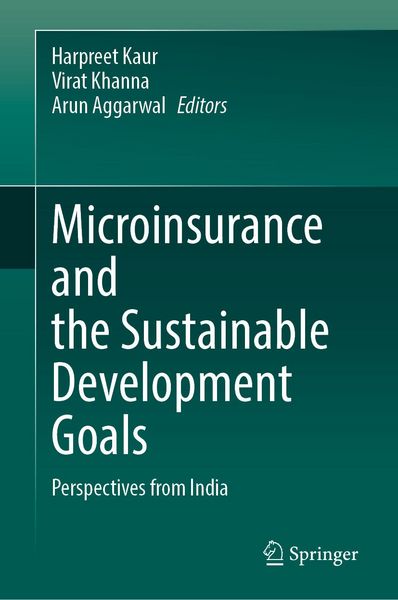
Microinsurance and the Sustainable Development Goals Perspectives from India

175,99 €

inkl. gesetzl. MwSt., Versandkostenfrei


Beschreibung

This contributed volume examines the role of microinsurance as a strategic instrument for advancing sustainable development and strengthening the resilience of vulnerable populations. With a particular focus on the Indian context, the book explores how affordable risk protection can address interconnected...

Beschreibung

This contributed volume examines the role of microinsurance as a strategic instrument for advancing sustainable development and strengthening the resilience of vulnerable populations. With a particular focus on the Indian context, the book explores how affordable risk protection can address interconnected challenges related to poverty, food insecurity, healthcare access, income instability, financial exclusion, and climate-related vulnerability. The volume is structured around key Sustainable Development Goals, with dedicated parts addressing SDG 1 (No Poverty), SDG 2 (Zero Hunger), SDG 3 (Good Health and Well-being), SDG 8 (Decent Work and Economic Growth), and SDG 13 (Climate Action). It brings together perspectives on poverty reduction, agricultural risk management, food security, healthcare access, health equity, income volatility, economic resilience, climate-risk financing, weather-index insurance, and climate-resilient practices.

Going beyond the conventional view of insurance as a mechanism for financial compensation, the book examines the broader developmental impacts of microinsurance, including livelihood security, social protection, financial inclusion, risk management, and resilience building. It also considers the demand-side and supply-side challenges that influence the adoption, accessibility, effectiveness, and long-term sustainability of microinsurance. 

Portrait

Harpreet Kaur is an Assistant Professor at Maharaja Agrasen University, Baddi, and holds a PhD from Punjabi University, Patiala. A UGC-NET qualified scholar with over a decade of teaching and research experience, she specialises in micro insurance, financial inclusion, and sustainable development. She has published extensively in UGC-CARE and Scopus-indexed journals, authored and edited four books, and presented at numerous national and international conferences. She is the recipient of the Young Researcher Award (2025).Virat Khanna is serving as Associate Dean, Research and Development, Chandigarh University, Punjab, India. He is an accomplished academic and researcher with over 16 years of experience in higher education and scientific research. He has authored more than 90 publications in high-impact, peer-reviewed journals indexed in SCI, Scopus, and Web of Science. He has served as an editor for multiple books and conference proceedings with leading international publishers, including Springer, CRC Press, IGI Global, and Bentham Science. He is actively involved in scholarly publishing and currently serves on the Editorial Board of Scientific Reports (Nature Group) and Discover Nano (Springer). Additionally, he holds the position of Academic Editor for the Journal of Nanotechnology published by Wiley. Dr Khanna is also the Book Series Editor for Recent Advances in Materials for Nanotechnology, published by CRC Press (Taylor & Francis)Arun Aggarwal is an accomplished academic, researcher, and editor in management and organizational studies. He currently serves at Liwa University, Abu Dhabi, after holding an Associate Professorship at Chitkara University, India. Recognized among Stanford’s Top 2% Scientists in 2025, he has published extensively in leading Scopus-indexed and ABDC-ranked journals across human resource management, organizational behaviour, tourism, hospitality, education, and consumer research. He is Senior Editor of Global Business and Organizational Excellence and has supervised several awarded doctoral theses. His expertise includes structural equation modelling, multilevel analysis, fuzzy AHP-TOPSIS, research methodology, and advanced statistical techniques using SPSS and AMOS software.

Produktdetails

Einband

Gebundene Ausgabe

Erscheinungsdatum

24.02.2027

Abbildungen

IX, 287 p. 51 illus., 41 illus. in color.

Herausgeber Harpreet Kaur + weitere

Produktdetails

Einband

Gebundene Ausgabe

Erscheinungsdatum

24.02.2027

Abbildungen

IX, 287 p. 51 illus., 41 illus. in color.

Herausgeber
Verlag Springer
Seitenzahl

287

Maße (B/H)

15,5/23,5 cm

Sprache

Englisch

ISBN

978-3-032-41120-4

Herstelleradresse

Springer Nature Customer Service Center GmbH
Europaplatz 3
69115 Heidelberg
DE
ProductSafety@springernature.com

Noch keine Bewertungen vorhanden

Verfassen Sie die erste Bewertung zu diesem Artikel

Helfen Sie anderen Kundinnen und Kunden durch Ihre Meinung.

Kundinnen und Kunden meinen

Bewertungen (0)

  • Produktbild: Microinsurance and the Sustainable Development Goals
  • Chapter 1: Empowering The Vulnerable: Microinsurance For Sustainable Development.- Part 1: Sustainable Development Goal 1 – No Poverty.- Chapter 2: Exploring The Domain Knowledge And Role of Microinsurance In Combating Poverty: A Bibliometric Analysis.- Chapter 3: Impact of Micro Insurance On Poverty Reduction.- Part 2: Sustainable Development Goal 2 – Zero Hunger.- Chapter 4: Agricultural Microinsurance: A Risk Management Tool For Smallholder Farmers.- Chapter 5: Microinsurance and Agricultural Risk Management: A Global Policy Perspective With Lessons For India.- Chapter 6: Ensuring Food Security Through Micro-Insurance.- Part 3: Sustainable Development Goal 3 – Good Health and Well-being.- Chapter 7: Microinsurance and Healthcare Access: Bridging the Gap For Low-Income Populations.- Chapter 8: Coverage To Care: Assessing Micro-Insurance As An Instrument of Health Equity In India.- Part 4: Sustainable Development Goal 8 – Decent Work and Economic Growth.- Chapter 9: Broke To Buffer: Exploring Microinsurance As A Solution To Income Volatility.- Chapter 10: Microinsurance and Economic Resilience.- Part 5: Sustainable Development Goal 13 – Climate Action.- Chapter 11: Micro-insurance and Climate Change.- Chapter 12: Mitigating Climate Risks Through Weather Index Insurance.- Chapter 13: Promoting Climate-Resilient Practices and Supporting Climate Action.