KI-Beratung Beta

Gutscheinbedingungen

**Gültig bis 11.11.2026 auf Spielzeug, Schreibwaren, Filme, Geschenke & Trends, Musik, tolino eReader & Zubehör, Hörbücher und Hörbuch-Downloads, nicht preisgebundene Bücher und Kalender online auf thaalia.live und in der Thalia App. Einzelne Artikel können ausgeschlossen sein. Aufgrund der Buchpreisbindung sind deutschsprachige Bücher und eBooks ausgenommen. Zusätzlich ausgenommen sind Abos & Flatrates, Games, Geschenkkarten/-boxen, Shelfies, Software, Zeitschriften sowie einzelne Artikel von tonies®. Pro Einkauf einmal einlösbar. Click & Collect nur bei Onlinevorabzahlung möglich. Keine Barauszahlung. Nicht kombinierbar mit anderen Aktionen und Gutscheinen. Gutschein wird auf max. 500€ Bestellwert angerechnet. Nicht gültig für Versandkosten und Services.

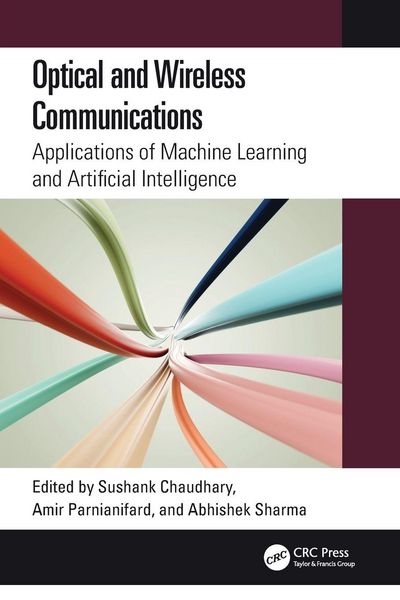
Produktbild: Optical and Wireless Communications

Optical and Wireless Communications Applications of Machine Learning and Artificial Intelligence

89,99 €

inkl. gesetzl. MwSt., Versandkostenfrei


Beschreibung

This edited volume brings together diverse perspectives on machine learning and AI applications in optical and wireless systems, offering a structured and comprehensive resource for researchers and professionals. It explores advancements driven by 5G, IoT, and the increasing demand for high-speed, reliable...

Beschreibung

This edited volume brings together diverse perspectives on machine learning and AI applications in optical and wireless systems, offering a structured and comprehensive resource for researchers and professionals. It explores advancements driven by 5G, IoT, and the increasing demand for high-speed, reliable communication. Covering optical fiber systems, wireless networks, and AI-driven optimizations, the book provides insights into real-world applications impacting telecommunications, healthcare, and transportation.

The contributing authors discuss key topics such as signal processing techniques, optimization algorithms, and deep learning models applied to optical and wireless networks. The volume also highlights emerging challenges, security concerns, and future trends in AI-powered communication systems. This resource is essential for professionals in electrical and computer engineering, telecommunications, and computer science, helping them stay ahead in these rapidly evolving technologies.

Produktdetails

Einband

Taschenbuch

Erscheinungsdatum

27.08.2026

Abbildungen

schwarz-weiss Illustrationen, Raster,schwarz-weiss, Zeichnungen, schwarz-weiss, Tabellen, schwarz-weiss

Herausgeber Sushank Chaudhary + weitere

Produktdetails

Einband

Taschenbuch

Erscheinungsdatum

27.08.2026

Abbildungen

schwarz-weiss Illustrationen, Raster,schwarz-weiss, Zeichnungen, schwarz-weiss, Tabellen, schwarz-weiss

Herausgeber
Verlag Taylor and Francis
Seitenzahl

244

Maße (L/B/H)

23,4/15,6/1,4 cm

Gewicht

367 g

Sprache

Englisch

ISBN

978-1-03-275125-2

Herstelleradresse

Libri GmbH
Europaallee 1
36244 Bad Hersfeld
DE

Email: gpsr@libri.de

Noch keine Bewertungen vorhanden

Verfassen Sie die erste Bewertung zu diesem Artikel

Helfen Sie anderen Kundinnen und Kunden durch Ihre Meinung.

Kundinnen und Kunden meinen

Bewertungen (0)

  • Produktbild: Optical and Wireless Communications
  • 1. Introduction to Advances in Optical and Wireless Communication: Role of Machine Learning and AI, 2. A Study to Discuss the Potential of Mobile Network Optimization Using Machine Learning, 3. AI in Mobile Network Management and Performance Enhancement, 4. Application of Evolutionary Algorithms on Wireless Sensor Network Coverage Optimization: Comparative Study, 5. Fundamentals of Machine Learning in Communication Systems, 6. Cuckoo Search Optimizer Based on Aquila Exploration Strategy, 7. Semantic Segmentation: Techniques, Challenges, and Applications in Intelligent Transportation Systems, 8. Illuminate the Pathways of Moth Flame Optimization for Global Optimization: Applications in Signal Processing and AI for Optical Communication Systems, 9. Optical Communication and Signal Process with AI, 10. Microwave Photonic Radar: Introduction and Signal Processing Challenges