KI-Beratung Beta

Gutscheinbedingungen

**Gültig am 25.11.2026 auf fremdsprachige Bücher online auf thaalia.live und in der Thalia App. Einzelne Artikel können ausgeschlossen sein. Ausgenommen sind preisgebundene Artikel & eBooks. Pro Einkauf einmal einlösbar. Click & Collect nur bei Onlinevorabzahlung möglich. Keine Barauszahlung. Nicht kombinierbar mit anderen Aktionen und Gutscheinen. Gutschein wird auf max. 500€ Bestellwert angerechnet. Nicht gültig für Geschenkkarten, Versandkosten und Services.

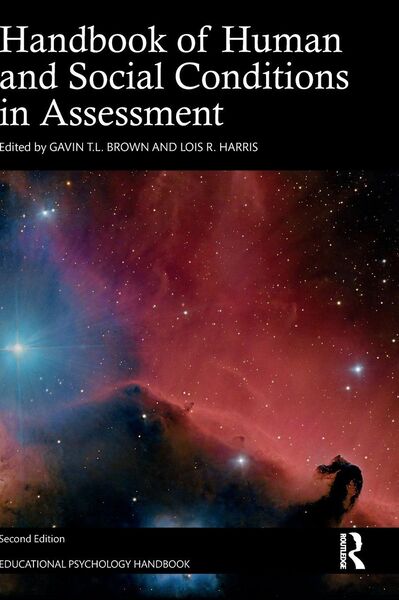
Produktbild: Handbook of Human and Social Conditions in Assessment
Vorbesteller Neu

Handbook of Human and Social Conditions in Assessment

376,99 €

inkl. gesetzl. MwSt., Versandkostenfrei


Beschreibung

The Handbook of Human and Social Conditions in Assessment is the first book to explore assessment issues and opportunities occurring due to the real world of human, cultural, historical, and societal influences upon assessment practices, policies, and statistical modeling. This book engages with numerous...

Beschreibung

The Handbook of Human and Social Conditions in Assessment is the first book to explore assessment issues and opportunities occurring due to the real world of human, cultural, historical, and societal influences upon assessment practices, policies, and statistical modeling. This book engages with numerous forms of assessment, from classroom-level formative assessment practices to national accountability and international comparative testing practices, all of which are significantly influenced by social and cultural conditions. Across four sections, assessment foundations and practice are examined in relation to teachers, students, classroom conditions, and cultural factors.

A unique contribution to the field of educational psychology, this revised and expanded second edition extends its coverage into studies of diversity. Original and synthesized research on individual differences (gifted and talented, physical and intellectual disabilities, gender identities) and populations (cultures, language, religion, region, socio-economic status, educational level) offer a path into assessment beyond what has been established through the field's historic reliance on "WEIRD" samples. In addition, each chapter will examine evidence or theories that offer counterarguments or contradictions to its perspectives to ensure that diversity of thought is well-represented.

Taken together, the chapters in this volume will provide educators, scholars, test developers, and policymakers with an understanding of the human and social complexities that shape assessment at all levels of learning.

Portrait

Gavin T. L. Brown is Professor and Director of the Quantitative Data Analysis and Research Unit in the Faculty of Education and Social Work at the University of Auckland, New Zealand.

Lois R. Harris, PhD, is a Senior Research Fellow at the Institute for Learning Sciences and Teacher Education at Australian Catholic University.

Produktdetails

Einband

Gebundene Ausgabe

Erscheinungsdatum

07.12.2026

Abbildungen

schwarz-weiss Illustrationen, Raster,schwarz-weiss, Zeichnungen, schwarz-weiss, Tabellen, schwarz-weiss

Herausgeber Gavin T. L. Brown + weitere

Produktdetails

Einband

Gebundene Ausgabe

Erscheinungsdatum

07.12.2026

Abbildungen

schwarz-weiss Illustrationen, Raster,schwarz-weiss, Zeichnungen, schwarz-weiss, Tabellen, schwarz-weiss

Herausgeber
Verlag Taylor and Francis
Seitenzahl

486

Maße (L/B)

25,4/17,8 cm

Auflage

2 ed

Sprache

Englisch

ISBN

978-1-03-273915-1

Herstelleradresse

Libri GmbH
Europaallee 1
36244 Bad Hersfeld
DE

Email: gpsr@libri.de

Noch keine Bewertungen vorhanden

Verfassen Sie die erste Bewertung zu diesem Artikel

Helfen Sie anderen Kundinnen und Kunden durch Ihre Meinung.

Kundinnen und Kunden meinen

Bewertungen (0)

  • Produktbild: Handbook of Human and Social Conditions in Assessment
  • Foreword - James H. McMillan

    1. The Continued Importance of Understanding Human and Social Conditions in Assessment

    Gavin T. L. Brown and Lois R. Harris

    PART I: Teachers

    2. An Ecological Systems Theory Approach to Teachers' Perceptions of Classroom Assessment

    Sarah M. Bonner and Parker M. Schiltz

    3. Learning to Become an Assessor: Assessment in Initial Teacher Education

    Christopher DeLuca, Jill Willis, and Nathan Rickey

    4. In-Service Teacher Professional Learning: Use of Assessment in Data-Informed Decision-Making

    Mei Kuin Lai and Kim Schildkamp

    5. Adapting Assessment for Diverse Learners: The Challenges and Consideration of Personalization, Universal Design for Learning and Differentiated Instruction

    Tonya R. Moon

    6. Teacher and Classroom Assessment Practices that Support Learning

    Bronwen Cowie and Christine Harrison

    PART II: Students

    7. Emotions that Matter to Achievement: Student Feelings about Assessment

    Elisabeth Vogl and Reinhard Pekrun

    8. Student Identity and Assessment

    Lois R. Harris, Joanne Dargusch, and Rola Ajjawi

    9. Student Involvement in Assessment: Peer and Self-Assessment

    Ernesto Panadero

    10. The Student-Feedback Interaction Model: A Revised Framework and Empirical Foundations

    Anastasiya Lipnevich, Carolina Lopera-Oquendo, and Jeffrey K. Smith

    11. Academic Assessment and Integrity in the Age of Artificial Intelligence

    Jason M. Stephens

    12. The Validity of Assessment When Students Don't Give Good Effort

    Michalis P. Michaelides and Hanna Eklöf

    13. A Systematic Review of the Role of Metacognition and Types of Regulated Learning in Assessment

    Daniel L. Dinsmore and Hope E. Wilson

    14. Student Experiences of Digital Assessments: Examples from Mathematics Education

    Kaitlin Riegel

    15. Assessment of Collaborative Learning Revisited

    Jan-Willem Strijbos

    PART III: Contexts

    16 The Role of Assessment Reporting in Education: Now and Looking Ahead

    April L. Zenisky and Priya Kannan

    17. Enhancing Privacy in Classroom Assessment

    Martha J. Koch

    18. High Consequence Test-Based Accountability

    Sharon L. Nichols, Audrey Amrein-Beardsley, and Imogen R. Herrick

    19. Public Perceptions About Assessment in Education

    Chad W. Buckendahl

    20. The Impact of International Testing Projects on Policy and Practice

    Janna Teltemann and Dario Nitschke

    21. Profiting From Education: The Role of Edu-Business in Educational Assessment

    Steven Lewis, Sarah Langman, and Bob Lingard

    PART IV: Diversity

    22. Exploring Contexts, Cultures, and Assessment

    Kerry J. Kennedy and Atta Gebril

    23. Colonized, Decolonized, or Localized?: Rethinking Assessment Systems in the Global South

    David Baidoo-Anu and Daniel Asamoah

    24. Equitable Assessments to Support Valid Decision-Making for Students with Special Educational Needs

    Meagan Karvonen, Leanne R. Ketterlin-Geller, and John Paul Henry

    25. Assessing Students' Intelligence and Cognitive Factors

    Nicholas Benson

    26. Issues in Assessing Minority Students in Multicultural Contexts: Marginalization vs. Inclusion

    Guri A. Nortvedt

    27. Assessing Socio-Emotional Learning: Perspectives on Educational Goals at the Individual and Group Level

    Christine Sälzer, Albert Denk, Fabian Müller, and Maren Kholti

    28. Indigenous Students and Assessment: A Decolonizing Approach to Assessment Practices

    Elizabeth McKinley, David Pollock, and Nikki Moodie