KI-Beratung Beta

Produktbild: Plants as Monitors and Mitigators of Air Pollution
Neu

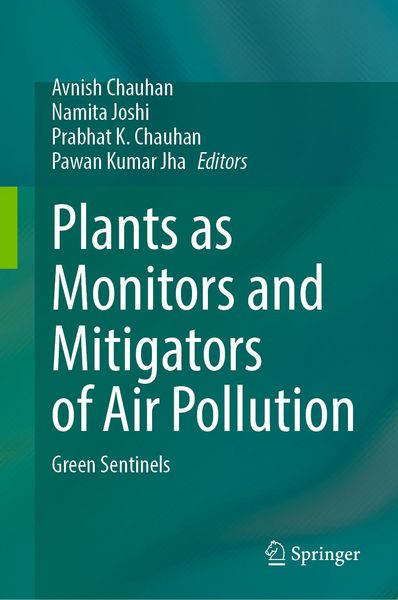
Plants as Monitors and Mitigators of Air Pollution Green Sentinels

219,99 €

inkl. gesetzl. MwSt., Versandkostenfrei


Beschreibung

This book explores the intricate relationship between air pollutants and plant responses, highlighting the role of plants as bioindicators, biomarkers and active agents in pollution mitigation. The chapters present the physiological, biochemical and molecular responses of plants to various pollutants,...

Beschreibung

This book explores the intricate relationship between air pollutants and plant responses, highlighting the role of plants as bioindicators, biomarkers and active agents in pollution mitigation. The chapters present the physiological, biochemical and molecular responses of plants to various pollutants, including gaseous substances, heavy metals, particulate matter and acid deposition. The book further addresses the impact of these pollutants on crop yield, food security and rural livelihoods, offering insights into plant-based monitoring of air quality and advancements in bioengineered phytoremediators. Innovative strategies for enhancing air pollution mitigation through the use of plants, moss, algae and trees designed for maximum pollutant sequestration are also discussed.

By bridging fundamental plant science with applied environmental research, this volume provides a vital resource for those seeking sustainable solutions to air quality management. The book is a must-read for researchers, policymakers and environmental practitioners, offering a guide to harnessing plant-based strategies in the fight against air pollution.

Portrait

Dr. Avnish Chauhan is a distinguished environmental scientist specializing in air pollution, plant physiology and sustainable environmental management. He is currently serving as an associate professor in the Department of Environmental Science at Graphic Era Hill University, Dehradun, Uttarakhand, India. With over 17 years of teaching and research experience, he has made significant contributions to air quality monitoring, pollution impact assessment and plant stress physiology. Dr. Chauhan has authored and edited 34 books, including textbooks and reference works, and published over 75 research papers in reputed national and international journals. His research primarily focuses on the physiological responses of plants to air pollution, urban environmental management and climate change adaptation.
 
Dr. Namita is currently serving as the Professor, Head, and Dean at the Department of Zoology and Environmental Science, Gurukula Kangri (Deemed to be) University, Haridwar, India. With over 31 years of research experience and 28 years in teaching, she has significantly contributed to understanding environmental pollution, soil and water toxicity, and their impacts on plant physiology and biodiversity. Her research spans air quality monitoring, pollutant remediation and the physiological responses of plants to environmental stressors. She has published over 120 research papers and authored/co-authored six books, showcasing her extensive contributions to environmental sciences. She is an active member of esteemed scientific societies, including the Indian Science Congress Association and the International Society for Conservation of Natural Resources.

Dr. Prabhat K. Chauhan is an Assistant Professor in the Department of Environmental Science at A K S University, Satna, India. His research interests encompass plant-microbe interactions, salinity stress management, soil restoration, and environmental pollution control. He possesses strong expertise in molecular and analytical techniques, including DNA quantification, molecular identification, enzyme kinetics, cell and tissue culture, environmental monitoring, air sampling, and heavy metal analysis. Dr. Chauhan holds a Ph.D. in Environmental Science from V.B.S. Purvanchal University, Jaunpur, India. His doctoral research focused on the role of native salt-tolerant plant growth-promoting rhizobacteria in alleviating salinity stress in maize. 
He has published more than 20 research and review articles in reputed international journals. Additionally, he has contributed 12 book chapters and authored 3 books published by Scopus-indexed publishers.

Dr. Pawan Kumar Jha is a distinguished environmental scientist specializing in water pollution, nutrient transport and sustainable solid waste management. He holds a PhD in environmental science from Hokkaido University, Japan. He is currently serving as an assistant professor in the Centre of Environmental Studies at the University of Allahabad, Prayagraj, Uttar Pradesh, India. With over 13 years of teaching and research experience, he has made significant contributions to water quality monitoring, trophic state assessment and heavy metal contamination. He has published more than 50 research and review articles in esteemed international journals and 10 book chapters published by Scopus-indexed publishers.
Produktdetails

Einband

Gebundene Ausgabe

Erscheinungsdatum

21.10.2026

Abbildungen

XXII, 275 p. 32 illus., 30 illus. in color.

Herausgeber Avnish Chauhan + weitere

Produktdetails

Einband

Gebundene Ausgabe

Erscheinungsdatum

21.10.2026

Abbildungen

XXII, 275 p. 32 illus., 30 illus. in color.

Herausgeber
Verlag Springer Singapore
Seitenzahl

275

Maße (L/B/H)

24,1/16/2,1 cm

Gewicht

620 g

Sprache

Englisch

ISBN

978-981-9214-54-9

Herstelleradresse

Springer-Verlag KG
Sachsenplatz 4-6
1201 Wien
AT

Email: ProductSafety@springernature.com

Noch keine Bewertungen vorhanden

Verfassen Sie die erste Bewertung zu diesem Artikel

Helfen Sie anderen Kundinnen und Kunden durch Ihre Meinung.

Kundinnen und Kunden meinen

Bewertungen (0)

  • Produktbild: Plants as Monitors and Mitigators of Air Pollution
  • .- Chapter 1: Plant-Based Molecular Sentinels for Air Pollution Detection 

    .- Chapter 2: Lichens as Biosensors for Ecosystem Pollution Monitoring

    .- Chapter 3: Green sentinel plant monitoring airborne toxins and vegetative performance, effect on growth, carbon use and airborne pollutants 

    .- Chapter 4: Molecular Mechanisms of Plant Adaptation and Stress Tolerance to Airborne Pollutants

    .- Chapter 5: Phytoremediation 2.0: Advances in Genetically Engineered Plants for Air Pollution Mitigation

    .- Chapter 6: CRISPER-Edited Urban Green Spaces: Designing Super Plants for Maximum Air Filtration 

    .- Chapter 7: Genetically Enhanced Moss and Algae: Nature’s Living Air Purifiers for Urban Environments

    .- Chapter 8: Bio-engineered Trees for Smog Reduction: Harnessing Green Technologies for Cleaner Air

    .- Chapter 9: Ecological Engineering for Air Quality: Integrating Nature-Based Approaches with Technological Innovation

    .- Chapter 10:Socioeconomic Implications of Air Pollution: Agriculture, Food Security and Rural Livelihoods

    .- Chapter 11:Policy, Ethics and Public Engagement in Plant Based Pollution Mitigation Strategies

    .- Chapter 12:Green sentinel plants monitoring the role in future Directions Converging Biotechnology, Ecology, and Urban Planning for Smarter Air Quality Solutions.