KI-Beratung Beta

Gutscheinbedingungen

**Gültig bis 11.11.2026 auf Spielzeug, Schreibwaren, Filme, Geschenke & Trends, Musik, tolino eReader & Zubehör, Hörbücher und Hörbuch-Downloads, nicht preisgebundene Bücher und Kalender online auf thaalia.live und in der Thalia App. Einzelne Artikel können ausgeschlossen sein. Aufgrund der Buchpreisbindung sind deutschsprachige Bücher und eBooks ausgenommen. Zusätzlich ausgenommen sind Abos & Flatrates, Games, Geschenkkarten/-boxen, Shelfies, Software, Zeitschriften sowie einzelne Artikel von tonies®. Pro Einkauf einmal einlösbar. Click & Collect nur bei Onlinevorabzahlung möglich. Keine Barauszahlung. Nicht kombinierbar mit anderen Aktionen und Gutscheinen. Gutschein wird auf max. 500€ Bestellwert angerechnet. Nicht gültig für Versandkosten und Services.

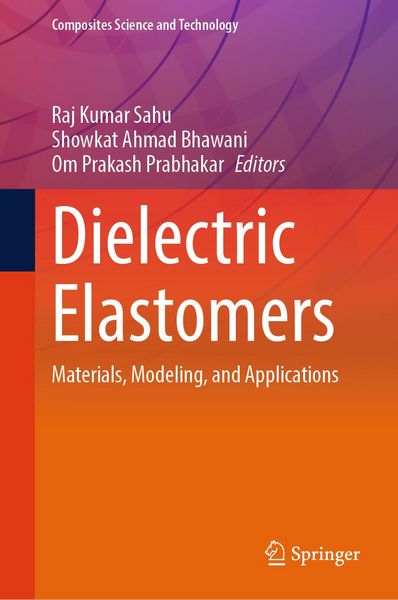
Produktbild: Dielectric Elastomers
Neu

Dielectric Elastomers Materials, Modeling, and Applications

197,99 €

inkl. gesetzl. MwSt., Versandkostenfrei


Beschreibung

This book provides a clear understanding of dielectric elastomer materials suited for soft electromechanical systems (EMS) for numerous engineering applications by establishing the relationship between various stimuli and response. It provides a comprehensive introduction to electroactive polymer (EAP),...

Beschreibung

This book provides a clear understanding of dielectric elastomer materials suited for soft electromechanical systems (EMS) for numerous engineering applications by establishing the relationship between various stimuli and response. It provides a comprehensive introduction to electroactive polymer (EAP), a dielectric elastomer belonging to the class of smart materials, which possesses viscoelastic behavior and in response to the external electric field generates mechanical deformation, and vice-versa. In addition, high-energy density, high-strain rate, and low-elastic modulus, etc., make EAP a suitable material for various EMS applications. Despite having a wide range of applications, its non-linearity, viscoelastic losses, leakage current, etc., make it challenging for researchers as well as manufacturers to use it as actuators, sensors, generators, and so on. This book addresses the issue of non-linearity in dielectric elastomers along with their response to electrical, mechanical, and electromechanical loads with various suitable material models. It provides a complete understanding of material performance, working principle, and design will provide scope for the design, development, and manufacturing of novel devices with different input and response in the field of actuators, sensors, and generators. It is expected that the book is helpful for researchers from mechanical, electrical, mechatronics, and various other branches to understand the modeling and application aspects of dielectric elastomers completely.

Portrait

Dr. Raj Kumar Sahu is working as an associate professor at Department of Mechanical Engineering of National Institute of Technology Raipur, Chhattisgarh, India. He received M.Tech. degree in Mechanical Engineering from National Institute of Technology Jamshedpur in 2010, and Ph.D. degree in Mechanical Engineering from Indian Institute of Technology Patna (IITP), India, in 2014. Dr. Sahu has expertise on design and fabrication of flexible actuator and sensors, self-healing elastomers, material development and characterization, electromechanical behavior of smart materials, composite materials, and functionally graded materials. Dr. Sahu is also involved in polymer nanocomposites for energy harvesting and storage applications, including triboelectric nanogenerators and supercapacitors.
Dr. Showkat Ahmad Bhawani is presently working as an associate professor at the Faculty of Resource Science and Technology, Universiti Malaysia Sarawak. In addition to this, he has a teaching experience of two years from King AbdulAziz University—North Jeddah and a postdoctoral experience of Three years from the Universiti Sains Malaysia, Malaysia. He received his M.Sc. in Analytical Chemistry and Ph.D. in Applied Chemistry from Aligarh Muslim University, Aligarh, India. He is working on the synthesis of molecular imprinting polymers for the removal/extraction of dyes, fungicides, and various natural products from environmental and biological samples. He is involved in the analysis of samples like: surfactants, amino acids, drugs, vitamins, sugars, and metal ions. He has published 12 books and 27 book chapters, and he has published more than 70 papers in various journals.
Dr. Om Prakash Prabhakar works as a research fellow in the Department of Mechanical Engineering at National Institute of Technology Raipur, Chhattisgarh, India. He received M.Tech. degree in Machine Design from National Institute of Technology Raipur (NITRR) in 2019, and Ph.D. degree in Mechanical Engineering from same institution in 2025. Dr. Prabhakar specializes in triboelectric nanogenerators for energy harvesting from low-frequency vibrations, dielectric elastomer composites, electromechanical characterization of soft actuators, and material modeling. Post-Ph.D., his work has been on fatigue delamination in fiber-reinforced polymer composites under dynamic thermo-mechanical loading.

Produktdetails

Einband

Gebundene Ausgabe

Erscheinungsdatum

28.10.2026

Abbildungen

VIII, 276 p. 56 illus., 48 illus. in color.

Herausgeber Raj Kumar Sahu + weitere

Produktdetails

Einband

Gebundene Ausgabe

Erscheinungsdatum

28.10.2026

Abbildungen

VIII, 276 p. 56 illus., 48 illus. in color.

Herausgeber
Verlag Springer Singapore
Seitenzahl

276

Maße (L/B)

23,5/15,5 cm

Auflage

1. Auflage

Sprache

Englisch

ISBN

978-981-9575-17-6

Herstelleradresse

Libri GmbH
Europaallee 1
36244 Bad Hersfeld
DE

Email: gpsr@libri.de

Noch keine Bewertungen vorhanden

Verfassen Sie die erste Bewertung zu diesem Artikel

Helfen Sie anderen Kundinnen und Kunden durch Ihre Meinung.

Kundinnen und Kunden meinen

Bewertungen (0)

  • Produktbild: Dielectric Elastomers
  • Introduction to dielectric elastomers materials.- Dielectric elastomers actuator.- Dielectric elastomers sensors.- Dielectric elastomers generators.- Dielectric elastomers for EMI shielding.- Dielectric elastomers self-powered nanogenerators.- Dielectric elastomer ceramic nanocomposites.- Dielectric elastomer conductive nanocomposites.- Dielectric elastomer polyacrylate nanocomposites.- Dielectric elastomer ionic gel nanocomposites.- Dielectric elastomers characterizations techniques.- Electromechanical performance evaluation of dielectric elastomers.- Time dependent behavior of dielectric elastomers.- Hyperelastic behavior of dielectric elastomers and its modelling.- Viscoelastic behavior of dielectric elastomers and its modelling.- Visco hyperelastic model for dielectric elastomers.- Modelling dielectric elastomer actuator.- Modelling dielectric elastomer sensors.- Modelling dielectric elastomer generators.- Modelling dielectric elastomer EMI Shielding.- Multiphysics approach for design and fabrication of dielectric elastomer transducers.- Opportunities and outlook.