KI-Beratung Beta

Gutscheinbedingungen

**Gültig am 20.11.2026 ab einem Mindestbestellwert von 30€ auf Spielzeug, Schreibwaren, Filme, Geschenke & Trends, Musik, tolino eReader & Zubehör, Hörbücher und Hörbuch-Downloads, nicht preisgebundene Bücher und Kalender online auf thaalia.live und in der Thalia App. Einzelne Artikel können ausgeschlossen sein. Aufgrund der Buchpreisbindung sind deutschsprachige Bücher und eBooks ausgenommen. Zusätzlich ausgenommen sind Abos & Flatrates, Games, Geschenkkarten/-boxen, Shelfies, Software, Zeitschriften sowie einzelne Artikel von tonies®. Pro Einkauf einmal einlösbar. Click & Collect nur bei Onlinevorabzahlung möglich. Keine Barauszahlung. Nicht kombinierbar mit anderen Aktionen und Gutscheinen. Gutschein wird auf max. 500€ Bestellwert angerechnet. Nicht gültig für Versandkosten und Services. Preisgebundene Artikel sind vom Mindestbestellwert ausgeschlossen.

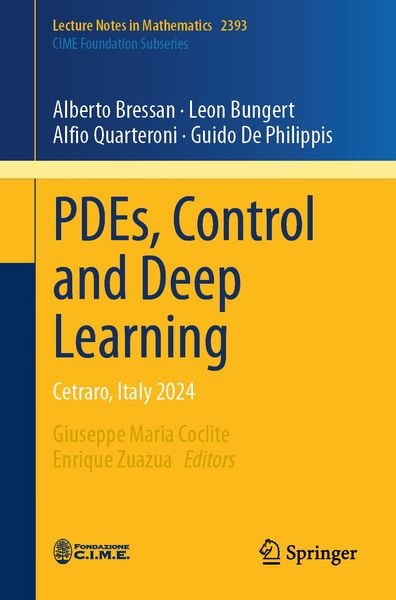
Produktbild: PDEs, Control and Deep Learning
Band 2393 Vorbesteller

PDEs, Control and Deep Learning Cetraro, Italy 2024

74,99 €

inkl. gesetzl. MwSt., Versandkostenfrei


Beschreibung

This volume includes lectures presented at the CIME School on “PDEs, Control and Deep Learning”, held in Cetraro (Italy) from July 22 to 26, 2024. It provides a comprehensive and up-to-date view of the diverse and rapidly evolving field of nonlinear partial differential equations (PDEs), with an emphasis...

Beschreibung

This volume includes lectures presented at the CIME School on “PDEs, Control and Deep Learning”, held in Cetraro (Italy) from July 22 to 26, 2024. It provides a comprehensive and up-to-date view of the diverse and rapidly evolving field of nonlinear partial differential equations (PDEs), with an emphasis on modeling, analysis, control, and deep learning aspects. 

The theory of PDEs interacts closely with almost all areas of physics and many branches of mathematics. As explicit solutions of PDEs are rarely available (except in the simplest cases), numerical approximations play a central role in their study. Machine learning, particularly through artificial neural networks, introduces powerful methods for function approximation through layered structures of interconnected units (neurons) that combine linear transformations and nonlinear activations. Deep learning (the use of neural networks with many hidden layers) has proven to be remarkably effective in a wide range of applications. At the same time, recent advances in PDEs and control theory are beginning to inform machine learning, providing new theoretical perspectives.

The book will be a valuable resource for PhD students and researchers seeking to deepen their understanding of partial differential equations, control, and their connections to modern machine learning. 

Produktdetails

Einband

Taschenbuch

Erscheinungsdatum

24.02.2027

Abbildungen

IX, 129 p. 43 illus., 39 illus. in color.

Herausgeber Giuseppe Maria Coclite + weitere

Produktdetails

Einband

Taschenbuch

Erscheinungsdatum

24.02.2027

Abbildungen

IX, 129 p. 43 illus., 39 illus. in color.

Herausgeber
Verlag Springer
Seitenzahl

129

Maße (L/B)

23,5/15,5 cm

Sprache

Englisch

ISBN

978-3-032-18742-0

Herstelleradresse

Libri GmbH
Europaallee 1
36244 Bad Hersfeld
DE

Email: gpsr@libri.de

Noch keine Bewertungen vorhanden

Verfassen Sie die erste Bewertung zu diesem Artikel

Helfen Sie anderen Kundinnen und Kunden durch Ihre Meinung.

Kundinnen und Kunden meinen

Bewertungen (0)

  • Produktbild: PDEs, Control and Deep Learning
  • Chapter 1. Introduction.- Chapter 2. Control Problems for Propagation Fronts and Moving Sets.- Chapter 3. PDEs in Data Science: From Graph Learning to Adversarial Training.- Chapter 4. The Bernoulli Free Boundary Problem.- Chapter 5. Scientific Machine Learning for differential problems: Integrating physics-based and data-driven approaches.