KI-Beratung Beta

Gutscheinbedingungen

**Gültig bis 18.11.2026 auf englischsprachige Klassiker (klassiker-32728) online auf thaalia.live und in der Thalia App. Einzelne Artikel können ausgeschlossen sein. Ausgenommen sind preisgebundene Artikel & eBooks. Pro Einkauf einmal einlösbar. Click & Collect nur bei Onlinevorabzahlung möglich. Keine Barauszahlung. Nicht kombinierbar mit anderen Aktionen und Gutscheinen. Gutschein wird auf max. 500€ Bestellwert angerechnet. Nicht gültig für Geschenkkarten, Versandkosten und Services.

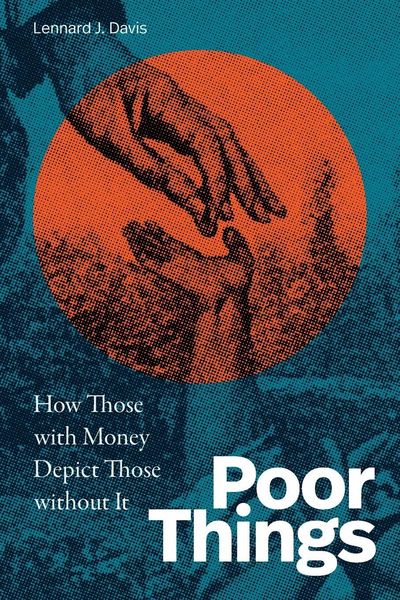
  • Produktbild: Poor Things
  • Produktbild: Poor Things

Poor Things How Those with Money Depict Those without It

27,99 €

inkl. gesetzl. MwSt., zzgl. Versandkosten


  • Kostenlose Lieferung ab 30 € Einkaufswert
  • Versandkostenfrei für Bonuscard-Kund*innen

Beschreibung

For generations most of the canonical works that detail the lives of poor people have been created by rich or middle-class writers like Charles Dickens, John Steinbeck, or James Agee. This has resulted in overwhelming depictions of poor people as living abject, violent lives in filthy and degrading conditions....

Beschreibung

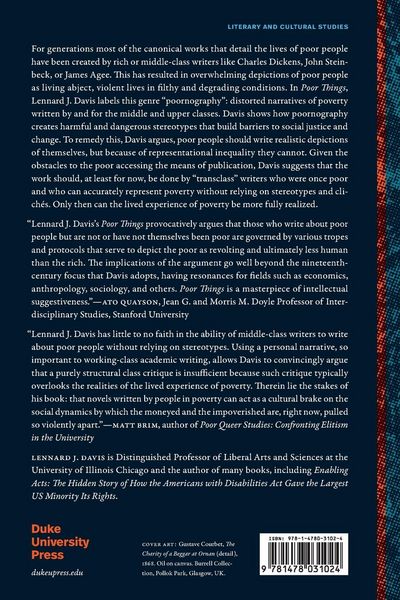
For generations most of the canonical works that detail the lives of poor people have been created by rich or middle-class writers like Charles Dickens, John Steinbeck, or James Agee. This has resulted in overwhelming depictions of poor people as living abject, violent lives in filthy and degrading conditions. In Poor Things, Lennard J. Davis labels this genre "poornography": distorted narratives of poverty written by and for the middle and upper classes. Davis shows how poornography creates harmful and dangerous stereotypes that build barriers to social justice and change. To remedy this, Davis argues, poor people should write realistic depictions of themselves, but because of representational inequality they cannot. Given the obstacles to the poor accessing the means of publication, Davis suggests that the work should, at least for now, be done by "transclass" writers who were once poor and who can accurately represent poverty without relying on stereotypes and clichÉs. Only then can the lived experience of poverty be more fully realized.

Rezension

"Lennard J. Davis's Poor Things provocatively argues that those who write about poor people but are not or have not themselves been poor are governed by various tropes and protocols that serve to depict the poor as revolting and ultimately less human than the rich. The implications of the argument go well beyond the nineteenth-century focus that Davis adopts, having resonances for fields such as economics, anthropology, sociology, and others. Poor Things is a masterpiece of intellectual suggestiveness." - Ato Quayson, Jean G. and Morris M. Doyle Professor of Interdisciplinary Studies, Stanford University "Lennard J. Davis has little to no faith in the ability of middle-class writers to write about poor people without relying on stereotypes. Using a personal narrative, so important to working-class academic writing, allows Davis to convincingly argue that a purely structural class critique is insufficient because such critique typically overlooks the realities of the lived experience of poverty. Therein lie the stakes of his book: that novels written by people in poverty can act as a cultural brake on the social dynamics by which the moneyed and the impoverished are, right now, pulled so violently apart." - Matt Brim, author of (Poor Queer Studies: Confronting Elitism in the University) "Whether considering the hypocrisy of 'poornography' or the common limitations of well-meaning characterizations of the impoverished, Davis's range of authentic criticism is impressive. . . . Poor Things provides a deep reflection and the start of a conversation that could go on forever." - Theodore Bain (Journal of American Culture)

Produktdetails

Einband

Taschenbuch

Erscheinungsdatum

15.11.2024

Abbildungen

34 illustrations

Verlag Duke University Press

Produktdetails

Einband

Taschenbuch

Erscheinungsdatum

15.11.2024

Abbildungen

34 illustrations

Verlag Duke University Press
Seitenzahl

304

Maße (L/B/H)

22,9/15,2/2 cm

Gewicht

655 g

Sprache

Englisch

ISBN

978-1-4780-3102-4

Herstelleradresse

Libri GmbH
Europaallee 1
36244 Bad Hersfeld
DE

Email: gpsr@libri.de

Noch keine Bewertungen vorhanden

Verfassen Sie die erste Bewertung zu diesem Artikel

Helfen Sie anderen Kundinnen und Kunden durch Ihre Meinung.

Kundinnen und Kunden meinen

Bewertungen (0)

  • Produktbild: Poor Things
  • Produktbild: Poor Things
  • Preface. What It’s All About?  ix
    Introduction. Scenes from a Life and from Lives  1
    Interchapter 1. Why Me?  21
    1. How to Read This Book and How the Lives of the Poor Have Been Read, or Why You? 25
    2. The Problem of Representing the Poor  42
    3. Transclass: Endo- and Exo-writers  70
    4. Biocultural Myths of the Poor Body  110
    5. Female Sex Workers  153
    6. The Encounter, or, the Object Talks Back  170
    Interchapter 2. They Got It Right Now?  205
    Conclusion. What Is to Be Done? Endings and Beginnings  219
    Notes  231
    Bibliography  253
    Index