KI-Beratung Beta

Gutscheinbedingungen

**Gültig bis 11.11.2026 auf Spielzeug, Schreibwaren, Filme, Geschenke & Trends, Musik, tolino eReader & Zubehör, Hörbücher und Hörbuch-Downloads, nicht preisgebundene Bücher und Kalender online auf thaalia.live und in der Thalia App. Einzelne Artikel können ausgeschlossen sein. Aufgrund der Buchpreisbindung sind deutschsprachige Bücher und eBooks ausgenommen. Zusätzlich ausgenommen sind Abos & Flatrates, Games, Geschenkkarten/-boxen, Shelfies, Software, Zeitschriften sowie einzelne Artikel von tonies®. Pro Einkauf einmal einlösbar. Click & Collect nur bei Onlinevorabzahlung möglich. Keine Barauszahlung. Nicht kombinierbar mit anderen Aktionen und Gutscheinen. Gutschein wird auf max. 500€ Bestellwert angerechnet. Nicht gültig für Versandkosten und Services.

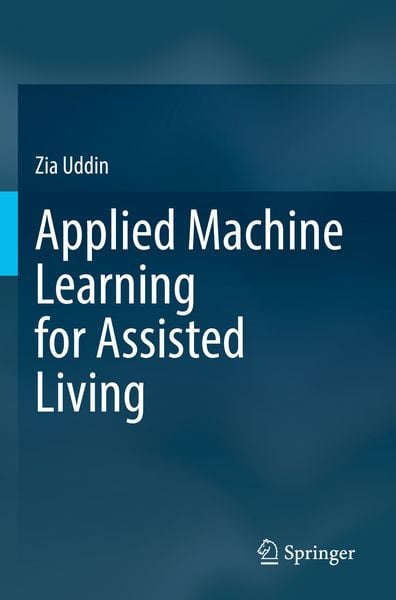
Produktbild: Applied Machine Learning for Assisted Living
- 13%

Applied Machine Learning for Assisted Living

13% sparen

142,99 € UVP 164,99 €

inkl. gesetzl. MwSt., Versandkostenfrei


Beschreibung

User care at home is a matter of great concern since unforeseen circumstances might occur that affect people's well-being. Technologies that assist people in independent living are essential for enhancing care in a cost-effective and reliable manner. Assisted care applications often demand real-time...

Beschreibung

User care at home is a matter of great concern since unforeseen circumstances might occur that affect people's well-being. Technologies that assist people in independent living are essential for enhancing care in a cost-effective and reliable manner. Assisted care applications often demand real-time observation of the environment and the resident’s activities using an event-driven system. As an emerging area of research and development, it is necessary to explore the approaches of the user care system in the literature to identify current practices for future research directions. 

Therefore, this book is aimed at a comprehensive review of data sources (e.g., sensors) with machine learning for various smart user care systems. To encourage the readers in the field, insights of practical essence of different machine learning algorithms with sensor data (e.g., publicly available datasets) are also discussed. Some code segments are also included to motivate the researchers ofthe related fields to practically implement the features and machine learning techniques. It is an effort to obtain knowledge of different types of sensor-based user monitoring technologies in-home environments. With the aim of adopting these technologies, research works, and their outcomes are reported. Besides, up to date references are included for the user monitoring technologies with the aim of facilitating independent living.

Research that is related to the use of user monitoring technologies in assisted living is very widespread, but it is still consists mostly of limited-scale studies. Hence, user monitoring technology is a very promising field, especially for long-term care. However, monitoring of the users for smart assisted technologies should be taken to the next level with more detailed studies that evaluate and demonstrate their potential to contribute to prolonging the independent living of people. The target of this book is to contribute towards that direction.


Produktdetails

Einband

Taschenbuch

Erscheinungsdatum

31.08.2023

Abbildungen

XI, 131 p. 60 illus., 52 illus. in color.

Verlag Springer

Produktdetails

Einband

Taschenbuch

Erscheinungsdatum

31.08.2023

Abbildungen

XI, 131 p. 60 illus., 52 illus. in color.

Verlag Springer
Seitenzahl

131

Maße (L/B/H)

23,5/15,5/0,9 cm

Gewicht

230 g

Auflage

23001 Auflage 1st ed. 2022

Sprache

Englisch

ISBN

978-3-031-11536-3

Herstelleradresse

Springer-Verlag KG
Sachsenplatz 4-6
1201 Wien
AT

Email: ProductSafety@springernature.com

Noch keine Bewertungen vorhanden

Verfassen Sie die erste Bewertung zu diesem Artikel

Helfen Sie anderen Kundinnen und Kunden durch Ihre Meinung.

Kundinnen und Kunden meinen

Bewertungen (0)

  • Produktbild: Applied Machine Learning for Assisted Living
  • 1.Assisted Living.- 1. 1. Introduction .- 1.2. Surveys on Assisted Living.- 1.3. Assisted Living Projects.- 1.4. Target Users.- 1.4.1. Indoor Observations.- 1.4.2. Outdoor Observations.- 1.5. Privacy and Data Protection.- 1.6. Conclusion.- References.- 2. Sensors and Features for Assisted Living Technologies .- 2.1. Sensors in User care.- 2.1.1. Wearable Sensors.- 2.1.2. Smart Daily Objects.- 2.1.3. Environmental Sensors.- 2.1.2. Wearables with Ambient Sensors.- 2.1.3. Ambient Sensors in Robotic Assisted Living.- 2.2. Feature Extraction.- 2.2.1. Feature Extraction Using PCA.- 2.2.2. Kernel Principal Component Analysis (KPCA).- 2.2.3. Feature Extraction Using ICA.- 2.2.4. Linear Discriminant Analysis (LDA).- 2.2.5. Generalized Discriminant Analysis (GDA).- 2.3. Discussion.- 2.4. Conclusion.- References.- 3. Machine Learning.- 3.1 Shallow Machine Learning.- 3.1.1. Support Vector Machines.- vii.- 3.1.2. Random Forests.- 3.1.3. AdaBoost and Gradient Boosting.- 3.1.4. Nearest Neighbors .- 3.1.5. Examples.- 3.2. Deep Machine Learning.- 3.2.1. Deep Belief Networks (DBN).- 3.2.2. Convolutional Neural Network.- 3.2.3. Recurrent Neural Networks.- 3.2.4. Neural Structured Learning.- 3.2.4. Pre-trained deep learning models.- 3.3. Explainable AI (XAI).- 3.3.1. Local Explanations.- 3.3.2. Rule-based Explanations.- 3.3.3. Visual Explanations.- 3.3.4. Feature Relevance Explanations.- 3.4. Discussion.- 3.5. Conclusion.- References .- 4. Applications.- 4.1. Wearable Sensor-based Behavior Recognition.- 4.1.1. MHEALTH Dataset.- 4.1.2. Experimental Results on MHEALTH Dataset.- 4.1.3. PUC-Rio Dataset.- 4.1.4. Experimental Results on PUC-Rio Dataset.- 4.1.5. ARem Dataset.- 4.1.6. Experimental Results on AReM Dataset.- 4.3. Video Camera-based Behavior Recognition.- 4.3.1. Binary Silhouettes and Features.- 4.3.2. Depth Silhouettes and Features.- 4.3.3. 3-D Model-based HAR.- 4.4. Other Ambient Sensor-based Behavior Recognition.- 4.4.1. CASAS Dataset.- viii.- 4.4.2. Experimental Results.- 4.5. Conclusion.- References.