KI-Beratung Beta

Gutscheinbedingungen

**Gültig bis 11.11.2026 auf Spielzeug, Schreibwaren, Filme, Geschenke & Trends, Musik, tolino eReader & Zubehör, Hörbücher und Hörbuch-Downloads, nicht preisgebundene Bücher und Kalender online auf thaalia.live und in der Thalia App. Einzelne Artikel können ausgeschlossen sein. Aufgrund der Buchpreisbindung sind deutschsprachige Bücher und eBooks ausgenommen. Zusätzlich ausgenommen sind Abos & Flatrates, Games, Geschenkkarten/-boxen, Shelfies, Software, Zeitschriften sowie einzelne Artikel von tonies®. Pro Einkauf einmal einlösbar. Click & Collect nur bei Onlinevorabzahlung möglich. Keine Barauszahlung. Nicht kombinierbar mit anderen Aktionen und Gutscheinen. Gutschein wird auf max. 500€ Bestellwert angerechnet. Nicht gültig für Versandkosten und Services.

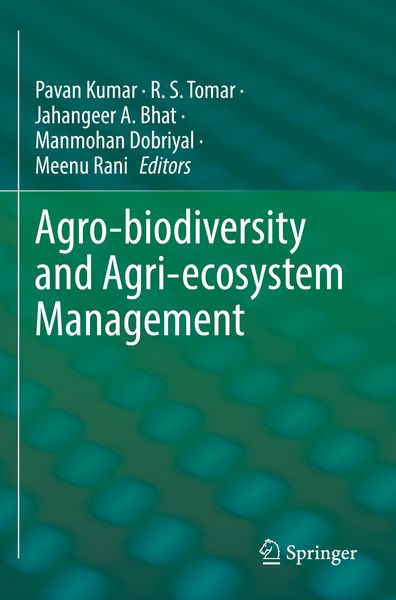
Produktbild: Agro-biodiversity and Agri-ecosystem Management
- 12%

Agro-biodiversity and Agri-ecosystem Management

12% sparen

144,99 € UVP 164,99 €

inkl. gesetzl. MwSt., Versandkostenfrei


Beschreibung

This edited book collates latest findings in the field of agro-biodiversity and agri-ecosystem management across the globe through selected case studies. The primary aim of the book is to cover agro-biodiversity and agri-ecosystem advancements in the field of agricultural resource management. The book...

Beschreibung

This edited book collates latest findings in the field of agro-biodiversity and agri-ecosystem management across the globe through selected case studies. The primary aim of the book is to cover agro-biodiversity and agri-ecosystem advancements in the field of agricultural resource management. The book explores a range of technologies that support sustainable use of resources and facilities, such as Natural Resource Management (NRM), Resource Conservation Technologies (RCTs), Integrated Farming System (IFS), Integrated Crop Management (ICM), Integrated Nutrient Management (INM), use of solar energy, promotion of agro-ecological zone specific agricultural production, application of climate resilient technologies, secondary agricultural practices and post-harvest technologies. Agro-biodiversity and agri-ecosystem not only contributes to overall growth of the economy but also reduces poverty by providing employment and food security to the majority of the population in the continent andthus it is the most inclusive growth sectors of the economy of Asian and African countries. The book is relevant for researchers and policy makes in the field of agriculture, food system research, ecology, agricultural diversification, resource management etc.


Portrait


Dr. Pavan Kumar is a Faculty of College of Horticulture and Forestry, Rani Lakshmi Bai Central Agricultural University, Jhansi, U.P., India. He obtained his Ph.D. degrees from Faculty of Natural Sciences, Jamia Millia Islamia, New Delhi. He did B.Sc. (Botany) and M.Sc.  (Environmental Science) from Banaras Hindu University, Varanasi, India and subsequently obtained Master’s degree in Remote Sensing (M. Tech) from Birla Institute of Technology, Mesra Ranchi, India. His current research interests include resilient agriculture and Climate Change studies. Dr. Kumar has published fifty research papers in international journals and authored several books. 
Dr. R.S. Tomar is a Faculty in College of Horticulture and Forestry, Rani Lakshmi Bai Central Agricultural University, Jhansi, U.P., India. He worked in his Ph.D. degrees at Indian Agricultural Research Institute, New Delhi. He did B.Sc. (Biochemistry) and M.Sc.  (Biotechnology) from Jiwaji University, Gwalior, India. His research area includes molecular breeding of rice, wheat, soybean and lentil. He has been awarded with Eminent Scientist, Distinguished Scientist, Young Biotechnologist Award, Young Scientist and Scientist of the Year Award by various scientific organisations. 
Dr. Jahangeer A. Bhat is currently a faculty member at Rani Lakshmi Bai Central Agricultural University, India. Before joining the present University, Dr. Jahangeer served as Head for Department of Forestry at College of Agriculture, Fisheries and Forestry, Fiji National University, Republic of Fiji Islands. Dr. Jahangeer has 11 years of research and 08 years of teaching experience with a publication record of more than 70, which includes research articles, review papers, conference papers, book chapters and books with national and international repute. Prof. Manmohan Dobriyal, Professional Forester educated in forestry from graduation to Doctoral at different institutes like GB Pant University, Pantnagar, TNAU, Coimbatore and Forest Research Institute, Dehradun. 15 Years experience in Forestry Research and 15 years in Forestry Teaching and extension. Specialization in Forest ecology/ Silviculture- Non Wood Forest Products (Medicinal and Aromatic Plants) deals in different aspects of forestry, Agroforestry, environment conservation, biodiversity and wildlife. Goal is to work for development of forestry sector and to give recognition to our forests which harbors the biodiversity in total for the benefit of mankind.
Dr. Meenu Rani is a researcher in the Department of Geography, Kumaun University, Nainital, Uttarakhand, India. Dr. Rani received her M. Tech degree in Remote Sensing from Birla Institute of Technology, Ranchi, India. Dr. Rani has authored several peer-reviewed scientific research papers and presented works at many national and international conferences in the USA, Italy and China. She has been awardedwith various fellowships from the International Association for Ecology, Future Earth Coast and SCAR Scientific Research Programme. She was awarded early career scientists achievement in 2017 at Columbia University, New York, USA.

Produktdetails

Einband

Taschenbuch

Erscheinungsdatum

17.07.2023

Abbildungen

XV, 366 p. 48 illus., 37 illus. in color.

Herausgeber Pavan Kumar + weitere

Produktdetails

Einband

Taschenbuch

Erscheinungsdatum

17.07.2023

Abbildungen

XV, 366 p. 48 illus., 37 illus. in color.

Herausgeber
Verlag Springer Singapore
Seitenzahl

366

Maße (L/B/H)

23,5/15,5/2 cm

Gewicht

651 g

Auflage

23001 Auflage 1st edition 2022

Sprache

Englisch

ISBN

978-981-19-0930-6

Herstelleradresse

Springer-Verlag KG
Sachsenplatz 4-6
1201 Wien
AT

Email: ProductSafety@springernature.com

Noch keine Bewertungen vorhanden

Verfassen Sie die erste Bewertung zu diesem Artikel

Helfen Sie anderen Kundinnen und Kunden durch Ihre Meinung.

Kundinnen und Kunden meinen

Bewertungen (0)

  • Produktbild: Agro-biodiversity and Agri-ecosystem Management
  • Section I General.- Chapter 1: Introduction to agro-biodiversity and agri-ecosystem in the 21st century.- Section II Agro Biodiversity Conservation and Challenges.- Chapter 2: An Assessment of Forest Diversity: Challenges and Management.- Chapter 3: Agrobiodiversity, Status, and Conservation Strategies.- Chapter 4: Role of Range grasses in conservation and restoration of biodiversity.- Chapter 5: Molecular approaches in Agro Biodiversity Conservation.- Section III Agri Ecosystem Services and Climate Resilience.- Chapter 6: Carbon Sequestration Potential in Agricultural Systems.- Chapter 7: Inter-Connectivity between Climate Resilience, Climate Change and Adaptability.- Chapter 8: Soil organic carbon and total nitrogen stocks under different land uses in Achanakmaar Amarkantak Biosphere Reserve, India.- Chapter 9: Vegetation Biomass and Carbon Stock Assessment under Different Forest Types of Temperate and Alpine Forest Ecosystem of Western Himalayas.- Section IV Advance Approaches for Agrobiodiversity Conservation and Restoration.- Chapter 10: Molecular approaches in conservation and restoration of agro-biodiversity.- Chapter 11: Adapting Land Degradation and Enhancing Ethnic Livelihood Security through Fruit Production: Evidence from Hilly Areas of Bangladesh.- Chapter 12: Restoration and Conservation of Plant Genetic Resources via Molecular Techniques: An Important Measure for Sustainable Agriculture.- Chapter 13: Molecular Approaches in Restoration of Agrobiodiversity.- Chapter 14: Genomics Approaches for Restoration and Conservation of Agro-biodiversity.- Section V Technological Intervention for Agricultural Development.- Chapter 15: Polyhydroxyalkanoates Production in Transgenic Plants: Green Plastics for Better Future & Environmental Sustainability.- Chapter 16: Application of artificial intelligence for the development of sustainable agriculture.- Chapter 17: Information and technology use in agriculture and Livestock development.- Chapter 18: Use of wild edible plants can meet the needs of future generation.