KI-Beratung Beta

Gutscheinbedingungen

**Gültig bis 11.11.2026 auf Spielzeug, Schreibwaren, Filme, Geschenke & Trends, Musik, tolino eReader & Zubehör, Hörbücher und Hörbuch-Downloads, nicht preisgebundene Bücher und Kalender online auf thaalia.live und in der Thalia App. Einzelne Artikel können ausgeschlossen sein. Aufgrund der Buchpreisbindung sind deutschsprachige Bücher und eBooks ausgenommen. Zusätzlich ausgenommen sind Abos & Flatrates, Games, Geschenkkarten/-boxen, Shelfies, Software, Zeitschriften sowie einzelne Artikel von tonies®. Pro Einkauf einmal einlösbar. Click & Collect nur bei Onlinevorabzahlung möglich. Keine Barauszahlung. Nicht kombinierbar mit anderen Aktionen und Gutscheinen. Gutschein wird auf max. 500€ Bestellwert angerechnet. Nicht gültig für Versandkosten und Services.

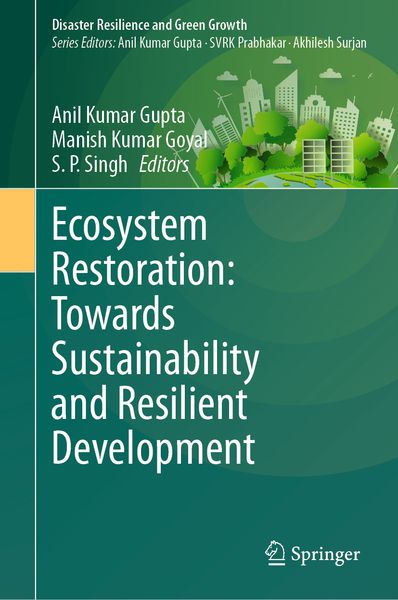
Produktbild: Ecosystem Restoration: Towards Sustainability and Resilient Development
- 12%

Ecosystem Restoration: Towards Sustainability and Resilient Development

12% sparen

192,99 € UVP 219,99 €

inkl. gesetzl. MwSt., Versandkostenfrei


Beschreibung

This edited book offers coverage towards SDG 15 in particular, but it provides for all the SDGs in general. The book is an inclusive comprehension on ecosystem restoration and sustainability including agricultural and ecosystem resilience, the role of biodiversity, climate change and water resources,...

Beschreibung

This edited book offers coverage towards SDG 15 in particular, but it provides for all the SDGs in general. The book is an inclusive comprehension on ecosystem restoration and sustainability including agricultural and ecosystem resilience, the role of biodiversity, climate change and water resources, hydrological modelling, extreme events, disaster risk and management, sustainable policy making on disaster management.  The world is facing diverse and severe challenges. Millions of people are suffering from the catastrophic effects of extreme disasters, climate emergencies, water and food insecurity, and the repercussions of COVID-19 pandemic. Ecosystems are essential players in people’s capacity to meet these challenges. Hence, managing them and protecting their resources in sustainable ways is crucial. The book ‘Ecosystem Restoration:  Towards Sustainable and Resilient Development’ provides comprehensive information on fundamentals, approaches and latest developments in the field of ecosystem restoration, resilience and sustainability. This book is of interest to teachers, researchers, climate change scientists, and valuable source of reference to the professionals and students in the relevant disciplines. Besides, the book serves as additional reading for graduate students of water, ecology, restoration forestry, soil science, and environmental sciences. National and international ecological policy makers, scientists and planners will also find this to be a useful read.


Portrait


Prof. Anil Kumar Gupta
is a noted resilience and sustainability strategist, crisis management professional, and thought leader. Presently he is Head of Division, Director of Projects & COE, in-charge of International Cooperation and Advisory Services, and Full Professor of Policy-planning and strategies at India’s National Institute of Disaster Management at New Delhi. He is known for pioneering National and Sectoral planning, National human resource planning, ebA/ecoDRR & NBS, Adaptation strategies, and Consortium projects, in DRR and sustainability areas. He implemented projects of action research, policy-planning, advocacy, knowledge management, etc. with many international and national partners.


Prof. Manish Kumar Goyal
is Professor of Civil Engineering and Dean of Infrastructure Development at Indian Institute of Technology, Indore, India. His research interests include climate change, environment, water resources, hydrology, biodiversity, Artificial intelligence and GIS-remote sensing applications.


Prof. S. P. Singh
is among the top-notch Himalayan ecologists. His research systems range from the blade of a leaf to inherently fragile and disaster-prone landscapes. He along with his associates have studied almost all dimensions of the Himalayan forest ecosystems, including biomass and productivity, nutrient cycling, carbon sequestration, phenology, tree water relations, forest fire adaptation, and ecosystem services.


Produktdetails

Einband

Gebundene Ausgabe

Erscheinungsdatum

31.10.2023

Abbildungen

XVIII, 366 p. 1 illus.

Herausgeber Anil Kumar Gupta + weitere

Produktdetails

Einband

Gebundene Ausgabe

Erscheinungsdatum

31.10.2023

Abbildungen

XVIII, 366 p. 1 illus.

Herausgeber
Verlag Springer Singapore
Seitenzahl

366

Maße (L/B/H)

24,1/16/2,7 cm

Gewicht

689 g

Auflage

23001 Auflage 1st edition 2023

Sprache

Englisch

ISBN

978-981-9936-86-1

Herstelleradresse

Springer-Verlag KG
Sachsenplatz 4-6
1201 Wien
AT

Email: ProductSafety@springernature.com

Noch keine Bewertungen vorhanden

Verfassen Sie die erste Bewertung zu diesem Artikel

Helfen Sie anderen Kundinnen und Kunden durch Ihre Meinung.

Kundinnen und Kunden meinen

Bewertungen (0)

Weitere Artikel finden Sie in

  • Produktbild: Ecosystem Restoration: Towards Sustainability and Resilient Development
  • Chapter 1. Ecological restoration: An Overview of Science & Policy Regime.- Chapter 2. Lifestyle for Environment: Life Mission and Synergies with Eco-restoration.- Chapter 3. Optimal Management of Potential Water and Sediment Yield from Urban Hilly Watershed.- Chapter 4. Mainstreaming Peri-Urban Ecosystems for Urban Resilience through Policy-Planning Framework: An Opportunity Analysis for Indian Cities.- Chapter 5. Urban Forest and Ecosystem Services Intercede Urban Habitat in Delhi.- Chapter 6. Restoration and rejuvenation of rivers, streams and wetlands: Challenges and way forward.- Chapter 7. Ecosystem services for Water Management: A review of global approaches and experiences.- Chapter 8. Rejuvenation of Rivers in India-A Case Study on efforts for Rejuvenation of River Ganga.- Chapter 9. Rejuvenation of Kukrail Drain.- Chapter 10. Hydrological modelling using HEC-HMS and estimation of the flood peak by Gumbel’s method of Hasdeo Basin, Chhattisgarh, India.- Chapter 11. Comparing Runoff of NRCS-CN Method and Observed Runoff Data A Case Study.- Chapter 12. Artificial neural network models for rainfall-runoff modeling in India- studies from of Kolar and Kuttiyadi River watersheds.- Chapter 13. Analysis of urbanization and assessment of its impact on ground water & land use land cover using GIS techniques – Case study of Bhopal & Gurugram district.- Chapter 14. Application of Water Accounting Plus Framework for the assessment of the Water consumption pattern and Food security.- Chapter 15. Comparison of Probability Distributions for Extreme Value Analysis and Predicting Monthly Rainfall Pattern using Bayesian Regularized-ANN.- Chapter 16. An Indexing Method for Evaluating Managerial Effectiveness of a Watershed Project and Functional Involvement of Participant Organisations.- Chapter 17. Pathways to build resilience towards the impact of climate change on the Indian Sunderban.- Chapter 18. Eco-restoration for Climate Resilience and Disaster Risk Reduction.- Chapter19. Ecosystems and Nature - Based Solutions (NbS) for Health Protection and Epidemic Resilience.- Chapter 20. Fresh Water Ecosystem Conservation for Social Protection, Business, and Local Economy.