KI-Beratung Beta

Gutscheinbedingungen

**Gültig am 20.11.2026 ab einem Mindestbestellwert von 30€ auf Spielzeug, Schreibwaren, Filme, Geschenke & Trends, Musik, tolino eReader & Zubehör, Hörbücher und Hörbuch-Downloads, nicht preisgebundene Bücher und Kalender online auf thaalia.live und in der Thalia App. Einzelne Artikel können ausgeschlossen sein. Aufgrund der Buchpreisbindung sind deutschsprachige Bücher und eBooks ausgenommen. Zusätzlich ausgenommen sind Abos & Flatrates, Games, Geschenkkarten/-boxen, Shelfies, Software, Zeitschriften sowie einzelne Artikel von tonies®. Pro Einkauf einmal einlösbar. Click & Collect nur bei Onlinevorabzahlung möglich. Keine Barauszahlung. Nicht kombinierbar mit anderen Aktionen und Gutscheinen. Gutschein wird auf max. 500€ Bestellwert angerechnet. Nicht gültig für Versandkosten und Services. Preisgebundene Artikel sind vom Mindestbestellwert ausgeschlossen.

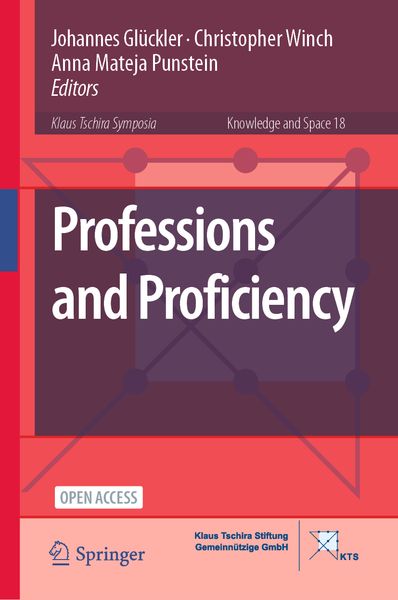
Produktbild: Professions and Proficiency
Band 18

Professions and Proficiency

Aus der Reihe Knowledge and Space

49,99 €

inkl. gesetzl. MwSt., Versandkostenfrei


Beschreibung

This open access book takes an original view on the social production of knowledge in and across space. It explores how people build and transfer proficiency within and beyond the bounds of social groups. Social groups, such as professions, epistemic communities, or academic disciplines, collectively...

Beschreibung

This open access book takes an original view on the social production of knowledge in and across space. It explores how people build and transfer proficiency within and beyond the bounds of social groups. Social groups, such as professions, epistemic communities, or academic disciplines, collectively organize to help individuals gain understanding of and knowledge about specific subjects of expertise. Yet, at the same time, they frame legitimate ways of thinking and learning, and they sanction other ways of knowing that are collectively seen as false, inelegant, or inappropriate etc. Acknowledging the interdependency between proficiency and professions, the interdisciplinary contributions to this volume focus on three aspects. Part I looks into the social processes of professions and what actually makes qualifications, competence and proficiency. Part II elaborates on the dynamics that transform intangible knowledge by exploring, for instance, the legitimacy of scientists withinsociety. Part III gives insights into how space influences the development of professional work, for instance, by reconstructing the historical formation of the psychology profession in Argentina. This volume provides a valuable read for scholars, students, and professionals in the fields of innovation, knowledge creation and governance.

Portrait


Johannes Glückler is Professor of Economic and Social Geography and Fellow of the Marsilius Center for Advanced Studies at Heidelberg University. In his research he follows a relational perspective and builds on theories of social networks and institutions in the study of the geography of knowledge and regional development. He is a founding board member of the German Society for Social Network Research DGNet and co-founder of the M.Sc. Governance of Risks and Resources at the Heidelberg Center for Latin America in Santiago de Chile. 

Christopher Winch is currently Professor of Educational Philosophy and Policy in the School of Education, Communication and Society at King’s College London. He is a philosopher of education with a particular interest in professional education, professional judgement, qualifications and the assessment of professional competence. He has taken part in research projects concerned with professional qualifications in Europe, including work on the European Qualification Framework. This appeared as “Knowledge, Skills and Competence in the European Labour Market, 2011”, co-authored with Linda Clarke, Michaela Brockmann, Georg Hanf, Philippe Méhaut and Anneke Westerhuis. He is also the author of “ Dimensions of Expertise”  2010, an analysis of professional know-how and expertise. 

Anna Mateja Punstein currently works as a corporate quality engineer. She was a Research Associate in Economic Geography at the Institute of Geography at Heidelberg University, Germany until 2022, where she also received her PhD in 2020. Her fields of interest include geographical research on innovation, business services and epistemology, focusing particularly on value creation at the intersection between services and industries as well as on cooperation during product development.

Produktdetails

Einband

Gebundene Ausgabe

Erscheinungsdatum

17.03.2023

Abbildungen

X, 270 p. 1 illus.

Herausgeber Johannes Glückler + weitere

Produktdetails

Einband

Gebundene Ausgabe

Erscheinungsdatum

17.03.2023

Abbildungen

X, 270 p. 1 illus.

Herausgeber
Verlag Springer
Seitenzahl

270

Maße (L/B/H)

24,1/16/2 cm

Gewicht

587 g

Auflage

23001 Auflage 1st edition 2023

Sprache

Englisch

ISBN

978-3-031-24909-9

Herstelleradresse

Springer-Verlag GmbH
Europaplatz 3
69115 Heidelberg
DE

Email: ProductSafety@springernature.com

Noch keine Bewertungen vorhanden

Verfassen Sie die erste Bewertung zu diesem Artikel

Helfen Sie anderen Kundinnen und Kunden durch Ihre Meinung.

Kundinnen und Kunden meinen

Bewertungen (0)

  • Produktbild: Professions and Proficiency

  • Chapter 1. Professions, proficiency, and place: An introduction.- Part I: The Creation of Proficiency.- Chapter 2. Qualifications as Guarantees of Proficiency—Do We Understand Their Role?.- Chapter 3. Improficiency and the Professionalization of Undisciplined Practices.- Chapter 4. The Interplay of Knowledge, Strategies, and Interest in the Development of Expertise within Professions.- Chapter 5. What Does it Take to Be a Professional Translator? Identity as a Resource.- Part II: Transformation of Professions.- Chapter 6. The Changing Fortunes of the Architect Profession in Post-War Britain: Complexity, Technological Change, and the (Re)construction of Knowledge.- Chapter 7. Preserving the Epistemic Authority of Science in World Politics.- Chapter 8. Mobilizing Intangibles under the Acceluction Regime.- Part III: Proficiency and Professions in Place.- Chapter 9. The Beginnings of the Psychology Profession in Argentina: Science, Institutional Context, and Society.- Chapter 10. William Siemens: An Engineer and Industrialist in Germany and England.- Chapter 11. Professions, Knowledge, and Workplace Change: The Case of Canadian Engineers.- Chapter 12. Spielwiesen: Preparing a Research Agenda on Playgrounds and Serious Work in Academia.