
KI-Beratung Beta

Gutscheinbedingungen

**Gültig am 25.11.2026 auf fremdsprachige Bücher online auf thaalia.live und in der Thalia App. Einzelne Artikel können ausgeschlossen sein. Ausgenommen sind preisgebundene Artikel & eBooks. Pro Einkauf einmal einlösbar. Click & Collect nur bei Onlinevorabzahlung möglich. Keine Barauszahlung. Nicht kombinierbar mit anderen Aktionen und Gutscheinen. Gutschein wird auf max. 500€ Bestellwert angerechnet. Nicht gültig für Geschenkkarten, Versandkosten und Services.

  • Produktbild: The Mathematics of Errors
  • Produktbild: The Mathematics of Errors

The Mathematics of Errors

139,99 €

inkl. gesetzl. MwSt., Versandkostenfrei


Beschreibung

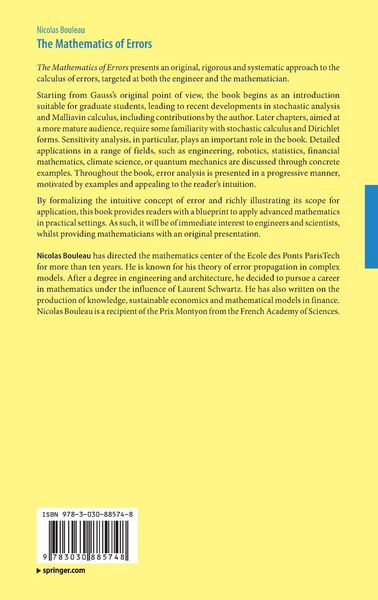
The Mathematics of Errors presents an original, rigorous and systematic approach to the calculus of errors, targeted at both the engineer and the mathematician.

Starting from Gauss's original point of view, the book begins as an introduction suitable for graduate students, leading to recent developments...

Beschreibung

The Mathematics of Errors
presents an original, rigorous and systematic approach to the calculus of errors, targeted at both the engineer and the mathematician.

Starting from Gauss's original point of view, the book begins as an introduction suitable for graduate students, leading to recent developments in stochastic analysis and Malliavin calculus, including contributions by the author. Later chapters, aimed at a more mature audience, require some familiarity with stochastic calculus and Dirichlet forms. Sensitivity analysis, in particular, plays an important role in the book. Detailed applications in a range of fields, such as engineering, robotics, statistics, financial mathematics, climate science, or quantum mechanics are discussed through concrete examples. Throughout the book, error analysis is presented in a progressive manner, motivated by examples and appealing to the reader’s intuition.


By formalizing the intuitive concept of error and richly illustrating its scope for application, this book provides readers with a blueprint to apply advanced mathematics in practical settings. As such, it will be of immediate interest to engineers and scientists, whilst providing mathematicians with an original presentation.

Nicolas Bouleau
 has directed the mathematics center of the Ecole des Ponts ParisTech for more than ten years. He is known for his theory of error propagation in complex models. After a degree in engineering and architecture, he decided to pursue a career in mathematics under the influence of Laurent Schwartz. He has also written on the production of knowledge, sustainable economics and mathematical models in finance. Nicolas Bouleau is a recipient of the Prix Montyon from the French Academy of Sciences.


Produktdetails

Einband

Gebundene Ausgabe

Erscheinungsdatum

24.02.2022

Abbildungen

XII, 448 p. 63 illus.

Verlag Springer

Produktdetails

Einband

Gebundene Ausgabe

Erscheinungsdatum

24.02.2022

Abbildungen

XII, 448 p. 63 illus.

Verlag Springer
Seitenzahl

448

Maße (L/B/H)

24,1/16/3,1 cm

Gewicht

800 g

Auflage

22001 Auflage 1st edition 2021

Sprache

Englisch

ISBN

978-3-030-88574-8

Herstelleradresse

Springer-Verlag GmbH
Europaplatz 3
69115 Heidelberg
DE

Email: ProductSafety@springernature.com

Noch keine Bewertungen vorhanden

Verfassen Sie die erste Bewertung zu diesem Artikel

Helfen Sie anderen Kundinnen und Kunden durch Ihre Meinung.

Kundinnen und Kunden meinen

Bewertungen (0)

  • Produktbild: The Mathematics of Errors
  • Produktbild: The Mathematics of Errors
  • I. Error computations à la Gauss.- 1. The different approaches.- 2. Finite dimensional examples.- 3. An intuitive introduction to error structures.- 4. Weakly and strongly random errors.- II. Probabilistic and Functional Models.- 5. Strongly continuous semi-groups and Dirichlet forms.- 6. Error structures.- 7. Images and products of error structures.- 8. The gradient and the sharp and other calculation tools.- 9. Error structures on fundamental spaces.- III. The subtleness of the notion of bias.- 10. Approximation and bias operators.- 11. Computations and simulation methods.- IV. Error structures and its applications.- 12. Statistical identification of error structures.- 13. The instantaneous structure of a stochastic process.- 14. Models inspired by finance.- 15. Examples in Physics.- 16. The principle of arbitrary functions and error structures.- V. Historical elements and research themes.- 17. Error calculations from Gauss and Laplace.- 18. Extensions and open questions.- Hints forexercises.- Pedagogical References.- Chronological Bibliography.