KI-Beratung Beta

Gutscheinbedingungen

**Gültig bis 11.11.2026 auf Spielzeug, Schreibwaren, Filme, Geschenke & Trends, Musik, tolino eReader & Zubehör, Hörbücher und Hörbuch-Downloads, nicht preisgebundene Bücher und Kalender online auf thaalia.live und in der Thalia App. Einzelne Artikel können ausgeschlossen sein. Aufgrund der Buchpreisbindung sind deutschsprachige Bücher und eBooks ausgenommen. Zusätzlich ausgenommen sind Abos & Flatrates, Games, Geschenkkarten/-boxen, Shelfies, Software, Zeitschriften sowie einzelne Artikel von tonies®. Pro Einkauf einmal einlösbar. Click & Collect nur bei Onlinevorabzahlung möglich. Keine Barauszahlung. Nicht kombinierbar mit anderen Aktionen und Gutscheinen. Gutschein wird auf max. 500€ Bestellwert angerechnet. Nicht gültig für Versandkosten und Services.

Produktbild: Optical Switching

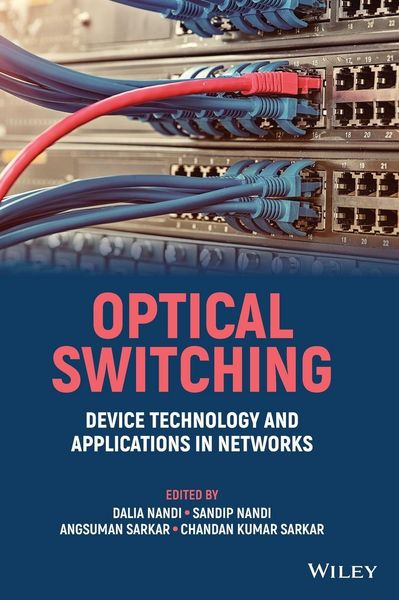
Optical Switching Device Technology and Applications in Networks

131,99 €

inkl. gesetzl. MwSt., Versandkostenfrei


Beschreibung

OPTICAL SWITCHING

Comprehensive coverage of optical switching technologies and their applications in optical networks

Optical Switching: Device Technology and Applications in Networks delivers an accessible exploration of the evolution of optical networks with clear explanations of the current state-of-the-art...

Beschreibung

OPTICAL SWITCHING

Comprehensive coverage of optical switching technologies and their applications in optical networks

Optical Switching: Device Technology and Applications in Networks delivers an accessible exploration of the evolution of optical networks with clear explanations of the current state-of-the-art in the field and modern challenges in the development of Internet-of-Things devices. A variety of optical switches-including MEMS-based, magneto, photonic, and SOA-based-are discussed, as is the application of optical switches in networks.

The book is written in a tutorial style, easily understood by both undergraduate and graduate students. It describes the fundamentals and recent developments in optical switch networks and examines the architectural and design challenges faced by those who design and construct emerging optical switch networks, as well as how to overcome those challenges. The book offers ways to assess and analyze systems and applications, comparing a variety of approaches available to the reader. It also provides:

  • A thorough introduction to switch characterization, including optical, electro optical, thermo optical, magneto optical, and acoustic-optic switches
  • Comprehensive explorations of MEMS-based, SOA-based, liquid crystal, photonic crystal, and optical electrical optical (OEO) switches
  • Practical discussions of quantum optical switches, as well as nonlinear optical switches
  • In-depth examinations of the application of optical switches in networks, including switch fabric control and optical switching for high-performance computing

Perfect for researchers and professionals in the fields of telecommunications, Internet of Things, and optoelectronics, Optical Switching: Device Technology and Applications in Networks will also earn a place in the libraries of advanced undergraduate and graduate students studying optical networks, optical communications, and sensor applications.

Produktdetails

Einband

Gebundene Ausgabe

Erscheinungsdatum

02.08.2022

Herausgeber Dalia Nandi + weitere
Verlag John Wiley & Sons Inc

Produktdetails

Einband

Gebundene Ausgabe

Erscheinungsdatum

02.08.2022

Herausgeber
Verlag John Wiley & Sons Inc
Seitenzahl

384

Maße (L/B/H)

25,4/17,8/2,2 cm

Gewicht

885 g

Auflage

1. Auflage

Sprache

Englisch

ISBN

978-1-119-81923-3

Herstelleradresse

Libri GmbH
Europaallee 1
36244 Bad Hersfeld
DE

Email: gpsr@libri.de

Noch keine Bewertungen vorhanden

Verfassen Sie die erste Bewertung zu diesem Artikel

Helfen Sie anderen Kundinnen und Kunden durch Ihre Meinung.

Kundinnen und Kunden meinen

Bewertungen (0)

Die Leseprobe wird geladen.
  • Produktbild: Optical Switching
  • Preface xvi

    About the Editors xviii

    List of Contributors xix

    Part A Introduction 1

    Introduction 3
    Sandip Nandi and Dalia Nandi

    A. Optical Communication Networks 3

    A.1 Historical Perspective 3

    A.2 Essential Background 6

    A.2.1 Optical Networks 6

    A.2.2 SONET/SDH 6

    A.2.3 Multiplexing 7

    A.2.4 All-Optical Networks 7

    A.2.5 Optical Transport Network 8

    B. Optical Switching in Networks 8

    B.1 Historical Perspective 8

    B.2 Essential Background 9

    B.2.1 Optical Switching in Networks 9

    B.2.2 Optical Switching in Practice 9

    B.2.3 Optical Switch Technology 10

    C. Organization of This Book 10

    Bibliography 11

    Part B Switch Characterization 13

    1 Optical Switches 15
    Rajan Agrahari, Sambit Kumar Ghosh, and Somak Bhattacharyya

    1.1 Introduction 15

    1.2 Electro-Optical Switching 16

    1.2.1 Working Principle of Electro-Optical Switches 16

    1.2.2 Realization of Electro-Optical Switches 17

    1.3 Acoustic-Optical Switching 18

    1.3.1 Types of Acoustic-Optical Switching 18

    1.3.2 Acoustic-Optical Device Materials and Applications 19

    1.4 Thermo-Optical Switching 19

    1.4.1 Working Principle of Thermo-Optical Switches 20

    1.4.2 Realization of Thermo-Optical Switches 20

    1.4.3 Thermo-Optical Switch Materials and Applications 21

    1.5 Liquid Crystal-Optical Switching 21

    1.5.1 Types of Liquid Crystal-Optical Switches 21

    1.5.2 Liquid Crystal-Optical Switch Applications 22

    1.6 Photonic Crystal Optical Switching 22

    1.7 Semiconductor Optical Amplifier (SOA) Optical Switching 23

    1.8 Magneto-Optical (MO) Optical Switching 25

    1.9 Micro Electro-Mechanical Systems (MEMS) Optical Switching 25

    1.10 Metasurfaces Switches 26

    1.11 Conclusion 26

    Bibliography 27

    2 Electro-Optic Switches 31
    Arpita Adhikari, Joydip Sengupta, and Arijit De

    2.1 Introduction 31

    2.2 Operating Principles 32

    2.2.1 Operating Principles of the Single-Mode Switch 32

    2.2.2 Operating Principles of the Multimode Switch 32

    2.3 Materials for the Fabrication of Electro-Optic Switch 34

    2.3.1 Ferroelectric Materials 34

    2.3.2 Compound Semiconductors 35

    2.3.3 Polymers 35

    2.4 Device Structures of Electro-Optical Switches 36

    2.4.1 1 × 1 Switch 36

    2.4.2 1 × 2 Switch 37

    2.4.3 2 × 2 Switch 39

    2.4.4 2 × 3 Switch 40

    2.4.5 3 × 2 Switch 41

    2.4.6 3 × 3 Switch 42

    2.4.7 1 × 4 Switch 42

    2.4.8 2 × 4 Switch 43

    2.5 Conclusions 43

    Bibliography 44

    3 Thermo-Optical Switches 47
    Fulong Yan, Xuwei Xue, and Chongjin Xie

    3.1 History of Thermal Optical Switching 47

    3.2 Principles of Thermo-Optic Switch 47

    3.2.1 Thermo-Optic Effect 47

    3.2.2 Trade-Off Between Switching Time and Power Consumption 48

    3.2.3 Merits of Thermo-Optic Switch 49

    3.3 Category 49

    3.3.1 Material 49

    3.3.2 Implementation Principle 51

    3.3.3 Device Architecture 51

    3.4 Scalability 52

    3.4.1 Binary Tree 52

    3.4.2 Modified Crossbar 53

    3.4.3 Benes 54

    3.5 Application Scenarios 54

    Bibliography 55

    4 Magneto-Optical Switches 57
    K. Sujatha

    4.1 Introduction 57

    4.1.1 Types of Optical Switch 57

    4.1.2 How Does an Optical Switch Work? 59

    4.1.3 Applications of Optical Switches 59

    4.2 All-Optical Switch 60

    4.2.1 Why is an All-Optical Switch Useful? 62

    4.3 Magneto-Optical Switches 64

    4.3.1 Magneto-Optical Switch Features 64

    4.3.2 Principles of Magneto-Optical Switches 65

    4.3.2.1 The Design Core of the Magneto-Optical Switch 65