KI-Beratung Beta

Gutscheinbedingungen

**Gültig am 25.11.2026 auf fremdsprachige Bücher online auf thaalia.live und in der Thalia App. Einzelne Artikel können ausgeschlossen sein. Ausgenommen sind preisgebundene Artikel & eBooks. Pro Einkauf einmal einlösbar. Click & Collect nur bei Onlinevorabzahlung möglich. Keine Barauszahlung. Nicht kombinierbar mit anderen Aktionen und Gutscheinen. Gutschein wird auf max. 500€ Bestellwert angerechnet. Nicht gültig für Geschenkkarten, Versandkosten und Services.

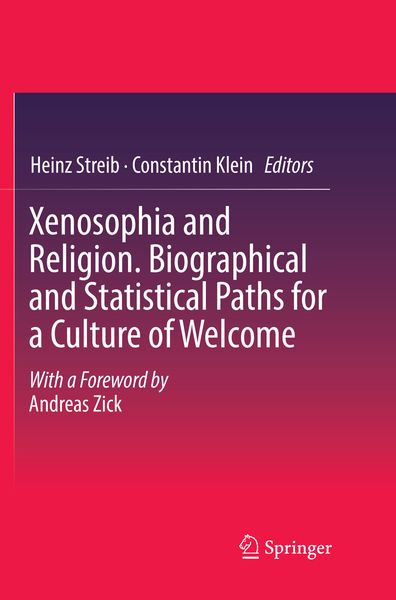
  • Produktbild: Xenosophia and Religion. Biographical and Statistical Paths for a Culture of Welcome
  • Produktbild: Xenosophia and Religion. Biographical and Statistical Paths for a Culture of Welcome

Xenosophia and Religion. Biographical and Statistical Paths for a Culture of Welcome

89,99 €

inkl. gesetzl. MwSt., Versandkostenfrei


Beschreibung

This book documents the current polarization in Germany regarding the issue of refugee immigration. It presents quantitative estimates for both xenophobia and xenophilia in the German population, including short-time changes. The book suggests a conceptual change of perspectives. It focuses not only...

Beschreibung

This book documents the current polarization in Germany regarding the issue of refugee immigration. It presents quantitative estimates for both xenophobia and xenophilia in the German population, including short-time changes. The book suggests a conceptual change of perspectives. It focuses not only on the pathogenic model that accounts for outcomes such as xenophobia, Islamophobia and other forms of (inter-religious) prejudice, but on a salutogenic model. In the book’s view, the salutogenic model entails xenosophia: the wisdom, creativity and inspiration that emerges from the encounter with the strange and the strange religion. The book addresses individual dispositions, which may lead to xenophobia or xenosophia, and takes into account predictors such as religiosity, religious schemata, value preferences, tolerance of complexity, and violence legitimizing norms of masculinity. A selection of case studies present typical biographical trajectories toward xenosophia.

Rezension

“This book shows that there is much insight to be gained for those who do. … Through their comprehensive study on xenosophia, … Streib and his team may give us pause and perhaps may even show us pathways that lead toward a more vibrant and welcoming culture.” (Wade C. Rowatt, The International Journal for the Psychology of Religion, Vol. 29 (3), 2019)

Portrait


Heinz Streib (M.A. 1977, Tübingen University; Ph.D. 1989, Emory University, Habilitation 1995, Frankfurt University) is Senior Professor at Bielefeld University. He has established the Research Center for Biographical Studies in Contemporary Religion at the University of Bielefeld and has conducted there a series of empirical studies. Streib’s major third-party funded research projects are the following: Fundamentalist Biographies (1996-1998, for an Enquete Commission of the German Parliament); Varieties of Deconversion in the USA and Germany (2002-2005); Semantics and psychology of “spirituality” in Germany and the USA (2009-2012); Xenosophia and Religion in Germany (2011-2015); Longitudinal research on religious development with the Faith Development Interview as key instrument (current). Key research interests include: Theory and longitudinal research in religious development in terms of religious styles and schemata; violence and inter-religious prejudice in Europe; Children’s and adolescents’ readiness for mediation.

Constantin Klein (Dipl.-Psych. 2003, Leipzig University; Dipl.-Theol. 2004, Leipzig University; Ph.D. 2013, Bielefeld University) is Professor for Spiritual Care at Ludwig-Maximilians-University München. Between 2009 and 2017, Klein was scientific assistant at Bielefeld University and associated with the Research Center for Biographical Studies in Contemporary Religion. Klein was primary researcher for the research project “Xenosophia and Religion in Germany” (2011-2015), the results of which are presented in this volume. Key research interests include: Theory and research in the psychology of religion; violence and inter-religious prejudice in Europe; spiritual care.


Produktdetails

Einband

Taschenbuch

Erscheinungsdatum

22.12.2018

Abbildungen

XIV, 392 p. 69 illus., 41 illus. in color.

Herausgeber Heinz Streib + weitere

Produktdetails

Einband

Taschenbuch

Erscheinungsdatum

22.12.2018

Abbildungen

XIV, 392 p. 69 illus., 41 illus. in color.

Herausgeber
Verlag Springer
Seitenzahl

392

Maße (L/B/H)

23,5/15,5/2,3 cm

Gewicht

616 g

Auflage

Softcover reprint of the original 1st edition 2018

Sprache

Englisch

ISBN

978-3-030-09022-7

Herstelleradresse

Springer-Verlag KG
Sachsenplatz 4-6
1201 Wien
AT

Email: ProductSafety@springernature.com

Noch keine Bewertungen vorhanden

Verfassen Sie die erste Bewertung zu diesem Artikel

Helfen Sie anderen Kundinnen und Kunden durch Ihre Meinung.

Kundinnen und Kunden meinen

Bewertungen (0)

  • Produktbild: Xenosophia and Religion. Biographical and Statistical Paths for a Culture of Welcome
  • Produktbild: Xenosophia and Religion. Biographical and Statistical Paths for a Culture of Welcome

  • Part 1. Points of Departure.- 1. What is Xenosophia? Philosophical and Psychological Explications (Streib).- 2. Extant Research on Inter-religious Prejudice and Xenophobia in Germany (Klein).- 3. Design, Hypotheses and Quantitative Instruments of the Study (Klein).- 4. The Faith Development Interview, Evaluation and Triangulation, and the Structure of Case Studies (Streib).- Part 2. Quantitative Results.- 5. Xenophilia under Pressure: Results of a Two-Wave-Survey in the Critical Times of Refugee Migration to Germany (Streib).- 6. Attitudes Towards Abrahamic Religions – Comparison of Implicit and Explicit Assessment (Klein).- 7. Inter-religious Prejudice in Context: Prejudice Against Black People, Homosexuals and Women, and the Role of the Violence Legitimizing Norms of Masculinity (Lühr).- 8. Xenosophia and its Potential Predictors and Outcomes: Religion, Religious Styles, and Tolerance of Complexity (Streib).- 9. Values and the Value Space as Coordinate System for Understanding Xenosophia and Inter-religious Prejudice (Gennerich).- Part III. Case Studies.- 10. A Typology of Biographical Trajectories Toward Xenophobia and Xenosophia (Streib).- 11.Case study.- 12. Case study.- 13. Case study.- 14. Case study.- 15. Case study.- 16. Conclusion (Streib).