KI-Beratung Beta

Produktbild: Argumentation in Science Education
Band 35

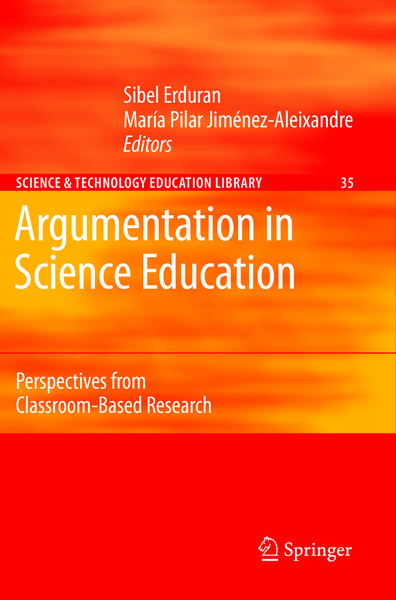
Argumentation in Science Education Perspectives from Classroom-Based Research

189,99 €

inkl. gesetzl. MwSt., Versandkostenfrei


Beschreibung

Our conversations about arguments began in Nashville in the Spring of 1996 in Richard Duschl’s doctoral seminar that we were both attending, Marilar Jiménez-Aleixandre as a visiting scholar at Vanderbilt University. Jiménez-Aleixandre and Duschl were designing authentic problems in genetics for the University...

Beschreibung

Our conversations about arguments began in Nashville in the Spring of 1996 in Richard Duschl’s doctoral seminar that we were both attending, Marilar Jiménez-Aleixandre as a visiting scholar at Vanderbilt University. Jiménez-Aleixandre and Duschl were designing authentic problems in genetics for the University of Santiago de Compostela-based RODA project aimed at engaging high school students in argumentation. Erduran and Duschl had been working on Project SEPIA extending their work in Pittsburgh schools to the design of curricula that support epistemological aspects of scientific inquiry including argumentation. In that spring we attended a NARST s- sion in St Louis, where Gregory Kelly, Steven Druker and Catherine Chen presented a paper about argumentation. As a consequence, a symposium about argumentation was organised (possibly the first of its kind) at the 1997 NARST meeting in Chicago, including papers from Kelly and colleagues and from Jiménez-Aleixandre, Bugallo and Duschl. The symposium was attended, among others, by Rosalind Driver, who had just submitted an application for funding of an argumentation project based at King’s College London, a project Erduran would incidentally work on after Driver’s untimely death. From this time frame in the 1990s to the present day, argumentation studies in science education have increased at a rapid pace, from stray papers for which we were unable to find an appropriate strand in a conference, to a wealth of research base exploring ever more sophisticated issues.

Rezension

From the reviews:

“Argumentation in Science Education … is a comprehensive and authoritative handbook on ‘school scientific argumentation’ … . The book is principally aimed at researchers in didactics of science … . The book comprises theoretical, empirical, and practical approaches that have clear implications both for analyzing and for fostering argumentation processes in the science classrooms of all educational levels, including teacher education. … provides the readers with many powerful ideas that could eventually be inspected in subsequent investigations.” (A. Adúriz-Bravo, Science & Education, September, 2010)

Produktdetails

Einband

Taschenbuch

Erscheinungsdatum

16.03.2019

Abbildungen

XVIII, 296 p.

Verlag Springer Netherland

Produktdetails

Einband

Taschenbuch

Erscheinungsdatum

16.03.2019

Abbildungen

XVIII, 296 p.

Verlag Springer Netherland
Seitenzahl

296

Maße (L/B/H)

23,5/15,5/1,8 cm

Gewicht

482 g

Auflage

1. Auflage

Sprache

Englisch

ISBN

978-94-024-1311-3

Herstelleradresse

Springer-Verlag KG
Sachsenplatz 4-6
1201 Wien
AT

Email: ProductSafety@springernature.com

Noch keine Bewertungen vorhanden

Verfassen Sie die erste Bewertung zu diesem Artikel

Helfen Sie anderen Kundinnen und Kunden durch Ihre Meinung.

Kundinnen und Kunden meinen

Bewertungen (0)

  • Produktbild: Argumentation in Science Education
  • Argumentation Foundations.- Argumentation in Science Education: An Overview.- Cognitive Foundations of Learning Argumentation.- Methodological Foundations in the Study of Argumentation in Science Classrooms.- What Can Argumentation Tell Us About Epistemology?.- Research on Teaching and Learning Argumentation.- Designing Argumentation Learning Environments.- Social Aspects of Argumentation.- Analysis of Lines of Reasoning in Written Argumentation.- Quality Argumentation and Epistemic Criteria.- Argumentation in Context.- Argumentation in Science Education: An Overview.- The Role of Moral Reasoning in Argumentation: Conscience, Character, and Care.- Technology-Enhanced Learning Environments to Support Students' Argumentation.- Science Teacher Education and Professional Development in Argumentation.