KI-Beratung Beta

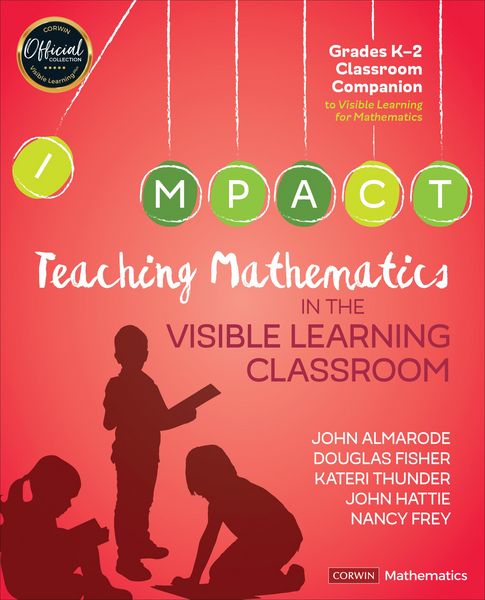
Produktbild: Teaching Mathematics in the Visible Learning Classroom, Grades K-2

Teaching Mathematics in the Visible Learning Classroom, Grades K-2

39,99 €

inkl. gesetzl. MwSt., Versandkostenfrei


Beschreibung

Select the right task, at the right time, for the right phase of learning

Young students come to elementary classrooms with different background knowledge, levels of readiness, and learning needs. What works best to help K 2 students develop the tools to become visible learners in mathematics? What works...

Beschreibung

Select the right task, at the right time, for the right phase of learning

Young students come to elementary classrooms with different background knowledge, levels of readiness, and learning needs. What works best to help K 2 students develop the tools to become visible learners in mathematics? What works best for K-= 2 mathematics learning at the surface, deep, and transfer levels?


In this sequel to the megawatt bestseller Visible Learning for Mathematics, John Almarode, Douglas Fisher, Kateri Thunder, John Hattie, and Nancy Frey help you answer those questions by showing how Visible Learning strategies look in action in K 2 mathematics classrooms. Walk in the shoes of teachers as they mix and match the strategies, tasks, and assessments seminal to making conceptual understanding, procedural knowledge, and the application of mathematical concepts and thinking skills visible to young students as well as to you.

 
Using grade-leveled examples and a decision-making matrix, you ll learn to

  • Articulate clear learning intentions and success criteria at surface, deep, and transfer levels
  • Employ evidence to guide students along the path of becoming metacognitive and self-directed mathematics achievers
  • Use formative assessments to track what students understand, what they don t, and why
  • Select the right task for the conceptual, procedural, or application emphasis you want, ensuring the task is for the right phase of learning
  • Adjust the difficulty and complexity of any task to meet the needs of all learners

It s not only what works, but when. Exemplary lessons, video clips, and online resources help you leverage the most effective teaching practices at the most effective time to meet the surface, deep, and transfer learning needs of every K 2 student.


Produktdetails

Einband

Taschenbuch

Erscheinungsdatum

09.04.2019

Verlag SAGE Publications
Seitenzahl

288

Produktdetails

Einband

Taschenbuch

Erscheinungsdatum

09.04.2019

Verlag SAGE Publications
Seitenzahl

288

Maße (L/B/H)

23,2/18,6/1,5 cm

Gewicht

524 g

Sprache

Englisch

ISBN

978-1-5443-3329-8

EU-Ansprechpartner

Kolibri 360 GmbH
Ettore-Bugatti-Straße 6-14
51149 Köln
DE
produktsicherheit@kolibri360.de

Herstelleradresse

SAGE Publications
1 Oliver's Yard 55 City Road
EC1Y 1SP London
GB
orders@sagepub.co.uk

Noch keine Bewertungen vorhanden

Verfassen Sie die erste Bewertung zu diesem Artikel

Helfen Sie anderen Kundinnen und Kunden durch Ihre Meinung.

Kundinnen und Kunden meinen

Bewertungen (0)

  • Produktbild: Teaching Mathematics in the Visible Learning Classroom, Grades K-2
  • List of Videos
    Acknowledgments
    About the Authors
    Introduction
    What Works Best
    What Works Best When
    The Path to Assessment-Capable Visible Learners in Mathematics
    How This Book Works
    Chapter 1. Teaching With Clarity in Mathematics
    Components of Effective Mathematics Learning
    Surface, Deep, and Transfer Learning
    Moving Learners Through the Phases of Learning
    Differentiating Tasks for Complexity and Difficulty
    Approaches to Mathematics Instruction
    Checks for Understanding
    Profiles of Three Teachers
    Reflection
    Chapter 2. Teaching for the Application of Concepts and Thinking Skills
    Mr. Southall and Number Combinations
    Ms. McLellan and Unknown Measurement Values
    Ms. Busching and the Ever-Expanding Number System
    Reflection
    Chapter 3. Teaching for Conceptual Understanding
    Mr. Southall and Patterns
    Ms. McLellan and the Meaning of the Equal Sign
    Ms. Busching and the Meaning of Addition
    Reflection
    Chapter 4. Teaching for Procedural Knowledge and Fluency
    Mr. Southall and Multiple Representations
    Ms. McLellan and Equality Conjectures
    Ms. Busching and Modeling Subtraction
    Reflection
    Chapter 5. Knowing Your Impact: Evaluating for Mastery
    What Is Mastery Learning?
    Ensuring Tasks Evaluate Mastery
    Ensuring Tests Evaluate Mastery
    Feedback for Mastery
    Conclusion
    Final Reflection
    Appendices
    A. Effect Sizes
    B. Teaching for Clarity Planning Guide
    C. Learning Intentions and Success Criteria Template
    D. A Selection of International Mathematical Practice or Process Standards
    References
    Index