KI-Beratung Beta

Gutscheinbedingungen

**Gültig bis 11.11.2026 auf Spielzeug, Schreibwaren, Filme, Geschenke & Trends, Musik, tolino eReader & Zubehör, Hörbücher und Hörbuch-Downloads, nicht preisgebundene Bücher und Kalender online auf thaalia.live und in der Thalia App. Einzelne Artikel können ausgeschlossen sein. Aufgrund der Buchpreisbindung sind deutschsprachige Bücher und eBooks ausgenommen. Zusätzlich ausgenommen sind Abos & Flatrates, Games, Geschenkkarten/-boxen, Shelfies, Software, Zeitschriften sowie einzelne Artikel von tonies®. Pro Einkauf einmal einlösbar. Click & Collect nur bei Onlinevorabzahlung möglich. Keine Barauszahlung. Nicht kombinierbar mit anderen Aktionen und Gutscheinen. Gutschein wird auf max. 500€ Bestellwert angerechnet. Nicht gültig für Versandkosten und Services.

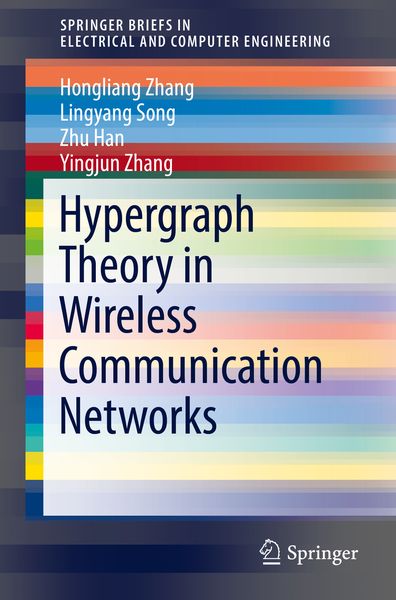
Produktbild: Hypergraph Theory in Wireless Communication Networks

Hypergraph Theory in Wireless Communication Networks

51,99 €

inkl. gesetzl. MwSt., Versandkostenfrei


Beschreibung

This brief focuses on introducing a novel mathematical framework, referred as hypergraph theory, to model and solve the multiple interferer scenarios for future wireless communication networks. First, in Chap. 1, the authors introduce the basic preliminaries of hypergraph theory in general, and develop...

Beschreibung

This brief focuses on introducing a novel mathematical framework, referred as hypergraph theory, to model and solve the multiple interferer scenarios for future wireless communication networks. First, in Chap. 1, the authors introduce the basic preliminaries of hypergraph theory in general, and develop two hypergraph based polynomial algorithms, i.e., hypergraph coloring and hypergraph clustering. Then, in Chaps. 2 and 3, the authors present two emerging applications of hypergraph coloring and hypergraph clustering in Device-to-Device (D2D) underlay communication networks, respectively, in order to show the advantages of hypergraph theory compared with the traditional graph theory. Finally, in Chap. 4, the authors discuss the limitations of using hypergraph theory in future wireless networks and briefly present some other potential applications.

This brief introduces the state-of-the-art research on the hypergraph theory and its applications in wireless communications. Anefficient framework is provided for the researchers, professionals and advanced level students who are interested in the radio resource allocation in the heterogeneous networks to solve the resource allocation and interference management problems.

Rezension

“The book is interesting, even for readers not involved in wireless networks research. It shows a systematic approach to the application of mathematical concepts and theories in telecommunications and information technology. The ideas raised are thought-provoking, and the approach may be customized for other fields, that is, mapping concepts onto hypergraphs, defining weights or other evaluation functions, and so on, thereby offering fruitful research directions.” (Bálint Molnár, Computing Reviews, January, 2019)

Produktdetails

Einband

Taschenbuch

Erscheinungsdatum

06.09.2017

Abbildungen

IX, 26 illus., 14 illus. in color., schwarz-weiss Illustrationen, farbige Illustrationen

Verlag Springer

Produktdetails

Einband

Taschenbuch

Erscheinungsdatum

06.09.2017

Abbildungen

IX, 26 illus., 14 illus. in color., schwarz-weiss Illustrationen, farbige Illustrationen

Verlag Springer
Seitenzahl

62

Maße (L/B/H)

23,3/15,1/1 cm

Gewicht

125 g

Auflage

1st ed. 2018

Sprache

Englisch

ISBN

978-3-319-60467-1

Herstelleradresse

Springer Nature Customer Service Center GmbH
Europaplatz 3
69115 Heidelberg
DE
ProductSafety@springernature.com

Noch keine Bewertungen vorhanden

Verfassen Sie die erste Bewertung zu diesem Artikel

Helfen Sie anderen Kundinnen und Kunden durch Ihre Meinung.

Kundinnen und Kunden meinen

Bewertungen (0)

  • Produktbild: Hypergraph Theory in Wireless Communication Networks
  • Basics in Hypergraph Theory.- Key Algorithms.- Applications of Hypergraph Theory.- Conclusions and Future Works.