KI-Beratung Beta

Produktbild: Recent Advances in Lichenology

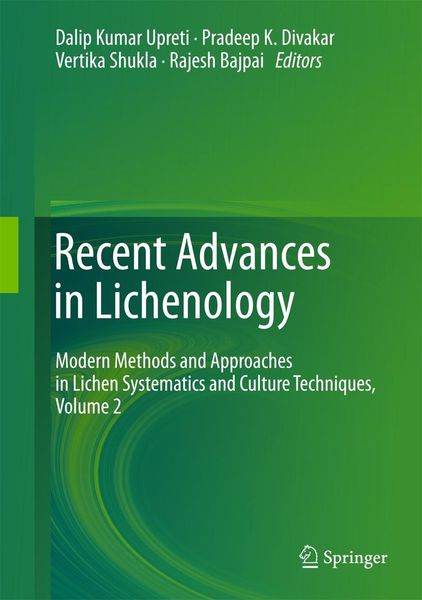
Recent Advances in Lichenology Modern Methods and Approaches in Lichen Systematics and Culture Techniques, Volume 2

153,99 €

inkl. gesetzl. MwSt.

Beschreibung

This book discusses in detail molecular, mycobiont culture, biomonitoring and bioprospection of lichens, providing insights into advances in different fields of lichenology by applying modern techniques and approaches and examining how their application has enhanced or changed classical approaches. It...

Beschreibung

This book discusses in detail molecular, mycobiont culture, biomonitoring and bioprospection of lichens, providing insights into advances in different fields of lichenology by applying modern techniques and approaches and examining how their application has enhanced or changed classical approaches. It offers a valuable resource, especially for beginners, students and researchers from different academic backgrounds interested in the study of lichens.

In recent years, the introduction of modern analytical techniques and approaches has significantly improved our understanding of the environment, including lichens. Lichens are unique organisms which possess untapped potential as effective and reliable bioindicators, sources of therapeutic phytochemicals, and as excellent extremophiles. The unique and peculiar characteristics of lichens underline the need for a multidimensional approach to explore their potential in various fields of environment science, botany and chemistry.

Modern techniques, especially molecular techniques, have greatly enriched the field of lichen taxonomy and its position in the plant kingdom, revealing little-known species and exploring their evolutionary history, while multivariate analysis and GIS approaches have established lichens as an ideal and reliable tool for monitoring air pollution. Advanced culture techniques have expanded the pharmacological applications of lichens, which was formerly restricted due to their small biomass. The advent of sophisticated analytical instrumentation has now facilitated the isolation and characterization of lichens' bioactive constituents, even in lower concentrations, as well as the estimation of their stress responses at different levels of pollution. As lichen diversity is adversely affected by increasing air pollution, there is a pressing need to develop effective management practices to conserve, restore and document lichen diversity.

Portrait

D. K. Upreti, FNASc, Head of the Lichenology Laboratory, CSIR-National Botanical Research Institute (CSIR-NBRI), Lucknow, has a Ph.D. (1983) in Botany on Studies on the lichen family Cladoniaceae from India and Nepal from Lucknow University under the guidance of Dr. D.D. Awasthi. Dr. Upreti has over 35 years of research experience and has published more than 300 research papers in peer-reviewed journals and coauthored eight books. Apart from taxonomy, Dr. Upreti has also carried out extensive research on
ecology, lichen chemistry, pollution monitoring, in vitro culture and biodeterioration studies and bioprospection of Indian lichens. Dr. Upreti was in Antarctica in 1991-1992. He is the Indian corresponding member to the British Lichen Society and International Association for Lichenology.P. K. Divakar has an M.Sc. in Botany and earned his Ph.D. (2002) on Revisionary studies on the lichen genus Parmelia sensu lato in India from Lucknow University. Dr. Divakar is Professor at the Department of Plant Sciences, Faculty of Pharmacy, Complutense University Madrid, Spain. Dr. Divakar has published two books and more than 70 papers in national and international journals. Currently he is editor of Biodiversity and Conservation, Mycokeys, Organisms Diversity and Evolution, and Lazaroa (Iberian Journal of Botany). His research activities center on molecular systematics, genetic diversity, evolution, speciation events, gene mapping, gene flow, TCS estimation of gene genealogies and phenotypic character mapping, ancestral character state, and genomics of fungi that form mutualistic symbioses with algae or cyanobacteria and mycobiont cultures.Vertika Shukla holds an M.Sc. in Organic Chemistry and a Ph.D. (2003) on the Chemical Study of Macrolichens of Garhwal Himalayas from H.N.B. Garhwal University, Srinagar (Garhwal). She is currently working in the Lichenology Laboratory of CSIR-NBRI as a DST scientist and to date she has published more than 50 scientific articles.Dr. Shukla has contributed to secondary metabolite chemistry, spatio-temporal behavior of pollutants in high altitude ecosystems, lichen responses to climate change and the role of lichens in bioremediation of atmospheric fallouts.
Rajesh Bajpai has an M.Sc. in Environmental Science and received his Ph.D. in 2009 from Babasaheb Bhimrao Ambedkar (Central) University, Lucknow on Studies on lichens of some monuments of Madhya Pradesh with reference to Biodeterioration and Biomonitoring, is working as a DST scientist in Lichenology Laboratory of CSIR-NBRI, Lucknow. Dr. Bajpai has published thirty research papers in various national and international journals.Dr. Bajpai has carried out extensive research work on the interaction of lichen with the environment, climate-change modeling, arsenic pollution and biodeterioration.

Produktdetails

Format

PDF

Kopierschutz

Nein

Family Sharing

Nein

Text-to-Speech

Nein

Produktdetails

Format

PDF

Format

eBooks im PDF-Format haben eine festgelegte Seitengröße und eignen sich daher nur bedingt zum Lesen auf einem tolino eReader oder Smartphone. Für den vollen Lesegenuss empfehlen wir Ihnen bei PDF-eBooks die Verwendung eines Tablets oder Computers.

Kopierschutz

Nein

Kopierschutz

Dieses eBook können Sie uneingeschränkt auf allen Geräten der tolino Familie, allen sonstigen eReadern und am PC lesen. Das eBook ist nicht kopiergeschützt und kann ein personalisiertes Wasserzeichen enthalten. Weitere Hinweise zum Lesen von eBooks mit einem personalisierten Wasserzeichen finden Sie unter Hilfe/Downloads.

Family Sharing

Nein

Family Sharing

Mit Family Sharing können Sie eBooks innerhalb Ihrer Familie (max. sechs Mitglieder im gleichen Haushalt) teilen. Sie entscheiden selbst, welches Buch Sie mit welchem Familienmitglied teilen möchten. Auch das parallele Lesen durch verschiedene Familienmitglieder ist durch Family Sharing möglich. Um eBooks zu teilen oder geteilt zu bekommen, muss jedes Familienmitglied ein Konto bei Thalia oder einem anderen tolino-Buchhändler haben. Weitere Informationen finden Sie unter Hilfe/Family-Sharing.

Text-to-Speech

Nein

Text-to-Speech

Bedeutet Ihnen Stimme mehr als Text? Mit der Funktion Text-to-Speech können Sie sich im tolino webReader und in der aktuellen Thalia – Lesen & Hören App das eBook vorlesen lassen. Weitere Informationen finden Sie unter Hilfe/Text-to-Speech.

Erscheinungsdatum

09.02.2015

Herausgeber
Verlag Springer India
Seitenzahl

232 (Printausgabe)

Dateigröße

9343 KB

Sprache

Englisch

EAN

9788132222354

Barrierefreiheit
  • keine Information zur Barrierefreiheit bekannt

Noch keine Bewertungen vorhanden

Verfassen Sie die erste Bewertung zu diesem Artikel

Helfen Sie anderen Kundinnen und Kunden durch Ihre Meinung.

Kundinnen und Kunden meinen

Bewertungen (0)

Weitere Artikel finden Sie in

  • Produktbild: Recent Advances in Lichenology
  • 1.  Lichenization: the origins of a fungal life-style.- 2. The dynamic discipline of species delimitation: Progress towards effectively recognizing species boundaries in natural populations.- 3. Molecular phylogenetic and phylogenomic approaches in studies of lichen systematics and evolution.- 4. High-throughput sequencing in studies of lichen population biology.- 5. Type-I NR-PKS gene characterization of the cultured lichen mycobiont Xanthoparmelia substrigosa (Ascomycota).- 6. Endolichenic fungi in Kumaun Himalaya: a case study.- 7. The diversity of lichenised fungi: ecosystem functions and ecosystem services.- 8. In-Vitro Culture of Lichen Partners: Need and Implications.- 9. Biochemical Diversity and Ecology of Lichen-forming Fungi. Lichen Substances, chemosyndromic variation and origin of Polyketide-type metabolites (biosynthetic pathways).- 10. Lichen substances and their biological activities.- 11. Anti-cancer activity of lichen metabolites and their mechanisms at the molecular level.- 12. Lichen dyes: Current scenario and future prospects.