KI-Beratung Beta

Gutscheinbedingungen

**Gültig bis 18.11.2026 auf englischsprachige Klassiker (klassiker-32728) online auf thaalia.live und in der Thalia App. Einzelne Artikel können ausgeschlossen sein. Ausgenommen sind preisgebundene Artikel & eBooks. Pro Einkauf einmal einlösbar. Click & Collect nur bei Onlinevorabzahlung möglich. Keine Barauszahlung. Nicht kombinierbar mit anderen Aktionen und Gutscheinen. Gutschein wird auf max. 500€ Bestellwert angerechnet. Nicht gültig für Geschenkkarten, Versandkosten und Services.

  • Produktbild: Model-Driven Risk Analysis
  • Produktbild: Model-Driven Risk Analysis

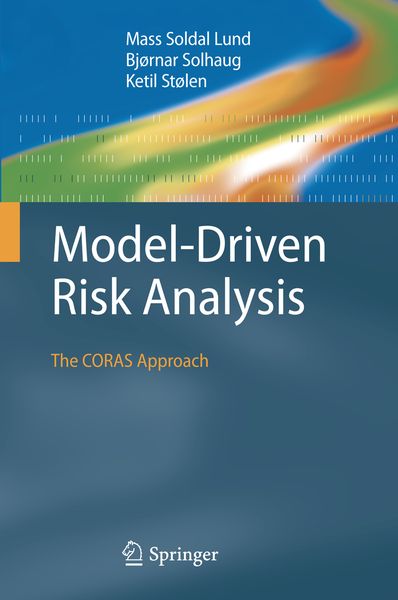
Model-Driven Risk Analysis The CORAS Approach

52,99 €

inkl. gesetzl. MwSt., Versandkostenfrei


Beschreibung

The term “risk” is known from many fields, and we are used to references to contractual risk, economic risk, operational risk, legal risk, security risk, and so forth. We conduct risk analysis, using either offensive or defensive approaches to identify and assess risk. Offensive approaches are concerned...

Beschreibung

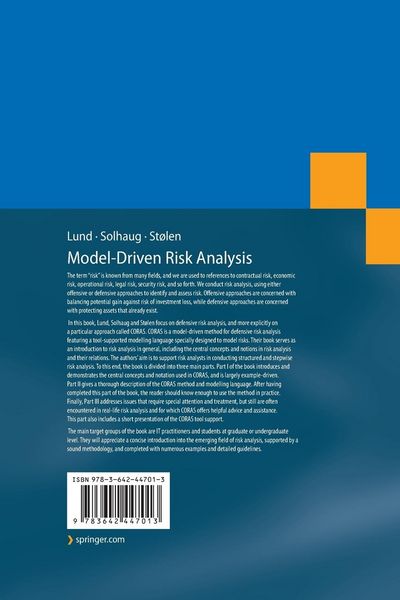
The term “risk” is known from many fields, and we are used to references to contractual risk, economic risk, operational risk, legal risk, security risk, and so forth. We conduct risk analysis, using either offensive or defensive approaches to identify and assess risk. Offensive approaches are concerned with balancing potential gain against risk of investment loss, while defensive approaches are concerned with protecting assets that already exist.
In this book, Lund, Solhaug and Stølen focus on defensive risk analysis, and more explicitly on a particular approach called CORAS. CORAS is a model-driven method for defensive risk analysis featuring a tool-supported modelling language specially designed to model risks. Their book serves as an introduction to risk analysis in general, including the central concepts and notions in risk analysis and their relations. The authors’ aim is to support risk analysts in conducting structured and stepwise risk analysis. To this end, the book is divided into three main parts. Part I of the book introduces and demonstrates the central concepts and notation used in CORAS, and is largely example-driven. Part II gives a thorough description of the CORAS method and modelling language. After having completed this part of the book, the reader should know enough to use the method in practice. Finally, Part III addresses issues that require special attention and treatment, but still are often encountered in real-life risk analysis and for which CORAS offers helpful advice and assistance. This part also includes a short presentation of the CORAS tool support.
The main target groups of the book are IT practitioners and students at graduate or undergraduate level. They will appreciate a concise introduction into the emerging field of risk analysis, supported by a sound methodology, and completed with numerous examples and detailed guidelines.

Rezension

"
The book is quite well organized [...].
Graduate students and researchers unfamiliar with risk assessment techniques and risk management issues will find [it] illuminating."
ACM Computing Reviews, Sandeep Shukla, June 2012

Produktdetails

Einband

Taschenbuch

Erscheinungsdatum

14.11.2014

Abbildungen

XVI, 460 p.

Verlag Springer Berlin

Produktdetails

Einband

Taschenbuch

Erscheinungsdatum

14.11.2014

Abbildungen

XVI, 460 p.

Verlag Springer Berlin
Seitenzahl

460

Maße (L/B/H)

23,5/15,5/2,6 cm

Gewicht

715 g

Auflage

2011

Sprache

Englisch

ISBN

978-3-642-44701-3

Herstelleradresse

Springer-Verlag KG
Sachsenplatz 4-6
1201 Wien
AT

Email: ProductSafety@springernature.com

Noch keine Bewertungen vorhanden

Verfassen Sie die erste Bewertung zu diesem Artikel

Helfen Sie anderen Kundinnen und Kunden durch Ihre Meinung.

Kundinnen und Kunden meinen

Bewertungen (0)

  • Produktbild: Model-Driven Risk Analysis
  • Produktbild: Model-Driven Risk Analysis
  • Part I: Introductory Overview
    1) Introduction - 2) Background and Related Work - 3) A Guided Tour to the CORAS Method

    Part II: Core Approach
    4) The CORAS Risk Modeling Language - 5) Preparations for the Analysis - 6) Customer Presentation of Target - 7) Refining the Target Description Using Asset Diagrams - 8) Approval of Target Description - 9) Risk Identification Using Threa Diagrams - 10) Risk Estimation Using Risk Diagrams - 11) Risk Evaluation Using Risk Evaluation Diagrams - 12) Risk Treatment Using Treatment Diagrams

    Part III: Selected Issues
    13) Analysing Likelihood Using CORAS Diagrams - 14) The High-Level CORAS Language - 15) Using CORAS to Support Change Management - 16) The Dependent CORAS Language - 17) Using CORAS to Analyse Legal Aspects - 18) The CORAS Tool

    Part IV: Appendices
    A) CORAS Language Grammar - B) CORAS Language Semantics - C) CORAS Guidelines