KI-Beratung Beta

Gutscheinbedingungen

**Gültig am 20.11.2026 ab einem Mindestbestellwert von 30€ auf Spielzeug, Schreibwaren, Filme, Geschenke & Trends, Musik, tolino eReader & Zubehör, Hörbücher und Hörbuch-Downloads, nicht preisgebundene Bücher und Kalender online auf thaalia.live und in der Thalia App. Einzelne Artikel können ausgeschlossen sein. Aufgrund der Buchpreisbindung sind deutschsprachige Bücher und eBooks ausgenommen. Zusätzlich ausgenommen sind Abos & Flatrates, Games, Geschenkkarten/-boxen, Shelfies, Software, Zeitschriften sowie einzelne Artikel von tonies®. Pro Einkauf einmal einlösbar. Click & Collect nur bei Onlinevorabzahlung möglich. Keine Barauszahlung. Nicht kombinierbar mit anderen Aktionen und Gutscheinen. Gutschein wird auf max. 500€ Bestellwert angerechnet. Nicht gültig für Versandkosten und Services. Preisgebundene Artikel sind vom Mindestbestellwert ausgeschlossen.

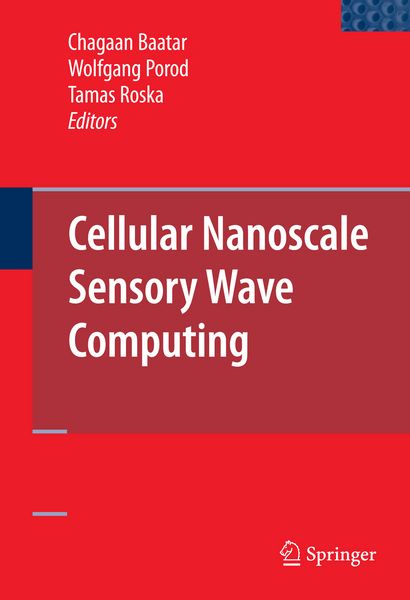
Produktbild: Cellular Nanoscale Sensory Wave Computing

Cellular Nanoscale Sensory Wave Computing

144,99 €

inkl. gesetzl. MwSt., Versandkostenfrei


Beschreibung

This book is loosely based on a Multidisciplinary University Research Initiative (MURI) project and a few supplemental projects sponsored by the Of?ce of Naval Research (ONR) during the time frame of 2004–2009. The initial technical scope and vision of the MURI project was formulated by Drs. Larry Cooper...

Beschreibung

This book is loosely based on a Multidisciplinary University Research Initiative (MURI) project and a few supplemental projects sponsored by the Of?ce of Naval Research (ONR) during the time frame of 2004–2009. The initial technical scope and vision of the MURI project was formulated by Drs. Larry Cooper and Joel Davis, both program of?cers at ONR at the time. The unifying theme of this MURI project and its companionefforts is the concept of cellular nonlinear/neuralnetwork (CNN) technology and its various extensions and chip implementations, including nanoscale sensors and the broadening ?eld of cellular wave computing. In recent years, CNN-based vision system drew much attention from vision scientists to device technologists and computer architects. Due to its early - plementation in a two-dimensional (2D) topography, it found success in early vision technologyapplications, such as focal-plane arrays, locally adaptable sensor/ processor integration, resulting in extremely high frame rates of 10,000 frames per second. More recently it drew increasing attention from computer architects, due to its intrinsic local interconnect architecture and parallel processing paradigm. As a result, a few spin-off companies have already been successful in bringing cel- lar wave computing and CNN technology to the market. This book aims to capture some of the recent advances in the ?eld of CNN research and a few select areas of applications.

Produktdetails

Einband

Taschenbuch

Erscheinungsdatum

28.11.2014

Abbildungen

VIII, 249 p.

Herausgeber Chagaan Baatar + weitere

Produktdetails

Einband

Taschenbuch

Erscheinungsdatum

28.11.2014

Abbildungen

VIII, 249 p.

Herausgeber
Verlag Springer Us
Seitenzahl

249

Maße (L/B/H)

23,5/15,5/1,5 cm

Gewicht

400 g

Auflage

2010

Sprache

Englisch

ISBN

978-1-4899-8453-1

Herstelleradresse

Springer-Verlag GmbH
Tiergartenstr. 17
69121 Heidelberg
DE

Email: ProductSafety@springernature.com

Noch keine Bewertungen vorhanden

Verfassen Sie die erste Bewertung zu diesem Artikel

Helfen Sie anderen Kundinnen und Kunden durch Ihre Meinung.

Kundinnen und Kunden meinen

Bewertungen (0)

  • Produktbild: Cellular Nanoscale Sensory Wave Computing
  • A Brief History of CNN and ONR.- Cellular Wave Computing in Nanoscale via Million Processor Chips.- Nanoantenna Infrared Detectors.- Memristors: A New Nanoscale CNN Cell.- Circuit Models of Nanoscale Devices.- A CMOS Vision System On-Chip with Multi-Core, Cellular Sensory-Processing Front-End.- Cellular Multi-core Processor Carrier Chip for Nanoantenna Integration and Experiments.- Circuitry Underlying Visual Processing in the Retina.- Elastic Grid-Based Multi-Fovea Algorithm for Real-Time Object-Motion Detection in Airborne Surveillance.- Low-Power Processor Array Design Strategy for Solving Computationally Intensive 2D Topographic Problems.