KI-Beratung Beta

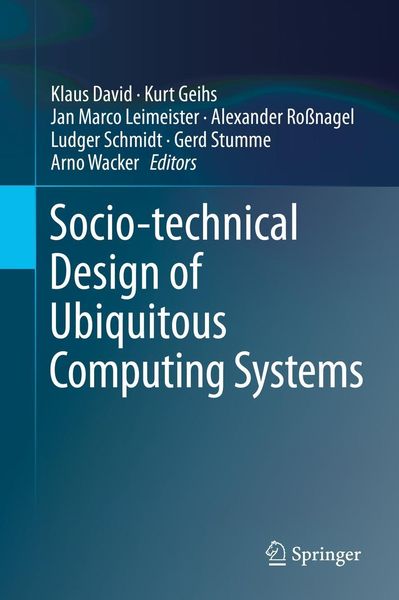
Produktbild: Socio-technical Design of Ubiquitous Computing Systems

Socio-technical Design of Ubiquitous Computing Systems

54,99 €

inkl. gesetzl. MwSt.

Beschreibung

By using various data inputs, ubiquitous computing systems detect their current usage context, automatically adapt their services to the user's situational needs and interact with other services or resources in their environment on an ad-hoc basis.

Designing such self-adaptive, context-aware knowledge...

Beschreibung

By using various data inputs, ubiquitous computing systems detect their current usage context, automatically adapt their services to the user's situational needs and interact with other services or resources in their environment on an ad-hoc basis.

Designing such self-adaptive, context-aware knowledge processing systems is, in itself, a formidable challenge. This book presents core findings from the VENUS project at the Interdisciplinary Research Center for Information System Design (ITeG) at Kassel University, where researchers from different fields, such as computer science, information systems, human-computer interaction and law, together seek to find general principles and guidelines for the design of socially aware ubiquitous computing systems. To this end, system usability, user trust in the technology and adherence to privacy laws and regulations were treated as particularly important criteria in the context of socio-technical system design.

During the project, a comprehensive blueprint for systematic, interdisciplinary software development was developed, covering the particular functional and non-functional design aspects of ubiquitous computing at the interface between technology and human beings. The organization of the book reflects the structure of the VENUS work program. After an introductory part I, part II provides the groundwork for VENUS by presenting foundational results from all four disciplines involved. Subsequently, part III focuses on methodological research funneling the development activities into a common framework. Part IV then covers the design of the demonstrators that were built in order to develop and evaluate the VENUS method. Finally, part V is dedicated to the evaluation phase to assess the user acceptance of the new approach and applications.

The presented findings are especially important for researchers in computer science, information systems, and human-computer interaction, but alsofor everyone working on the acceptance of new technologies in society in general.

Portrait

The Editors are all members of the Interdisciplinary Research Center for Information System Design (ITeG) at the University of Kassel in Germany. The ITeG focuses on a socio-technical perspective on the design of information technology, and encourages it's members to work with researchers outside of their own discipline. The research carried out within the center addresses the process of technical development from multiple perspectives including system usability, user trust and confidence in technology, and adherence to the law. In 2013 four research fields participated in the ITeG: Computer Science, Information Systems, Human-computer Interaction, and Law. All of these are represented in this book.

Produktdetails

Format

PDF

Kopierschutz

Nein

Family Sharing

Nein

Text-to-Speech

Nein

Produktdetails

Format

PDF

Format

eBooks im PDF-Format haben eine festgelegte Seitengröße und eignen sich daher nur bedingt zum Lesen auf einem tolino eReader oder Smartphone. Für den vollen Lesegenuss empfehlen wir Ihnen bei PDF-eBooks die Verwendung eines Tablets oder Computers.

Kopierschutz

Nein

Kopierschutz

Dieses eBook können Sie uneingeschränkt auf allen Geräten der tolino Familie, allen sonstigen eReadern und am PC lesen. Das eBook ist nicht kopiergeschützt und kann ein personalisiertes Wasserzeichen enthalten. Weitere Hinweise zum Lesen von eBooks mit einem personalisierten Wasserzeichen finden Sie unter Hilfe/Downloads.

Family Sharing

Nein

Family Sharing

Mit Family Sharing können Sie eBooks innerhalb Ihrer Familie (max. sechs Mitglieder im gleichen Haushalt) teilen. Sie entscheiden selbst, welches Buch Sie mit welchem Familienmitglied teilen möchten. Auch das parallele Lesen durch verschiedene Familienmitglieder ist durch Family Sharing möglich. Um eBooks zu teilen oder geteilt zu bekommen, muss jedes Familienmitglied ein Konto bei Thalia oder einem anderen tolino-Buchhändler haben. Weitere Informationen finden Sie unter Hilfe/Family-Sharing.

Text-to-Speech

Nein

Text-to-Speech

Bedeutet Ihnen Stimme mehr als Text? Mit der Funktion Text-to-Speech können Sie sich im tolino webReader und in der aktuellen Thalia – Lesen & Hören App das eBook vorlesen lassen. Weitere Informationen finden Sie unter Hilfe/Text-to-Speech.

Erscheinungsdatum

28.07.2014

Herausgeber
Verlag Springer
Seitenzahl

353 (Printausgabe)

Dateigröße

9185 KB

Sprache

Englisch

EAN

9783319050447

Barrierefreiheit
  • keine Information zur Barrierefreiheit bekannt

Noch keine Bewertungen vorhanden

Verfassen Sie die erste Bewertung zu diesem Artikel

Helfen Sie anderen Kundinnen und Kunden durch Ihre Meinung.

Kundinnen und Kunden meinen

Bewertungen (0)

Weitere Artikel finden Sie in

  • Produktbild: Socio-technical Design of Ubiquitous Computing Systems
  • Part I Introduction.- A Research Agenda for the Socio-Technical Design of Ubiquitous Computing Systems.- Part II Foundations.- Protecting Personality Rights and Legal Accountability.- Understanding the Formation of Trust.- User Model.- Enabling Active User Participation in Self-Adaptive Applications.- Matching and Mediation of Heterogeneous Context Information.- Mining Social Links for Ubiquitous Knowledge Engineering.- Collaborative Context Prediction.- Ranking Cryptographic Algorithms.- Part III Methods.- Socially Compatible Technology Design.- Requirement Patterns to Support Socio-technical System Design.- Designing Usable Adaptations.- SEMAT and VENUS - Different Perspectives?.- Part IV Applications.- Meet-U - Mobile Social Network.- Connect-U - A System for Enhancing Social Networking.- Support-U - Designing an Ambient Assisted Living System using Interdisciplinary Development Patterns.- Part V Evaluation.- System Evaluation.- Simulation Study.- Part VI Conclusion & Outlook.- The Future of Socio-Technical Design for Ubiquitous Computing Systems.