KI-Beratung Beta

Gutscheinbedingungen

**Gültig am 20.11.2026 ab einem Mindestbestellwert von 30€ auf Spielzeug, Schreibwaren, Filme, Geschenke & Trends, Musik, tolino eReader & Zubehör, Hörbücher und Hörbuch-Downloads, nicht preisgebundene Bücher und Kalender online auf thaalia.live und in der Thalia App. Einzelne Artikel können ausgeschlossen sein. Aufgrund der Buchpreisbindung sind deutschsprachige Bücher und eBooks ausgenommen. Zusätzlich ausgenommen sind Abos & Flatrates, Games, Geschenkkarten/-boxen, Shelfies, Software, Zeitschriften sowie einzelne Artikel von tonies®. Pro Einkauf einmal einlösbar. Click & Collect nur bei Onlinevorabzahlung möglich. Keine Barauszahlung. Nicht kombinierbar mit anderen Aktionen und Gutscheinen. Gutschein wird auf max. 500€ Bestellwert angerechnet. Nicht gültig für Versandkosten und Services. Preisgebundene Artikel sind vom Mindestbestellwert ausgeschlossen.

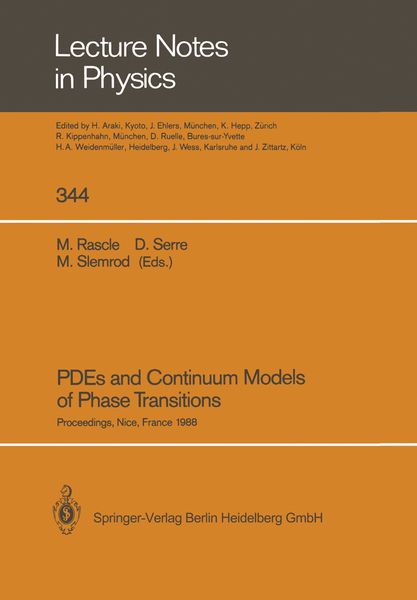
  • Produktbild: PDEs and Continuum Models of Phase Transitions
  • Produktbild: PDEs and Continuum Models of Phase Transitions
Band 344

PDEs and Continuum Models of Phase Transitions Proceedings of an NSF-CNRS Joint Seminar Held in Nice, France, January 18–22, 1988

Aus der Reihe Lecture Notes in Physics

99,99 €

inkl. gesetzl. MwSt., Versandkostenfrei


Beschreibung

The study of phase transitions is one of the fundamental problems of physics. The goal of this seminar was to understand better the spectacular progress made recently in constructing continuum models. Concentrating on a few examples such as the microstructure of crystals, defects in liquid crystals and...

Beschreibung

The study of phase transitions is one of the fundamental problems of physics. The goal of this seminar was to understand better the spectacular progress made recently in constructing continuum models. Concentrating on a few examples such as the microstructure of crystals, defects in liquid crystals and liquid-vapor interfaces, several key points are described, for example the structure and evolution of the interfaces, regularization via interfacial energy, and equilibrium theories. The mathematical treatment of these questions involves large-oscillation theories (Young's measures, compensated compactness), spectral theory, admissibility of shock waves, long-time behavior of dynamical systems, high-order perturbations, group actions, solitons, and others.

Produktdetails

Einband

Taschenbuch

Erscheinungsdatum

23.08.2014

Abbildungen

VII, 232 p. 64 illus.

Herausgeber Michel Rascle + weitere

Produktdetails

Einband

Taschenbuch

Erscheinungsdatum

23.08.2014

Abbildungen

VII, 232 p. 64 illus.

Herausgeber
Verlag Springer Berlin
Seitenzahl

232

Maße (L/B/H)

24,4/17/1,4 cm

Gewicht

429 g

Auflage

Softcover reprint of the original 1st ed. 1989

Sprache

Englisch

ISBN

978-3-662-13766-6

Herstelleradresse

Springer-Verlag KG
Sachsenplatz 4-6
1201 Wien
AT

Email: ProductSafety@springernature.com

Noch keine Bewertungen vorhanden

Verfassen Sie die erste Bewertung zu diesem Artikel

Helfen Sie anderen Kundinnen und Kunden durch Ihre Meinung.

Kundinnen und Kunden meinen

Bewertungen (0)

  • Produktbild: PDEs and Continuum Models of Phase Transitions
  • Produktbild: PDEs and Continuum Models of Phase Transitions
  • Clusters of singularities in liquid crystals.- Stability analysis of flows of liquid crystal polymers exhibiting a banding structure.- Coupled transverse-longitudinal solitons in elastic crystals.- The computation of the austenitic-martensitic phase transition.- Theory of diffusionless phase transitions.- Invariance properties of inviscid fluids of grade n.- On diffusion in two-phase systems: the sharp interface versus the transition layer.- Instabilities in shear flow of viscoelastic fluids with fading memory.- Singularities of the order parameter in condensed matter physics.- Swelling and shrinking of polyelectrolyte gels.- Adiabatic phase changes, fast and slow.- The continuous structure of discontinuities.- Riemann problems involving undercompressive shocks.- The viscosity-capillarity approach to phase transitions.- A version of the fundamental theorem for young measures.- Very slow phase separation in one dimension.