
KI-Beratung Beta

  • Produktbild: Behavior of Marine Animals
  • Produktbild: Behavior of Marine Animals
- 12%

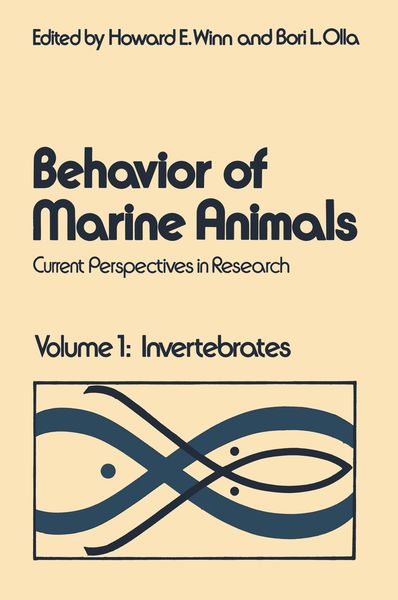
Behavior of Marine Animals Current Perspectives in Research Volume 1: Invertebrates

12% sparen

95,99 € UVP 109,99 €

inkl. gesetzl. MwSt., Versandkostenfrei


Beschreibung

What have been brought together in these volumes are works represent ing a variety of modern quantitative studies on a select group of marine organisms. Some of the species studied here represent basic biological ex perimental subjects-in some cases, marine versions of the white rat and pigeon-that are...

Beschreibung

What have been brought together in these volumes are works represent ing a variety of modern quantitative studies on a select group of marine organisms. Some of the species studied here represent basic biological ex perimental subjects-in some cases, marine versions of the white rat and pigeon-that are being used for a wide range of studies. Other species studied were virtually unknown as experimental animals. The authors have studied their animals in considerable depth, often in both the field and the laboratory. It is this cross reference between real life and the artificial but controlled conditions of the laboratory which gives us the necessary understanding, and ultimately the means, for improving our rapidly deteriorating environment, a must for man's survival, maintenance, and improvement of the quality of living standards. A direct outgrowth of a AAAS symposium entitled "Recent Advances in the Behavior of Marine Organisms" held in December 1966, these vol umes include a reasonable balance between review and original unpublished research. Of the many persons who have made these volumes possible, we wish to especially thank Nancy Fish, Lois Winn, Mabel Trafford, and Deborah Brennan. The latter two accomplished most of the final editorial work. The personnel of Plenum Press were cooperative in all aspects of our rela tionship. Only the two editors are responsible for defects in the volumes. We believe the papers presented are significant and will be of importance to members of the scientific community.

Produktdetails

Einband

Taschenbuch

Erscheinungsdatum

19.02.2012

Abbildungen

XVII, 244 p. 53 illus.

Verlag Springer Us

Produktdetails

Einband

Taschenbuch

Erscheinungsdatum

19.02.2012

Abbildungen

XVII, 244 p. 53 illus.

Verlag Springer Us
Seitenzahl

244

Maße (L/B/H)

22,9/15,2/1,6 cm

Gewicht

410 g

Auflage

Softcover Reprint of the Original 1st 1972 edition

Sprache

Englisch

ISBN

978-1-4684-0909-3

Herstelleradresse

Libri GmbH
Europaallee 1
36244 Bad Hersfeld
DE

Email: gpsr@libri.de

Noch keine Bewertungen vorhanden

Verfassen Sie die erste Bewertung zu diesem Artikel

Helfen Sie anderen Kundinnen und Kunden durch Ihre Meinung.

Kundinnen und Kunden meinen

Bewertungen (0)

  • Produktbild: Behavior of Marine Animals
  • Produktbild: Behavior of Marine Animals
  • of Volume 1.- 1 Orientation in Shore-Living Arthropods, Especially the Sand Fiddler Crab.- I. Introduction.- II. Review of Orientation in Shore-living Forms.- III. Orientation by Fiddler Crabs, Genus Uca.- IV. General Discussion.- References.- 2 Acoustic Signalling and Detection by Semiterrestrial Crabs of the Family Ocypodidae.- I. Introduction.- II. Patterns of Activity and Display.- III. Signal Characteristics.- IV. Detection of Tonal Stimuli.- V. Detection of Rapping Sounds.- VI. Discussion and Conclusions.- Acknowledgments.- References.- 3 Ritualization in Marine Crustacea.- I. Introduction.- II. Communication Studies in Marine Crustacea.- III. Model Presentations and Sequence Analysis.- IV. Ritualization in Hermit Crabs.- V. Discussion.- Acknowledgments.- References.- 4 Aggressive Behavior in Stomatopods and the Use of Information Theory in the Analysis of Animal Communication.- I. Introduction.- II. Information Theory.- III. Information Theory and Behavior.- IV. Stomatopod Aggressive Behavior—An Example of the Use of Information Theory in Behavioral Analysis.- V. General Discussion.- Acknowledgments.- References.- 5 Predatory Behavior of a Shell-Boring Muricid Gastropod.- I. Introduction.- II. Experimental Animals.- III. Detection and Approach to Prey.- IV. Penetration of Prey.- V. Relationship of Size of Borehole, ABO, and Radula.- VI. Feeding.- VII. Discussion and Conclusions.- Acknowledgments.- References.