KI-Beratung Beta

Gutscheinbedingungen

**Gültig bis 18.11.2026 auf englischsprachige Klassiker (klassiker-32728) online auf thaalia.live und in der Thalia App. Einzelne Artikel können ausgeschlossen sein. Ausgenommen sind preisgebundene Artikel & eBooks. Pro Einkauf einmal einlösbar. Click & Collect nur bei Onlinevorabzahlung möglich. Keine Barauszahlung. Nicht kombinierbar mit anderen Aktionen und Gutscheinen. Gutschein wird auf max. 500€ Bestellwert angerechnet. Nicht gültig für Geschenkkarten, Versandkosten und Services.

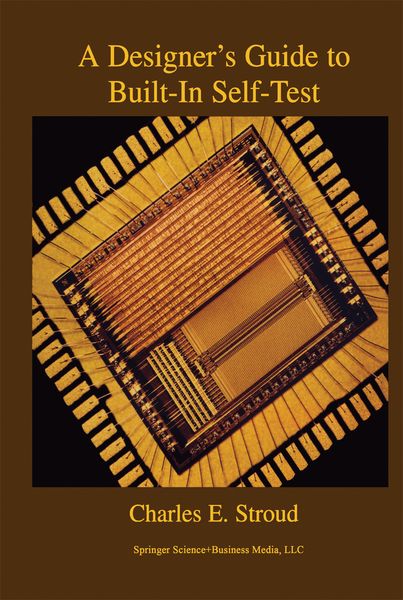
  • Produktbild: A Designer’s Guide to Built-In Self-Test
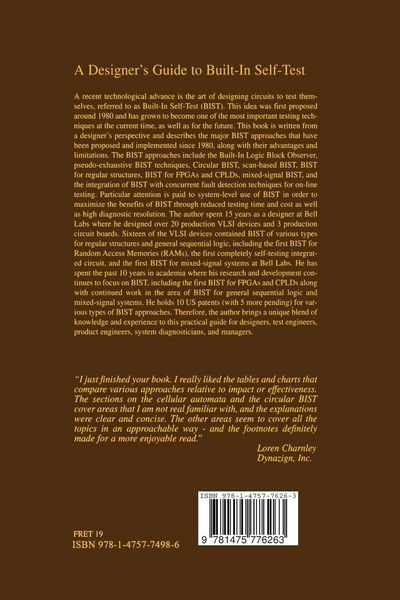
  • Produktbild: A Designer’s Guide to Built-In Self-Test
Band 19 - 13%

A Designer’s Guide to Built-In Self-Test

13% sparen

189,99 € UVP 219,99 €

inkl. gesetzl. MwSt., Versandkostenfrei


Beschreibung

A recent technological advance is the art of designing circuits to test themselves, referred to as a Built-In Self-Test (BIST). This idea was first proposed around 1980 and has grown to become one of the most important testing techniques at the current time, as well as for the future. This book is written...

Beschreibung

A recent technological advance is the art of designing circuits to test themselves, referred to as a Built-In Self-Test (BIST). This idea was first proposed around 1980 and has grown to become one of the most important testing techniques at the current time, as well as for the future. This book is written from a designer's perspective and describes the major BIST approaches that have been proposed and implemented since 1980, along with their advantages and limitations. The BIST approaches include the Built-In Logic Block Observer, pseudo-exhaustive BIST techniques, Circular BIST, scan-based BIST, BIST for regular structures, BIST for FPGAs and CPLDs, mixed-signal BIST, and the integration of BIST with concurrent fault detection techniques for on-line testing. Particular attention is paid to system-level use of BIST in order to maximize the benefits of BIST through reduced testing time and cost as well as high diagnostic resolution. The author spent 15 years as a designer at Bell Labs where he designed over 20 production VLSI devices and 3 production circuit boards. Sixteen of the VLSI devices contained BIST of various types for regular structures and general sequential logic, including the first BIST for Random Access Memories (RAMs), the first completely self-testing integrated circuit, and the first BIST for mixed-signal systems at Bell Labs. He has spent the past 10 years in academia where his research and development continues to focus on BIST, including the first BIST for FPGAs and CPLDs along with continued work in the area of BIST for general sequential logic and mixed-signal systems. He holds 10 US patents (with 5 more pending) for various types of BIST approaches. Therefore, the author brings a unique blend of knowledge and experience to this practical guide for designers, test engineers, product engineers, system diagnosticians, and managers.

Produktdetails

Einband

Taschenbuch

Erscheinungsdatum

18.03.2013

Abbildungen

XX, 320 p.

Verlag Springer Us

Produktdetails

Einband

Taschenbuch

Erscheinungsdatum

18.03.2013

Abbildungen

XX, 320 p.

Verlag Springer Us
Seitenzahl

320

Maße (L/B/H)

23,5/15,5/1,9 cm

Gewicht

522 g

Auflage

Softcover reprint of the original 1st ed. 2002

Sprache

Englisch

ISBN

978-1-4757-7626-3

Herstelleradresse

Springer-Verlag GmbH
Tiergartenstr. 17
69121 Heidelberg
DE

Email: ProductSafety@springernature.com

Noch keine Bewertungen vorhanden

Verfassen Sie die erste Bewertung zu diesem Artikel

Helfen Sie anderen Kundinnen und Kunden durch Ihre Meinung.

Kundinnen und Kunden meinen

Bewertungen (0)

  • Produktbild: A Designer’s Guide to Built-In Self-Test
  • Produktbild: A Designer’s Guide to Built-In Self-Test
  • An Overview of BIST.- Fault Models, Detection, and Simulation.- Design for Testability.- Test Pattern Generation.- Output Response Analysis.- Manufacturing and System-Level Use of BIST.- Built-In Logic Block Observer.- Pseudo-Exhaustive BIST.- Circular BIST.- Scan-Based BIST.- Non-Intrusive BIST.- BIST for Regular Structures.- BIST for FPGAs and CPLDs.- Applying Digital BIST to Mixed-Signal Systems.- Merging BIST and Concurrent Fault Detection.