KI-Beratung Beta

Gutscheinbedingungen

**Gültig bis 18.11.2026 auf englischsprachige Klassiker (klassiker-32728) online auf thaalia.live und in der Thalia App. Einzelne Artikel können ausgeschlossen sein. Ausgenommen sind preisgebundene Artikel & eBooks. Pro Einkauf einmal einlösbar. Click & Collect nur bei Onlinevorabzahlung möglich. Keine Barauszahlung. Nicht kombinierbar mit anderen Aktionen und Gutscheinen. Gutschein wird auf max. 500€ Bestellwert angerechnet. Nicht gültig für Geschenkkarten, Versandkosten und Services.

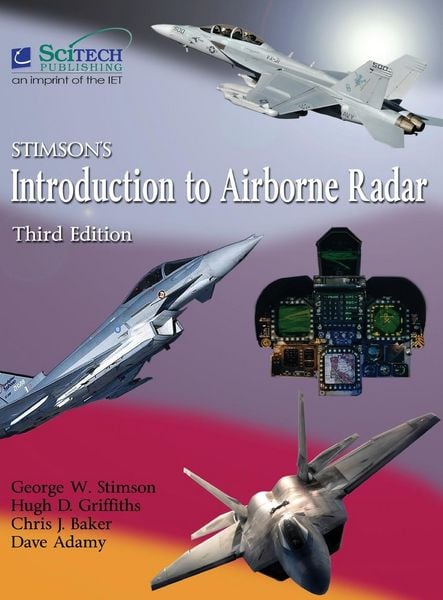
  • Produktbild: Stimson's Introduction to Airborne Radar, 3rd Edition
  • Produktbild: Stimson's Introduction to Airborne Radar, 3rd Edition

Stimson's Introduction to Airborne Radar, 3rd Edition

188,99 €

inkl. gesetzl. MwSt., Versandkostenfrei


Beschreibung

Completely modernized, greatly expanded, but retaining all the magic of the 2nd edition, Introduction to Airborne Radar has been brought into the 21st century without losing the hallmarks that made George Stimson's previous editions unique. Every chapter has been updated to reflect the constant transformations...

Beschreibung

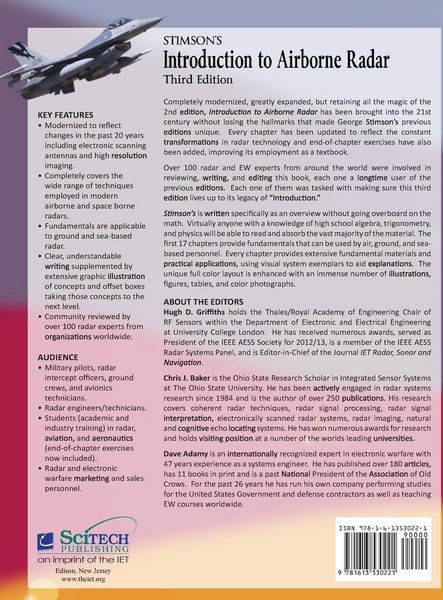
Completely modernized, greatly expanded, but retaining all the magic of the 2nd edition, Introduction to Airborne Radar has been brought into the 21st century without losing the hallmarks that made George Stimson's previous editions unique. Every chapter has been updated to reflect the constant transformations in radar technology and end-of-chapter exercises have also been added, improving its employment as a textbook.

Over 100 radar and EW experts from around the world were involved in reviewing, writing, and editing this book, each one a longtime user of the previous editions. Each one of them was tasked with making sure this third edition lives up to its legacy of 'Introduction.'

Stimson's is written specifically as an overview without going overboard on the math. Virtually anyone with a knowledge of high school algebra, trigonometry, and physics will be able to read and absorb the vast majority of the material. The first 17 chapters provide fundamentals that can be used by air, ground, and sea-based personnel. Every chapter provides extensive fundamental materials and practical applications, using visual system exemplars to aid explanations. The unique full color layout is enhanced with an immense number of illustrations, figures, tables, and color photographs.

Key features:

  • Modernized to reflect changes in the past 20 years including electronic scanning antennas and high resolution imaging.
  • Completely covers the wide range of techniques employed in modern airborne and space borne radars.
  • Fundamentals are applicable to ground and sea-based radar.
  • Clear, understandable writing supplemented by extensive graphic illustration of concepts and offset boxes taking those concepts to the next level.
  • Community reviewed by over 100 radar experts from organizations worldwide.

Produktdetails

Einband

Gebundene Ausgabe

Erscheinungsdatum

30.05.2014

Herausgeber Hugh D. Griffiths + weitere
Verlag SciTech Publishing Inc

Produktdetails

Einband

Gebundene Ausgabe

Erscheinungsdatum

30.05.2014

Herausgeber
Verlag SciTech Publishing Inc
Seitenzahl

774

Maße (L/B/H)

28,9/22,3/4,3 cm

Gewicht

2370 g

Auflage

3 ed

Sprache

Englisch

ISBN

978-1-61353-022-1

Herstelleradresse

Libri GmbH
Europaallee 1
36244 Bad Hersfeld
DE

Email: gpsr@libri.de

Noch keine Bewertungen vorhanden

Verfassen Sie die erste Bewertung zu diesem Artikel

Helfen Sie anderen Kundinnen und Kunden durch Ihre Meinung.

Kundinnen und Kunden meinen

Bewertungen (0)

  • Produktbild: Stimson's Introduction to Airborne Radar, 3rd Edition
  • Produktbild: Stimson's Introduction to Airborne Radar, 3rd Edition
    • Part I: Overview of Airborne Radar
    • Chapter 1: Basic Concepts
    • Chapter 2: Approaches to Implementation
    • Chapter 3: Representative Applications
    • Part II: Essential Groundwork
    • Chapter 4: Radio Waves and Alternating Current Signals
    • Chapter 5: A Nonmathematical Approach to Radar
    • Chapter 6: Preparatory Math for Radar
    • Part III: Fundamentals of Radar
    • Chapter 7: Choice of Radio Frequency
    • Chapter 8: Directivity and the Antenna Beam
    • Chapter 9: Electronically Scanned Array Antennas
    • Chapter 10: Electronically Scanned Array Design
    • Chapter 11: Pulsed Operation
    • Chapter 12: Detection Range
    • Chapter 13: The Range Equation: What It Does and Doesn't Tell Us
    • Chapter 14: Radar Receivers and Digitization
    • Chapter 15: Measuring Range and Resolving in Range
    • Chapter 16: Pulse Compression and High-Resolution Radar
    • Chapter 17: Frequency-Modulated Continuous Wave Ranging
    • Part IV: Pulse Doppler Radar
    • Chapter 18: The Doppler Effect
    • Chapter 19: The Spectrum of a Pulsed Signal
    • Chapter 20: The Pulsed Spectrum Unveiled
    • Chapter 21: Doppler Sensing and Digital Filtering
    • Chapter 22: Measuring Range-Rate
    • Part V: Clutter
    • Chapter 23: Sources and Spectra of Ground Return
    • Chapter 24: Effect of Range and Doppler Ambiguities on Ground Clutter
    • Chapter 25: Representing Clutter
    • Chapter 26: Separating Ground Moving Targets from Clutter
    • Part VI: Air-to-Air Operation
    • Chapter 27: PRF and Ambiguities
    • Chapter 28: Low PRF Operation
    • Chapter 29: Medium PRF Operation
    • Chapter 30: High PRF Operation
    • Chapter 31: Automatic Tracking
    • Part VII: Imaging Radar
    • Chapter 32: Radar and Resolution
    • Chapter 33: Imaging Methods
    • Chapter 34: SAR Image Formation and Processing
    • Chapter 35: SAR System Design
    • Part VIII Radar and Electronic Warfare
    • Chapter 36: Electronic Warfare Terms and Concepts
    • Chapter 37: Electronic Warfare Support
    • Chapter 38: Electronic Attack
    • Chapter 39: Electronic Protection
    • Chapter 40: Decoys
    • Chapter 41: Low Probability of Intercept (LPI)
    • Part IX: Special Topics and Advanced Concepts
    • Chapter 42: Antenna Radar Cross Section Reduction
    • Chapter 43: Advanced Processor Architectures
    • Chapter 44: Bistatic Radar
    • Chapter 45: Distributed Radar and MIMO Radar
    • Chapter 46: Radar Waveforms: Advanced Concepts
    • Chapter 47: Target Classification
    • Chapter 48: Emerging Radar Trends
    • Part X: Representative Radar Systems
    • Chapter 49: Airborne Early Warning and Control
    • Chapter 50: Reconnaissance & Surveillance
    • Chapter 51: Space Based Radar Systems
    • Chapter 52: Fighter & Attack