KI-Beratung Beta

Gutscheinbedingungen

**Gültig am 25.11.2026 auf fremdsprachige Bücher online auf thaalia.live und in der Thalia App. Einzelne Artikel können ausgeschlossen sein. Ausgenommen sind preisgebundene Artikel & eBooks. Pro Einkauf einmal einlösbar. Click & Collect nur bei Onlinevorabzahlung möglich. Keine Barauszahlung. Nicht kombinierbar mit anderen Aktionen und Gutscheinen. Gutschein wird auf max. 500€ Bestellwert angerechnet. Nicht gültig für Geschenkkarten, Versandkosten und Services.

  • Produktbild: Futures we are in
  • Produktbild: Futures we are in
Band 5

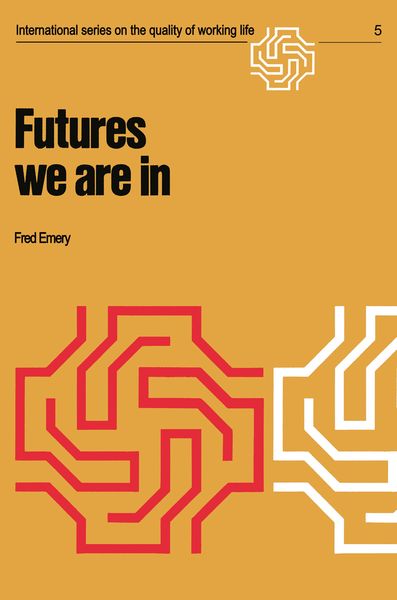
Futures we are in

51,99 €

inkl. gesetzl. MwSt., Versandkostenfrei


Beschreibung

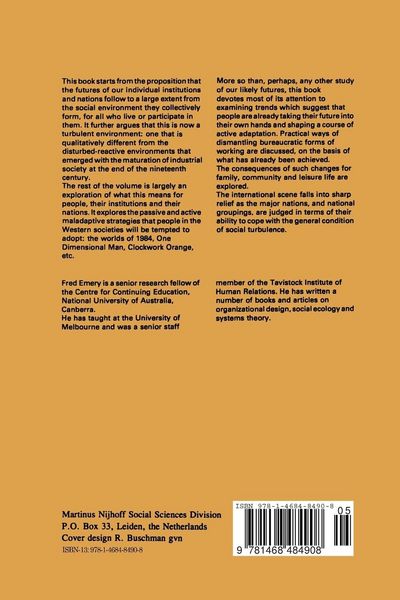
After explicating the analytical framework I will proceed to develop scenarios as follows: I. General scenarios -maladaptive and adaptive. 2. The future for the Western group of societies. Within this will seek to identify the main changes in the natures of work, leisure, family organisation, education...

Beschreibung

After explicating the analytical framework I will proceed to develop scenarios as follows: I. General scenarios -maladaptive and adaptive. 2. The future for the Western group of societies. Within this will seek to identify the main changes in the natures of work, leisure, family organisation, education and life styles. 3. The future for the major Asian powers, China, Japan and India. 4. A world scenario centred about the first two scenarios but also aimed to locate within this pattern the most probable future for sets of the smaller societies and under-developed countries. The scenarios will be developed in that order, for good reasons. Sociological forecasting has to deal, in the first instance, with sets of societies that are closely interdependent, each with the other. A scenario for Western societies generally is required before one can hope to write one for the individual countries, e.g. France, Australia, because they are not evolving independently. The widespread upsurge of student revolts in 1967-68 well illustrates this interdependence. Some writers, like Stevens (1970) have taken the U.S.A. as the model of the future for the other smaller Western societies. There is some justifi cation for this as the U.S. has certainly been the 'leading part' in the West for some decades. However, there is danger in assuming that that will persist. A change in the near future in the problems that commonly confront Western societies may make the U.S. example 'depasee', old hat, if not down-right misleading.

Produktdetails

Einband

Taschenbuch

Erscheinungsdatum

19.04.2012

Abbildungen

230 p.

Verlag Springer Us

Produktdetails

Einband

Taschenbuch

Erscheinungsdatum

19.04.2012

Abbildungen

230 p.

Verlag Springer Us
Seitenzahl

230

Maße (L/B/H)

22,9/15,2/1,4 cm

Gewicht

371 g

Auflage

Softcover reprint of the original 1st ed. 1977

Sprache

Englisch

ISBN

978-1-4684-8490-8

Herstelleradresse

Springer-Verlag KG
Sachsenplatz 4-6
1201 Wien
AT

Email: ProductSafety@springernature.com

Noch keine Bewertungen vorhanden

Verfassen Sie die erste Bewertung zu diesem Artikel

Helfen Sie anderen Kundinnen und Kunden durch Ihre Meinung.

Kundinnen und Kunden meinen

Bewertungen (0)

  • Produktbild: Futures we are in
  • Produktbild: Futures we are in
  • 1. From Evolving Systems to Evolving Environments.- 1.1.1. Type 1: Random, placid environments.- 1.1.2. Type 2: Clustered, placid environments.- 1.1.3. Type 3: Disturbed, reactive environments.- 1.1.4. Type 4: Turbulent environments.- 2. Three Patterns of Maladaptive Response to Turbulence; Three Possible Scenarios.- 2.1. Superficiality: Marcuse’s scenario.- 2.2. Segmentation: the Orwellian scenario.- 2.3. Dissociation: Neumann’s scenario.- 3. The Doomsday Scenarios.- 4. Active Adaptation: The Emergence of Ideal Seeking Systems.- 4.1. Turbulence, values and ideals.- 4.2. A theoretical note on the parameters of choice (and hence decision making).- 4.3. The embodiment of ideals.- 5. The Most Probable Future for Western Societies.- 5.1. Probable futures in work.- 5.2. Education.- 5.3. The family.- 5.4. Life patterns: security, mobility and leisure.- 6. A Scenario for Asia and the West.- 6.1. China as the leading part in Asia.- 6.2. China and the leading role of the West.- 6.3. China and the U.S.S.R.- 6.4. China and the rest of Asia.- 6.5. Japan.- 6.6. ‘Maphilindo’.- 6.7. India.- 6.8. India 1976: a new path?.- 7. Notes for a World Scenario.- 7.1. The ‘Third World’.- 7.2. International co-operation about international concerns.- 8. Epilogue: Social Sciences and Social Futures.- 8.1. Social science roles.- 8.2. Examples of ethical problems.- 8.3. Conclusions.- Appendix I. Social Forecasting.- A. Methodological premises of social forecasting.- B. Forecasting social futures as a problem in reduction of complexity.- C. The problem of detecting emerging processes.