KI-Beratung Beta

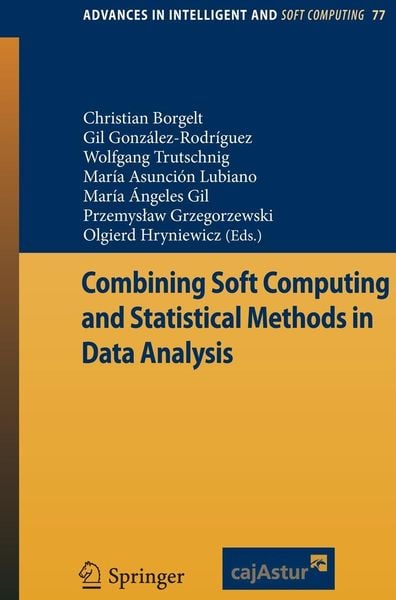
Produktbild: Combining Soft Computing and Statistical Methods in Data Analysis
Band 77

Combining Soft Computing and Statistical Methods in Data Analysis

317,90 €

inkl. gesetzl. MwSt.

Beschreibung

Over the last forty years there has been a growing interest to extend probability theory and statistics and to allow for more flexible modelling of imprecision, uncertainty, vagueness and ignorance. The fact that in many real-life situations data uncertainty is not only present in the form of randomness...

Beschreibung

Over the last forty years there has been a growing interest to extend probability theory and statistics and to allow for more flexible modelling of imprecision, uncertainty, vagueness and ignorance. The fact that in many real-life situations data uncertainty is not only present in the form of randomness (stochastic uncertainty) but also in the form of imprecision/fuzziness is but one point underlining the need for a widening of statistical tools. Most such extensions originate in a "softening" of classical methods, allowing, in particular, to work with imprecise or vague data, considering imprecise or generalized probabilities and fuzzy events, etc.
About ten years ago the idea of establishing a recurrent forum for discussing new trends in the before-mentioned context was born and resulted in the first International Conference on Soft Methods in Probability and Statistics (SMPS) that was held in Warsaw in 2002. In the following years the conference took place in Oviedo (2004), in Bristol (2006) and in Toulouse (2008). In the current edition the conference returns to Oviedo.
This edited volume is a collection of papers presented at the SMPS 2010 conference held in Mieres and Oviedo. It gives a comprehensive overview of current research into the fusion of soft methods with probability and statistics.

Produktdetails

Format

PDF

Kopierschutz

Nein

Family Sharing

Nein

Text-to-Speech

Nein

Produktdetails

Format

PDF

Format

eBooks im PDF-Format haben eine festgelegte Seitengröße und eignen sich daher nur bedingt zum Lesen auf einem tolino eReader oder Smartphone. Für den vollen Lesegenuss empfehlen wir Ihnen bei PDF-eBooks die Verwendung eines Tablets oder Computers.

Kopierschutz

Nein

Kopierschutz

Dieses eBook können Sie uneingeschränkt auf allen Geräten der tolino Familie, allen sonstigen eReadern und am PC lesen. Das eBook ist nicht kopiergeschützt und kann ein personalisiertes Wasserzeichen enthalten. Weitere Hinweise zum Lesen von eBooks mit einem personalisierten Wasserzeichen finden Sie unter Hilfe/Downloads.

Family Sharing

Nein

Family Sharing

Mit Family Sharing können Sie eBooks innerhalb Ihrer Familie (max. sechs Mitglieder im gleichen Haushalt) teilen. Sie entscheiden selbst, welches Buch Sie mit welchem Familienmitglied teilen möchten. Auch das parallele Lesen durch verschiedene Familienmitglieder ist durch Family Sharing möglich. Um eBooks zu teilen oder geteilt zu bekommen, muss jedes Familienmitglied ein Konto bei Thalia oder einem anderen tolino-Buchhändler haben. Weitere Informationen finden Sie unter Hilfe/Family-Sharing.

Text-to-Speech

Nein

Text-to-Speech

Bedeutet Ihnen Stimme mehr als Text? Mit der Funktion Text-to-Speech können Sie sich im tolino webReader und in der aktuellen Thalia – Lesen & Hören App das eBook vorlesen lassen. Weitere Informationen finden Sie unter Hilfe/Text-to-Speech.

Erscheinungsdatum

12.10.2010

Herausgeber
Verlag Springer
Seitenzahl

644 (Printausgabe)

Dateigröße

9050 KB

Sprache

Englisch

EAN

9783642147463

Barrierefreiheit
  • keine Information zur Barrierefreiheit bekannt

Noch keine Bewertungen vorhanden

Verfassen Sie die erste Bewertung zu diesem Artikel

Helfen Sie anderen Kundinnen und Kunden durch Ihre Meinung.

Kundinnen und Kunden meinen

Bewertungen (0)

Weitere Artikel finden Sie in

  • Produktbild: Combining Soft Computing and Statistical Methods in Data Analysis
  • Prior Knowledge in the Classification of Biomedical Data.- Estimation of a Simple Genetic Algorithm Applied to a Laboratory Experiment.- A Comparison of Robust Methods for Pareto Tail Modeling in the Case of Laeken Indicators.- R Code for Hausdorff and Simplex Dispersion Orderings in the 2D Case.- On Some Confidence Regions to Estimate a Linear Regression Model for Interval Data.- Possibilistic Coding: Error Detection vs. Error Correction.- Coherent Correction for Conditional Probability Assessments with R.- Inferential Rules for Weak Graphoid.- Fast Factorization of Probability Trees and Its Application to Recursive Trees Learning.- Option Pricing in Incomplete Markets Based on Partial Information.- Lorenz Curves of extrema.- Likelihood in a Possibilistic and Probabilistic Context: A Comparison.- Nonparametric Predictive Inference for Order Statistics of Future Observations.- Expected Pair-Wise Comparison of the Outcomes of a Fuzzy Random Variable.- The Behavioral Meaning of the Median.- Functional Classification and the Random Tukey Depth. Practical Issues.- On Concordance Measures and Copulas with Fractal Support.- Factorisation Properties of the Strong Product.- Hadamard Majorants for the Convex Order and Applications.- How to Avoid LEM Cycles in Mutual Rank Probability Relations.- Functional Inequalities Characterizing the Frank Family of Copulas.- Recent Developments in Censored, Non-Markov Multi-State Models.- Maximum Likelihood from Evidential Data: An Extension of the EM Algorithm.- A Decision Rule for Imprecise Probabilities Based on Pair-Wise Comparison of Expectation Bounds.- Handling Bipolar Knowledge with Credal Sets.- Coherent Upper Conditional Previsions and Their Integral Representation with Respect to Hausdorff Outer Measures.- Statistical Inference with Belief Functions and Possibility Measures: A Discussion of Basic Assumptions.- Representation of Exchangeable Sequences by Means of Copulas.- Area-Level Time Models for Small Area Estimation of Poverty Indicators.- Flood Analysis: On the Automation of the Geomorphological-Historical Method.- Geometric Sampling: An Approach to Uncertainty in High Dimensional Spaces.- Inverse Problems and Model Reduction Techniques.- A Linearity Test for a Simple Regression Model with LR Fuzzy Response.- Soft Methods in Robust Statistics.- S-Statistics and Their Basic Properties.- Particle Swarm Optimization and Inverse Problems.- Linear Approximations to the Power Function of Robust Tests.- Decision Support for Evolving Clustering.- On Jaffray's Decision Model for Belief Functions.- Quasi Conjunction and p-Entailment in Nonmonotonic Reasoning.- Elements of Robust Regression for Data with Absolute and Relative Information.- On Testing Fuzzy Independence Application in Quality Control.- The Fisher's Linear Discriminant.- Testing Archimedeanity.- An Attempt to Define Graphical Models in Dempster-Shafer Theory of Evidence.- Comparison of Time Series via Classic and Temporal Protoforms of Linguistic Summaries: An Application to Mutual Funds and Their Benchmarks.- Mining Gradual Dependencies Based on Fuzzy Rank Correlation.- From Probabilities to Belief Functions on MV-Algebras.- Soft Methods in Trend Detection.- Linguistic Decision Trees for Fusing Tidal Surge Forecasting Models.- Set-Valued Square Integrable Martingales and Stochastic Integral.- Smooth Transition from Mixed Models to Fixed Models.- Mixture Models with a Black-Hole Component.- On the Preservations of Contractions: An Application to Stochastic Orders.- A New Multivariate Stochastic Order, Main Properties.- ANOVA for Fuzzy Random Variables Using the R-package SAFD.- Probability Tree Factorisation with Median Free Term.- Comparison of Random Variables Coupled by Archimedean Copulas.- Two-Way Analysis of Variance for Interval-Valued Data.- Estimating the Variance of a Kernel Density Estimation.- Uncertainty Invariance Transformation in Continuous Case.- Detection of Outliers Using Robust Principal Component Analysis: A Simulation Study.- Exploiting Sparse Dependence Structure in Model Based Classification.- Independence Tests for Uncertain Data with a Frequentist Method.- Why Imprecise Regression: A Discussion.- Power Analysis of the Homoscedasticity Test for Random Fuzzy Sets.- Periodic Generalized-Differentiable Solutions to Fuzzy Differential Equations.- The Selection of the Shrinkage Region in Small Area Estimation.- Set-Valued Stochastic Processes and Sets of Probability Measures Induced by Stochastic Differential Equations with Random Set Parameters.- Coupled Brownian Motion.- The Median of a Random Interval.- The Use of Sets of Stochastic Operators to Constructing Imprecise Probabilities.- Prediction of Future Order Statistics from the Uniform Distribution.- Balance Sheet Approach to Agent-Based Computational Economics: The EURACE Project.- Connections between Statistical Depth Functions and Fuzzy Sets.- An Alternative Approach to Evidential Network Construction.- Large Deviations of Random Sets and Random Upper Semicontinuous Functions.- A Note of Proposed Privacy Measures in Randomized Response Models.