KI-Beratung Beta

Gutscheinbedingungen

**Gültig bis 11.11.2026 auf Spielzeug, Schreibwaren, Filme, Geschenke & Trends, Musik, tolino eReader & Zubehör, Hörbücher und Hörbuch-Downloads, nicht preisgebundene Bücher und Kalender online auf thaalia.live und in der Thalia App. Einzelne Artikel können ausgeschlossen sein. Aufgrund der Buchpreisbindung sind deutschsprachige Bücher und eBooks ausgenommen. Zusätzlich ausgenommen sind Abos & Flatrates, Games, Geschenkkarten/-boxen, Shelfies, Software, Zeitschriften sowie einzelne Artikel von tonies®. Pro Einkauf einmal einlösbar. Click & Collect nur bei Onlinevorabzahlung möglich. Keine Barauszahlung. Nicht kombinierbar mit anderen Aktionen und Gutscheinen. Gutschein wird auf max. 500€ Bestellwert angerechnet. Nicht gültig für Versandkosten und Services.

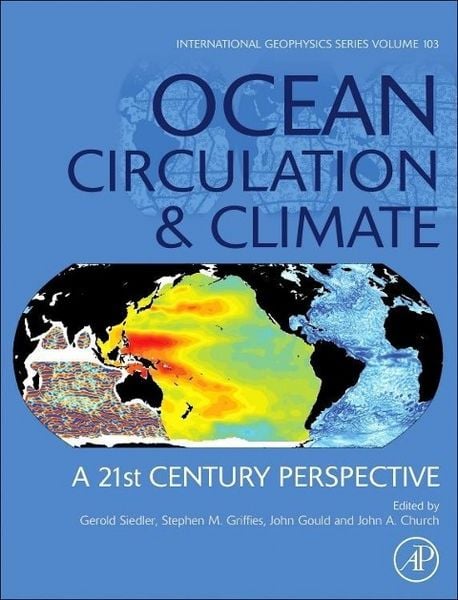
Produktbild: Ocean Circulation and Climate

Ocean Circulation and Climate A 21st Century Perspective Volume 103

Aus der Reihe International Geophysics

121,99 €

inkl. gesetzl. MwSt., Versandkostenfrei


Beschreibung

Produktdetails

Einband

Gebundene Ausgabe

Erscheinungsdatum

25.11.2013

Herausgeber

Gerold Siedler + weitere

Verlag

Elsevier Science & Technology

Seitenzahl

904

Maße (L/B/H)

28,4/22/4,8 cm

Gewicht

2823 g

Auflage

2nd edition

Sprache

Englisch

ISBN

978-0-12-391851-2

Beschreibung

Rezension

"The current state of knowledge is summarized in this new book, written by 76 authors from 15 countries...Two developments in particular provided new knowledge on the oceanic circulation. First there has been a most remarkable progress in ocean observations, with a transition from special experiments to long-term monitoring.

The introduction of the book summarizes the role of ocean in the present climate system and in the earlier paleoclimate state. After a discussion of current observational methods, new results are given on physical processes in the ocean. Because of the increasing importance of models for the understanding and prediction of ocean and climate change, a large part of the book deals with modeling and the results on long-term changes." --Geomar online, November 2013

"Ocean Circulation and Climate belongs on every climate geek's holiday wish list.the book, subtitled 'A 21st Century Perspective", is both timely and important. It contains 31 chapters that span the present state of knowledge.

"Ocean Circulation and Climate is the culmination of a multi-national, multi-decadal program designed to observe the global ocean. ...a voluminous book, unique in that there is no other single volume to which one can turn as a source for the cutting edge of knowledge of the large-scale circulation and properties of the ocean. ...lays the foundation for the daunting challenge of understanding the future of the world oceans and their role in climate change." --Journal Of International Geoscience

"...excellent editing and production quality plus hundreds of diagrams and dozens of color plates. It will be essential for ocean and climate scientists for years to come." --New Scientist, October 2001

Portrait

Gerold Siedler is a physical oceanographer at the marine research institute in Kiel/Germany. He established a highly regarded ocean observing unit and participated in almost 30 research cruises. His research focused on ocean processes and circulation in all three oceans. He was professor at Kiel University, Director of the marine research institute IfM (1976-1978) and Dean of the Faculty of Mathematics and Sciences (1991-1992) at Kiel University. In addition he worked as visiting investigator abroad, in particular at the Woods Hole Oceanographic Institution in the USA, including teaching in the WHOI/MIT joint program. He performed research at the University of Miami, the Jet Propulsion Laboratory/Pasadena, the University of Hawaii in the USA, the Laboratory for the Physics of the Ocean, Paris and Ifremer/Brest in France, and as a Humboldt researcher at the University of Cape Town in South Africa. He served in leading functions in major international ocean/climate programs, in particular GATE and WOCE. He was a vice-president of the Association for the Physical Sciences of the Ocean (IAPSO, 1975-1979) and a president of the Scientific Committee on Oceanic Research (SCOR, 1983-1988) at ICSU. He published 77 peer-reviewed papers, authored or edited 4 books and contributed to 18 books. He is now Emeritus Professor at Kiel University.
Stephen Griffies is a senior scientist at NOAA's Geophysical Fluid Dynamics Laboratory in Princeton, USA. He is an expert on physical and numerical aspects of ocean circulation models and their applications for understanding and predicting large-scale climate phenomena. His research focuses on questions related to global and regional sea level; ocean mesoscale dynamics and parameterizations; climate predictability; physically based analysis methods; and numerical algorithms. He is a leader in projects associated with the World Climate Research Programme (WCRP), having led the WCRP/CLIVAR Working Group on Ocean Model Development as part of coordinating ocean climate modeling efforts worldwide. Besides his 20 years in Princeton, he has worked for extended periods in Australia on topics related to the ocean climate modeling, Southern Ocean dynamics, and physical ocean processes. He authored a standard monograph on fundamentals of ocean climate models and co-authored more than 80 peer-reviewed research articles. He was awarded the 2014 Fridtjof Nansen Medal from the European Geosciences Union for contributions to oceanography.
John Gould (sometimes known as W. John) has had a long career in ocean research mostly focused on the collection and interpretation of ocean current measurements. His career started with working with John Swallow, who first developed the neutrally buoyant float at the UK National Institute of Oceanography. He led many research cruises in the North Atlantic Ocean. He was Project Director of the World Climate Research Programme's World Ocean Circulation Experiment- WOCE (1993-2002) and of its Climate Variability and Predictability Study -CLIVAR (1998-2002). From 2002-2006 he directed the international Argo profiling float project. At various times he has chaired the ICES Oceanic Hydrography Working Group and been a member of the executive of the International Association for the Physical Sciences of the Ocean and a member of the advisory board for Australia's Integrated Marine Observing System (IMOS). He has an interest in widening public awareness of marine science and of the oceans' role in climate. He is a member of the International Union of Geodesy and Geophysic's History Working Group and is a visiting scientist at the UK's National Oceanography Centre.
John Church is a CSIRO Fellow with the Centre for Australian Weather and Climate Research. His area of expertise is the role of the ocean in climate, particularly anthropogenic climate change and sea-level rise. He has been a Principal Investigator on NASA/CNES satellite altimeter Science Working Teams since 1987. He was co-convening lead author for the Chapter on Sea Level in the IPCC Third and Fifth Assessment Reports. He Co-Chaired the international Scientific Steering Group for the World Ocean Circulation Experiment from 1994 to 1998 and Chaired the Joint Scientific Committee of the World Climate Research Programme from 2006 to 2008. He was awarded the 2006 Roger Revelle Medal by the Intergovernmental Oceanographic Commission, was a winner of a CSIRO Medal for Research Achievement in 2006, won the 2007 Eureka Prize for Scientific Research and presented the 2008 AMOS R.H. Clarke Lecture. He is the author of over 120 refereed publications, 80 other reports and co-edited three books. He is a Fellow of the Australian Academy of Science and the Australian Academy of Technological Sciences and Engineering.

Produktdetails

Einband

Gebundene Ausgabe

Erscheinungsdatum

25.11.2013

Herausgeber

Verlag

Elsevier Science & Technology

Seitenzahl

904

Maße (L/B/H)

28,4/22/4,8 cm

Gewicht

2823 g

Auflage

2nd edition

Sprache

Englisch

ISBN

978-0-12-391851-2

Herstelleradresse

Libri GmbH
Europaallee 1
36244 Bad Hersfeld
DE

Email: gpsr@libri.de

Noch keine Bewertungen vorhanden

Verfassen Sie die erste Bewertung zu diesem Artikel

Helfen Sie anderen Kundinnen und Kunden durch Ihre Meinung.

Kundinnen und Kunden meinen

Bewertungen (0)

Die Leseprobe wird geladen.
  • Produktbild: Ocean Circulation and Climate
  • Part I: The oceans' role in the climate system
    1 The ocean as a component of the climate system
    2 Paleoclimatic ocean circulation and sea level changes
    Part II: Ocean observations
    3 In-situ ocean observations: A brief history, present status and future directions
    4 Remote sensing of the global ocean circulation
    Part III: Ocean processes
    5 Exchanges through the ocean surface
    6 Thermodynamics of seawater
    7 Diapycnal mixing processes in the ocean interior
    8 Lateral transport in the ocean interior
    9 Global distribution and formation of mode waters
    10 Deep water formation
    Part IV: Ocean circulation and water masses
    11 Conceptual models of the wind-driven and thermohaline circulation
    12 Ocean surface circulation
    13 Western boundary currents
    14 Currents and processes along the eastern boundaries
    15 The tropical ocean circulation and dynamics
    16 The marine cryosphere
    17 The Arctic and subarctic oceans/seas
    18 Dynamics of the Southern Ocean circulation
    19 Inter-ocean and inter-basin exchanges
    Part V: Modeling the ocean climate system
    20 Ocean circulation models and modeling
    21 Dynamically and kinematically consistent global ocean circulation and ice state estimates
    22 Methods and applications of ocean synthesis in climate research
    23 Coupled models and climate projections
    24 The oceans' role in modeling and predicting seasonal-to-interannual climate variations
    25 The oceans' role in modeling and predicting decadal climate variations
    26 Modeling ocean biogeochemical processes and resulting tracer distributions
    Part VI: The changing ocean
    27 Sea-level and ocean heat-content change
    28 Long-term salinity changes and implications for the global water cycle
    29 Ocean heat transport
    30 The marine carbon cycle and ocean carbon inventories
    31 Marine ecosystems, biogeochemistry, and climate