KI-Beratung Beta

Gutscheinbedingungen

**Gültig am 20.11.2026 ab einem Mindestbestellwert von 30€ auf Spielzeug, Schreibwaren, Filme, Geschenke & Trends, Musik, tolino eReader & Zubehör, Hörbücher und Hörbuch-Downloads, nicht preisgebundene Bücher und Kalender online auf thaalia.live und in der Thalia App. Einzelne Artikel können ausgeschlossen sein. Aufgrund der Buchpreisbindung sind deutschsprachige Bücher und eBooks ausgenommen. Zusätzlich ausgenommen sind Abos & Flatrates, Games, Geschenkkarten/-boxen, Shelfies, Software, Zeitschriften sowie einzelne Artikel von tonies®. Pro Einkauf einmal einlösbar. Click & Collect nur bei Onlinevorabzahlung möglich. Keine Barauszahlung. Nicht kombinierbar mit anderen Aktionen und Gutscheinen. Gutschein wird auf max. 500€ Bestellwert angerechnet. Nicht gültig für Versandkosten und Services. Preisgebundene Artikel sind vom Mindestbestellwert ausgeschlossen.

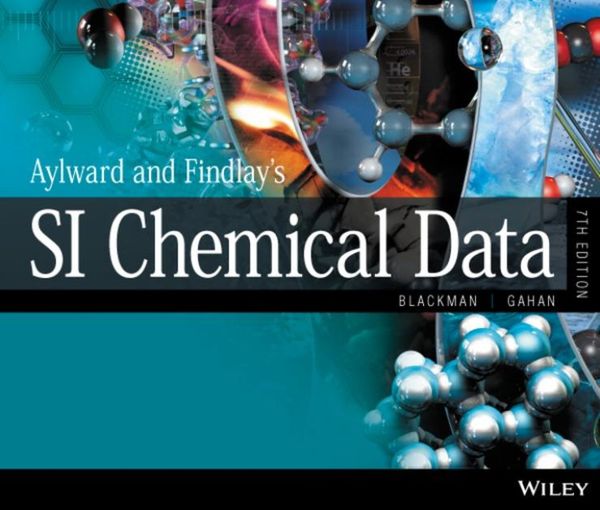
Produktbild: Aylward and Findlay's SI Chemical Data

Aylward and Findlay's SI Chemical Data

51,99 €

inkl. gesetzl. MwSt., Versandkostenfrei


Beschreibung

SI Chemical Data, 7th edition, is a supplementary text for students in undergraduate chemistry courses and in high school subjects specialising in chemistry. The chemicals included have been chosen specifically to cover those typically studied in these courses.

New to this edition

The adoption of the...

Beschreibung

SI Chemical Data, 7th edition, is a supplementary text for students in undergraduate chemistry courses and in high school subjects specialising in chemistry. The chemicals included have been chosen specifically to cover those typically studied in these courses.

New to this edition

The adoption of the Globally Harmonised System of Classification and Labelling of Chemicals (GHS) has necessitated extensive revision of the hazard codes that were elaborately detailed in earlier editions. Now, instead of listing individual hazard codes for each element and chemical, the GHS is explained in detail, along with how to interpret a material safety data sheet (MSDS). This information provides students with the skills to discover and understand the hazards that may be associated with the chemicals they use.

In addition to this major change, the order of the tables of data has been rearranged to systematise the sequence of presentation. The values of the fundamental constants have been updated, data have been updated based on the most recent published compendia and, in some cases, data have been presented in different formats to those in previous editions. New tables have been included to provide data and information on:

  • common radioisotopes
  • common amino acids
  • the miscibility of common solvents
  • 1H chemical shifts of residual protons in deuterated NMR solvents
  • 1H and 13C chemical shifts of common solvents
  • common biological buffers
  • the potentials and conversion factors for common reference electrodes.

Produktdetails

Einband

Taschenbuch

Erscheinungsdatum

04.10.2013

Verlag John Wiley & Sons Australia Ltd
Seitenzahl

176

Produktdetails

Einband

Taschenbuch

Erscheinungsdatum

04.10.2013

Verlag John Wiley & Sons Australia Ltd
Seitenzahl

176

Maße (L/B/H)

25,4/21,7/2 cm

Gewicht

528 g

Auflage

7 ed

Sprache

Englisch

ISBN

978-0-7303-0246-9

Herstelleradresse

Libri GmbH
Europaallee 1
36244 Bad Hersfeld
DE

Email: gpsr@libri.de

Noch keine Bewertungen vorhanden

Verfassen Sie die erste Bewertung zu diesem Artikel

Helfen Sie anderen Kundinnen und Kunden durch Ihre Meinung.

Kundinnen und Kunden meinen

Bewertungen (0)

  • Produktbild: Aylward and Findlay's SI Chemical Data
  • About the Authors iv

    Preface iv

    Acknowledgements v

    Section 1: General: Physical constants, units and symbols

    1 The International System of Units (SI) 3

    2 SI derived units commonly used in chemistry 3

    3 Fundamental constants (revised 2010) 4

    4 Common conversion factors 4

    5 The Greek alphabet 5

    6 Numerical prefixes 5

    7 Decimal fractions and multiples 6

    Section 2: The elements

    8 Ground state electronic configurations of the elements 9

    9 Properties of the elements 14

    10 Properties and applications of some common radioisotopes 22

    11 Electronegativities of the elements (Pauling scale) 24

    12 Enthalpies of melting, vaporisation and atomisation of the elements 25

    13 First ionisation enthalpies (E i1) of the elements 27

    14 Successive ionisation enthalpies (E in) of the elements 29

    15 Electron affinities (E ea) of the elements 31

    Section 3: Inorganic compounds

    16 Properties of elements and inorganic compounds 35

    17 Some crystal forms 84

    18 Shapes of some molecules and ions 87

    19 Bond lengths 88

    20 Average bond enthalpies 89

    21 Lattice enthalpies of ionic crystals 89

    22 Stability constants of complex ions 90

    23 Solubility products 91

    Section 4: Organic compounds

    24 Some important organic functional groups 95

    25 Properties of organic compounds 97

    26 Properties of amino acids 120

    27 Properties of solvents 123

    28 Miscibility of solvents 125

    29 Boiling temperature elevation and freezing temperature depression constants 126

    30 Critical constants and triple points 127

    Section 5: Spectroscopic data

    31 The spectral energies 131

    32 Infrared absorption frequencies 131

    33 NMR chemical shifts 132

    34 Chemical shifts and multiplicities of residual protons in deuterated NMR solvents 132

    35 NMR chemical shifts of common solvents in a variety of deuterated NMR solvents 133

    36 Important NMR-active nuclei 137

    37 Common singly charged (z = 1) fragments detected by mass spectrometry 137

    Section 6: Properties of acids and bases

    38 Dissociation constants of acids and hydrated metal ions 141

    39 Aqueous concentrations of common acids 142

    40 Common acid-base indicators 143

    41 Common buffers 143

    42 Buffering ranges of some common biological buffers (0.1 m) 144

    Section 7: Properties of aqueous solutions

    43 Ionic properties of water 149

    44 Molar conductivities of aqueous solutions at 298 K 149

    45 Ionic molar conductivities at infinite dilution at 298 K 149

    46 Solubility of gases in water 150

    47 Vapour pressure and density of water and mercury at different temperatures 150

    48 Densities of aqueous solutions at 298 K 151

    Section 8: Electrochemistry

    49 Standard electrode potentials and redox equilibria in aqueous solution 155

    50 Potentials of common reference electrodes at 298 K 159

    51 Conversion factors (mV) between common reference electrodes in acetonitrile 160

    Section 9: Appendices

    52 Globally Harmonised System of Classification and Labelling of Chemicals (GHS) 163

    53 Interpretation of a material safety data sheet (MSDS) 165

    54 Common formulae and definitions 173

    References 176

    Index 181