KI-Beratung Beta

Gutscheinbedingungen

**Gültig am 25.11.2026 auf fremdsprachige Bücher online auf thaalia.live und in der Thalia App. Einzelne Artikel können ausgeschlossen sein. Ausgenommen sind preisgebundene Artikel & eBooks. Pro Einkauf einmal einlösbar. Click & Collect nur bei Onlinevorabzahlung möglich. Keine Barauszahlung. Nicht kombinierbar mit anderen Aktionen und Gutscheinen. Gutschein wird auf max. 500€ Bestellwert angerechnet. Nicht gültig für Geschenkkarten, Versandkosten und Services.

Produktbild: Agent-Based Approaches in Economic and Social Complex Systems VII
Band 10 - 12%

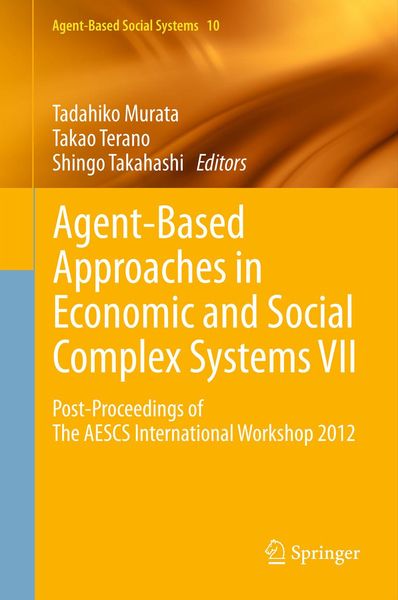
Agent-Based Approaches in Economic and Social Complex Systems VII Post-Proceedings of The AESCS International Workshop 2012

12% sparen

144,99 € UVP 164,99 €

inkl. gesetzl. MwSt., Versandkostenfrei


Beschreibung

Agent-based modeling/simulation is an emergent approach to the analysis of social and economic systems. It provides a bottom-up experimental method to be applied to social sciences such as economics, management, sociology, and politics as well as some engineering fields dealing with social activities....

Beschreibung

Agent-based modeling/simulation is an emergent approach to the analysis of social and economic systems. It provides a bottom-up experimental method to be applied to social sciences such as economics, management, sociology, and politics as well as some engineering fields dealing with social activities. This book includes selected papers presented at the Seventh International Workshop on Agent-Based Approaches in Economic and Social Complex Systems held in Osaka, Japan, in 2012.

At the workshop, 24 reviewed full papers were presented, and of those, 17 were selected to be included in this volume. The papers are divided into two groups as "Fundamentals of Agent-Based Modeling" and "Applications of Agent-Based Modeling".

Produktdetails

Einband

Gebundene Ausgabe

Erscheinungsdatum

29.05.2013

Abbildungen

X, 262 p.

Herausgeber Tadahiko Murata + weitere

Produktdetails

Einband

Gebundene Ausgabe

Erscheinungsdatum

29.05.2013

Abbildungen

X, 262 p.

Herausgeber
Verlag Springer Tokyo
Seitenzahl

262

Maße (L/B/H)

24,1/16/2 cm

Gewicht

524 g

Auflage

2013

Sprache

Englisch

ISBN

978-4-431-54278-0

Herstelleradresse

Springer-Verlag KG
Sachsenplatz 4-6
1201 Wien
AT

Email: ProductSafety@springernature.com

Noch keine Bewertungen vorhanden

Verfassen Sie die erste Bewertung zu diesem Artikel

Helfen Sie anderen Kundinnen und Kunden durch Ihre Meinung.

Kundinnen und Kunden meinen

Bewertungen (0)

  • Produktbild: Agent-Based Approaches in Economic and Social Complex Systems VII
  • Part 1 Fundamentals of Agent-Based Modeling
    1) Agent-based Modeling and Simulation Validation by Scenario Analysis2) Aspiration-Based Learning to Balance Exploration and Exploitation in Organizational Learning"3) Agent-Based Simulation of Diversity and Organizational Performance4) Configering Agents' Attributes with Simulated Annealing5) Money Emergence on a Network Topology6) The Agent-based Diffusion Model: Simulating: Informative and Normative Effects on Consumer Networks"7) Agent-based Simulation Using a Model of Network Formation8) Firms interaction in a scale-free trade network and prices dynamics"9) Analysis and Modeling of Customer-Perceived Value of Medical Insurance Products"
     
    Part 2 Applications of Agent-Based Modeling

    1) The Effects of Vaccination Strategies against Smallpox: Bioterrorism with Agent-based Simulation
    2) Influence of Government Expenditure Policies and Tax Rate on GDP in an Agent-Based Artificial Economic System
    3) The Role of Social Network in Migration and Economic Aggregation Through Brownian Agent Model
    4) Agent-based Simulation for Pension System in Japan
    5) The ASSA Project: An Intelligent Agent Simulation of Shop-Around Behavior
    6) Extension of the iterative proportional fitting procedure and its evaluation using agent-based Models
    7) An On-The-Fly Learning Framework for Fluctuating Number of Agents in a Multi-Agent System
    8) Learning in “do-it-yourself lottery” with full information: a computational study