KI-Beratung Beta

Gutscheinbedingungen

**Gültig bis 18.11.2026 auf englischsprachige Klassiker (klassiker-32728) online auf thaalia.live und in der Thalia App. Einzelne Artikel können ausgeschlossen sein. Ausgenommen sind preisgebundene Artikel & eBooks. Pro Einkauf einmal einlösbar. Click & Collect nur bei Onlinevorabzahlung möglich. Keine Barauszahlung. Nicht kombinierbar mit anderen Aktionen und Gutscheinen. Gutschein wird auf max. 500€ Bestellwert angerechnet. Nicht gültig für Geschenkkarten, Versandkosten und Services.

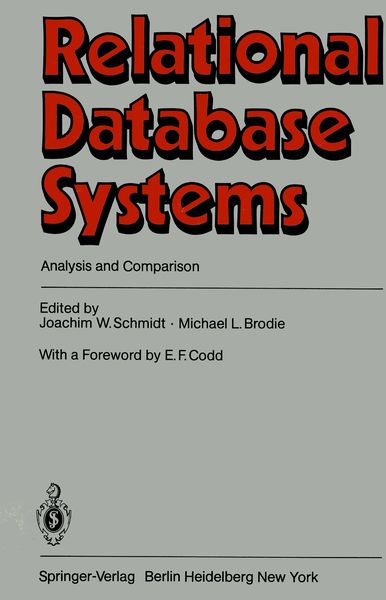
  • Produktbild: Relational Database Systems
  • Produktbild: Relational Database Systems

Relational Database Systems Analysis and Comparison

99,99 €

inkl. gesetzl. MwSt., Versandkostenfrei


Beschreibung

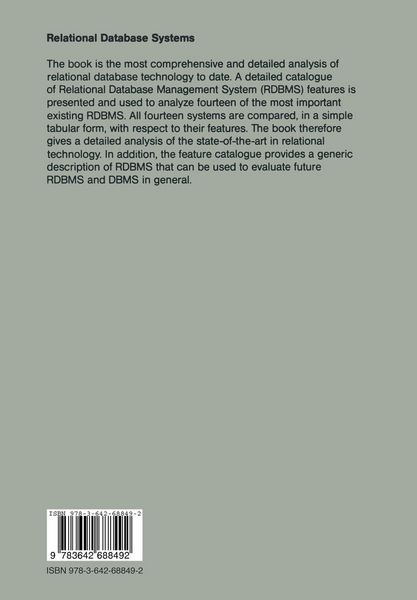
After a long period of research, development, test and trial, relational database management systems are at last being marketed in force. The feedback from early installations of these systems is overwhelmingly positive. The most frequent comment by users is that productivity has been increased by a...

Beschreibung

After a long period of research, development, test and trial, relational database management systems are at last being marketed in force. The feedback from early installations of these systems is overwhelmingly positive. The most frequent comment by users is that productivity has been increased by a significant factor (from 5 to 20 times what it was using previous approaches). Another comment is that, in many cases, end users can now handle their own problems by direct use of the system instead of using application programmers as mediators between them and the system. As the reputation of relational systems for ease of use and enhanced productivity has grown, there has been a strong temptation for vendors of other approaches to exploit the label "relational" somewhat indiscriminately. In some cases the label is being misapplied to a whole data system; in others it is being misapplied to an interface. It is therefore worth developing criteria which database management systems (DBMSs) should have in order to be called "relational". The Relational Task Group (RTG) of the American National Standards Institute (ANSI) undertook such an effort by developing a characterization of RDBMSs and analyzing fourteen DBMSs per this characterization. The result of this work is presented in this book. The conclusions of the RTG are in agreement with my view that a DBMS should not be called "relational" unless it satisfies at least the following conditions: 1. All information in the database is represented as values in tables.

Produktdetails

Einband

Taschenbuch

Erscheinungsdatum

10.12.2011

Abbildungen

XVI, 620 p.

Herausgeber Joachim W. Schmidt + weitere

Produktdetails

Einband

Taschenbuch

Erscheinungsdatum

10.12.2011

Abbildungen

XVI, 620 p.

Herausgeber
Verlag Springer Berlin
Seitenzahl

620

Maße (L/B/H)

24,4/17/3,5 cm

Gewicht

1087 g

Auflage

Softcover reprint of the original 1st ed. 1983

Sprache

Englisch

ISBN

978-3-642-68849-2

Herstelleradresse

Springer-Verlag KG
Sachsenplatz 4-6
1201 Wien
AT

Email: ProductSafety@springernature.com

Noch keine Bewertungen vorhanden

Verfassen Sie die erste Bewertung zu diesem Artikel

Helfen Sie anderen Kundinnen und Kunden durch Ihre Meinung.

Kundinnen und Kunden meinen

Bewertungen (0)

  • Produktbild: Relational Database Systems
  • Produktbild: Relational Database Systems
  • 1. Introduction.- 2. Features of Relational Database Systems.- 2.1 Development of the Feature Catalogue.- 2.2 The Feature Catalogue.- 3. Analysis of Relational Database Management Systems.- 3.1 ASTRAL (University of Trondheim).- 3.2 IDAMS (IBM Heidelberg).- 3.3 IDM (Britton-Lee).- 3.4 INGRES (University of California, Berkeley).- 3.5 MRDS (Honeywell).- 3.6 MRS (University of Toronto).- 3.7 NOMAD (National CSS, Inc.).- 3.8 ORACLE (Relational Software Incorporated).- 3.9 PASCAL/R (University of Hamburg).- 3.10 PRTV (IBM, United Kingdom).- 3.11 QBE (IBM, Thomas J. Watson).- 3.12 RAPID (Statistics Canada).- 3.13 RAPPORT (LOGICA, United Kingdom).- 3.14 SYSTEM R (IBM, San Jose).- 4. Feature Summaries and Comparisons.- 4.1 Database Constituents.- 4.2 Functional Capabilities.- 4.3 Schema Definitions.- 4.4 Additional Definition, Generation and Administration Facilities.- 4.5 Functional Classes.- 4.6 Interface Flavours.- 4.7 System Architecture.- 4.8 Operational Aspects.- 5. References.