KI-Beratung Beta

Gutscheinbedingungen

**Gültig am 20.11.2026 ab einem Mindestbestellwert von 30€ auf Spielzeug, Schreibwaren, Filme, Geschenke & Trends, Musik, tolino eReader & Zubehör, Hörbücher und Hörbuch-Downloads, nicht preisgebundene Bücher und Kalender online auf thaalia.live und in der Thalia App. Einzelne Artikel können ausgeschlossen sein. Aufgrund der Buchpreisbindung sind deutschsprachige Bücher und eBooks ausgenommen. Zusätzlich ausgenommen sind Abos & Flatrates, Games, Geschenkkarten/-boxen, Shelfies, Software, Zeitschriften sowie einzelne Artikel von tonies®. Pro Einkauf einmal einlösbar. Click & Collect nur bei Onlinevorabzahlung möglich. Keine Barauszahlung. Nicht kombinierbar mit anderen Aktionen und Gutscheinen. Gutschein wird auf max. 500€ Bestellwert angerechnet. Nicht gültig für Versandkosten und Services. Preisgebundene Artikel sind vom Mindestbestellwert ausgeschlossen.

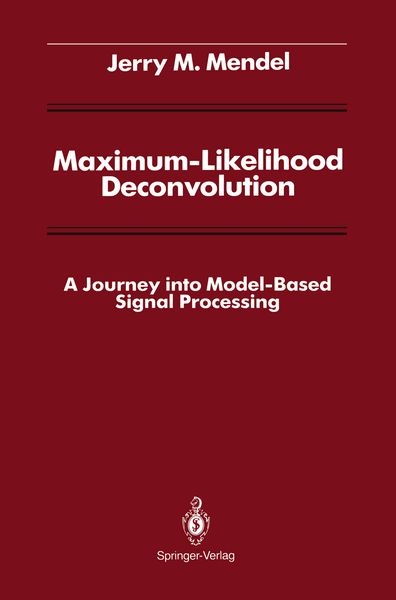
Produktbild: Maximum-Likelihood Deconvolution

Maximum-Likelihood Deconvolution A Journey into Model-Based Signal Processing

51,99 €

inkl. gesetzl. MwSt., Versandkostenfrei


Beschreibung

Convolution is the most important operation that describes the behavior of a linear time-invariant dynamical system. Deconvolution is the unraveling of convolution. It is the inverse problem of generating the system's input from knowledge about the system's output and dynamics. Deconvolution requires...

Beschreibung

Convolution is the most important operation that describes the behavior of a linear time-invariant dynamical system. Deconvolution is the unraveling of convolution. It is the inverse problem of generating the system's input from knowledge about the system's output and dynamics. Deconvolution requires a careful balancing of bandwidth and signal-to-noise ratio effects. Maximum-likelihood deconvolution (MLD) is a design procedure that handles both effects. It draws upon ideas from Maximum Likelihood, when unknown parameters are random. It leads to linear and nonlinear signal processors that provide high-resolution estimates of a system's input. All aspects of MLD are described, from first principles in this book. The purpose of this volume is to explain MLD as simply as possible. To do this, the entire theory of MLD is presented in terms of a convolutional signal generating model and some relatively simple ideas from optimization theory. Earlier approaches to MLD, which are couched in the language of state-variable models and estimation theory, are unnecessary to understand the essence of MLD. MLD is a model-based signal processing procedure, because it is based on a signal model, namely the convolutional model. The book focuses on three aspects of MLD: (1) specification of a probability model for the system's measured output; (2) determination of an appropriate likelihood function; and (3) maximization of that likelihood function. Many practical algorithms are obtained. Computational aspects of MLD are described in great detail. Extensive simulations are provided, including real data applications.

Produktdetails

Einband

Taschenbuch

Erscheinungsdatum

17.09.2011

Abbildungen

XIV, 227 p.

Herausgeber C.S. Burrus

Produktdetails

Einband

Taschenbuch

Erscheinungsdatum

17.09.2011

Abbildungen

XIV, 227 p.

Herausgeber C.S. Burrus
Verlag Springer Us
Seitenzahl

227

Maße (L/B/H)

23,5/15,5/1,4 cm

Gewicht

376 g

Auflage

Softcover reprint of the original 1st ed. 1990

Sprache

Englisch

ISBN

978-1-4612-7985-3

Herstelleradresse

Springer-Verlag KG
Sachsenplatz 4-6
1201 Wien
AT

Email: ProductSafety@springernature.com

Noch keine Bewertungen vorhanden

Verfassen Sie die erste Bewertung zu diesem Artikel

Helfen Sie anderen Kundinnen und Kunden durch Ihre Meinung.

Kundinnen und Kunden meinen

Bewertungen (0)

  • Produktbild: Maximum-Likelihood Deconvolution
  • 1 - Introduction.- 1.1 Introduction.- 1.2 Our Approach.- 1.3 Likelihood Versus Probability.- 1.4 Maximum-Likelihood Method.- 1.5 Comments.- 2 - Convolutional Model.- 2.1 Introduction.- 2.2 The Seismic Convolutional Model.- 2.3 Input.- 2.4 Channel Model IR (Seismic Wavelet).- 2.5 Measurement Noise.- 2.6 Other Effects.- 2.7 Mathematical Model.- 2.8 Summary.- 3 - Likelihood.- 3.1 Introduction.- 3.2 Loglikelihood.- 3.3 Likelihood Function.- 3.4 Using Given Information.- 3.5 Message for the Reader.- 3.6 Mathematical Likelihood Functions.- 3.7 Mathematical Loglikelihood Functions.- 3.8 Summary.- 4 - Maximizing Likelihood.- 4.1 Introduction.- 4.2 A Rationale.- 4.3 Block Component Search Algorithms.- 4.4 Mathematical Fact.- 4.5 Separation Principle.- 4.6 Update Random Parameters.- 4.7 Binary Detection.- 4.8 Update Wavelet Parameters.- 4.9 Update Statistical Parameters.- 4.10 Message for the Reader.- 4.11 Summary.- 5 - Properties and Performance.- 5.1 Introduction.- 5.2 Minimum-Variance Deconvolution.- 5.3 Detectors.- 5.4 A Modified Likelihood Function.- 5.5 An Objective Function.- 5.6 Marquardt-Levenberg Algorithm.- 5.7 Convergence.- 5.8 Entropy Interpretation.- 5.9 Summary.- 6 - Examples.- 6.1 Introduction.- 6.2 Some Real Data Examples.- 6.3 Minimum-Variance Deconvolution.- 6.4 Detection.- 6.5 Block Component Method.- 6.6 Backscatter.- 6.7 Noncausal Channel Models.- 6.8 Summary.- 7 - Mathematical Details for Chapter 4.- 7.1 Introduction.- 7.2 Mathematical Fact.- 7.3 Separation Principle.- 7.4 Minimum-Variance Deconvolution.- 7.5 Threshold Detector.- 7.6 Single Most-Likely Replacement Detector.- 7.7 Single Spike Shift Detector.- 7.8 SSS-SMLR Detector.- 7.9 Marquardt-Levenberg Algorithm.- 7.10 Calculating Gradients.- 7.11 Calculating Second Derivatives.- 7.12 Why vr Cannot be Estimated: Maximization of L or M is an Ill-Posed Problem.- 7.13 An Algorithm for ?.- 8 - Mathematical Details for Chapter 5.- 8.1 Introduction.- 8.2 MVD Filter Properties.- 8.3 Threshold Detector.- 8.4 Modified Likelihood Function.- 8.5 Separation Principle for P and Derivation of N from P.- 8.6 Why vr Cannot be Estimated: Maximization of P or N is not an Ill-Posed Problem.- 8.7 SMLR1 Detector Based on N.- 8.8 Quadratic Convergence of the Newton-Raphson Algorithm.- 8.9 Wavelet Identifiability.- 8.10 Convergence of Adaptive SMLR Detector.- 9 - Computational Considerations.- 9.1 Introduction.- 9.2 Recursive Processing.- 9.3 Summary.- References.