
KI-Beratung Beta

Gutscheinbedingungen

**Gültig am 20.11.2026 ab einem Mindestbestellwert von 30€ auf Spielzeug, Schreibwaren, Filme, Geschenke & Trends, Musik, tolino eReader & Zubehör, Hörbücher und Hörbuch-Downloads, nicht preisgebundene Bücher und Kalender online auf thaalia.live und in der Thalia App. Einzelne Artikel können ausgeschlossen sein. Aufgrund der Buchpreisbindung sind deutschsprachige Bücher und eBooks ausgenommen. Zusätzlich ausgenommen sind Abos & Flatrates, Games, Geschenkkarten/-boxen, Shelfies, Software, Zeitschriften sowie einzelne Artikel von tonies®. Pro Einkauf einmal einlösbar. Click & Collect nur bei Onlinevorabzahlung möglich. Keine Barauszahlung. Nicht kombinierbar mit anderen Aktionen und Gutscheinen. Gutschein wird auf max. 500€ Bestellwert angerechnet. Nicht gültig für Versandkosten und Services. Preisgebundene Artikel sind vom Mindestbestellwert ausgeschlossen.

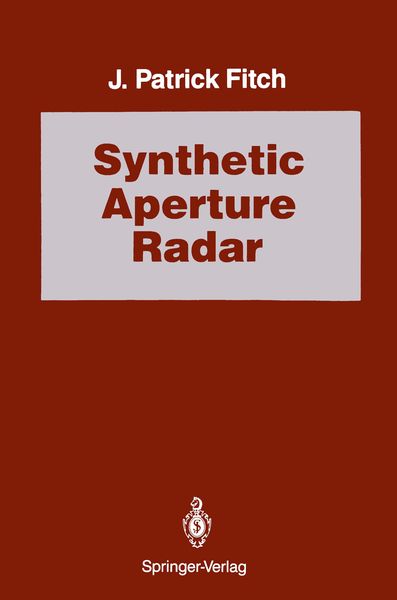
  • Produktbild: Synthetic Aperture Radar
  • Produktbild: Synthetic Aperture Radar

Synthetic Aperture Radar

51,99 €

inkl. gesetzl. MwSt., Versandkostenfrei


Beschreibung

Radar, like most well developed areas, has its own vocabulary. Words like Doppler frequency, pulse compression, mismatched filter, carrier frequency, in-phase, and quadrature have specific meaning to the radar engineer. In fact, the word radar is actually an acronym for RAdio Detection And Rang ing....

Beschreibung

Radar, like most well developed areas, has its own vocabulary. Words like Doppler frequency, pulse compression, mismatched filter, carrier frequency, in-phase, and quadrature have specific meaning to the radar engineer. In fact, the word radar is actually an acronym for RAdio Detection And Rang ing. Even though these words are well defined, they can act as road blocks which keep people without a radar background from utilizing the large amount of data, literature, and expertise within the radar community. This is unfortunate because the use of digital radar processing techniques has made possible the analysis of radar signals on many general purpose digi tal computers. Of special interest are the surface mapping radars, such as the Seasat and the shuttle imaging radars, which utilize a technique known as synthetic aperture radar (SAR) to create high resolution images (pic tures). This data appeals to cartographers, agronomists, oceanographers, and others who want to perform image enhancement, parameter estima tion, pattern recognition, and other information extraction techniques on the radar imagery. The first chapter presents the basics of radar processing: techniques for calculating range (distance) by measuring round trip propagation times for radar pulses. This is the same technique that sightseers use when calculat ing the width of a canyon by timing the round trip delay using echoes. In fact, the corresponding approach in radar is usually called the pulse echo technique.

Produktdetails

Einband

Taschenbuch

Erscheinungsdatum

08.10.2011

Abbildungen

VIII, 170 p.

Herausgeber C.S. Burrus

Produktdetails

Einband

Taschenbuch

Erscheinungsdatum

08.10.2011

Abbildungen

VIII, 170 p.

Herausgeber C.S. Burrus
Verlag Springer Us
Seitenzahl

170

Maße (L/B/H)

23,5/15,5/1,1 cm

Gewicht

289 g

Sprache

Englisch

ISBN

978-1-4612-8366-9

Herstelleradresse

Springer-Verlag KG
Sachsenplatz 4-6
1201 Wien
AT

Email: ProductSafety@springernature.com

Noch keine Bewertungen vorhanden

Verfassen Sie die erste Bewertung zu diesem Artikel

Helfen Sie anderen Kundinnen und Kunden durch Ihre Meinung.

Kundinnen und Kunden meinen

Bewertungen (0)

  • Produktbild: Synthetic Aperture Radar
  • Produktbild: Synthetic Aperture Radar
  • 1 Radar Processing.- 1.1 Radar: A Well Defined Problem.- 1.2 Transmitting and Receiving.- 1.3 Digital Processing of Radar Returns.- 1.4 Seasat Radar Processing.- 1.5 Summary of Radar Processing.- 1.6 References.- 1.7 Problems.- 2 Radar Imaging.- 2.1 Restrictions on Antenna Size.- 2.2 Antenna Arrays.- 2.3 Synthetic. Antenna Arrays.- 2.4 Airborne Synthetic Arrays.- 2.5 Matched Filter Interpretation.- 2.6 Model of the Antenna — Target Motion.- 2.7 Doppler Frequency Shift.- 2.8 Digital Implementation Considerations.- 2.9 Seasat Image Reconstruction.- 2.10 Summary of Radar Imaging.- 2.11 References.- 2.12 Problems.- 3 Optical Processing Of SAR Data.- 3.1 Optical Signal Processing.- 3.2 SAR Processor.- 3.3 Response to a Point Target.- 3.4 Holographic Interpretation.- 3.5 Advances in Optical Processing.- 3.6 Summary of Optical Processing Techniques.- 3.7 References.- 3.8 Problems.- 4 Related Algorithms: An Overview.- 4.1 Ultrasonic Inspection—SAFT-UT.- 4.2 Tomography.- 4.3 Spotlight Mode SAR.- 4.4 Inverse SAR.- 4.5 Summary of Related Algorithms.- 4.6 References.- 4.7 Problems.- A Signal Processing Tools.- A.1 Sampling Continuous Time Signals.- A.2 Specifying A Model: Linear Systems.- A.3 The Convolution Representation.- A.4 Fast Convolution with FFTs.- A.5 Summary of Signal Processing Tools.- A.6 References.- A.7 Problems.- B Matched Filter Derivation.- B.1 Problem Definition.- B.2 Optimization: Maximizing the SNR.- B.3 Example Assuming White Noise.- B.4 Summary of Matched Filter Statistics.- B.5 References.- B.6 Problems.- C Matched Filter Implementation.- C.1 Eliminating The Bit Reversal Operation.- C.2 FFT of a Real Valued Sequence.- C.3 Summary of Implementation Considerations.- C.4 References.- C.5 Problems.- D Solutions to Exercises.