KI-Beratung Beta

Gutscheinbedingungen

**Gültig am 20.11.2026 ab einem Mindestbestellwert von 30€ auf Spielzeug, Schreibwaren, Filme, Geschenke & Trends, Musik, tolino eReader & Zubehör, Hörbücher und Hörbuch-Downloads, nicht preisgebundene Bücher und Kalender online auf thaalia.live und in der Thalia App. Einzelne Artikel können ausgeschlossen sein. Aufgrund der Buchpreisbindung sind deutschsprachige Bücher und eBooks ausgenommen. Zusätzlich ausgenommen sind Abos & Flatrates, Games, Geschenkkarten/-boxen, Shelfies, Software, Zeitschriften sowie einzelne Artikel von tonies®. Pro Einkauf einmal einlösbar. Click & Collect nur bei Onlinevorabzahlung möglich. Keine Barauszahlung. Nicht kombinierbar mit anderen Aktionen und Gutscheinen. Gutschein wird auf max. 500€ Bestellwert angerechnet. Nicht gültig für Versandkosten und Services. Preisgebundene Artikel sind vom Mindestbestellwert ausgeschlossen.

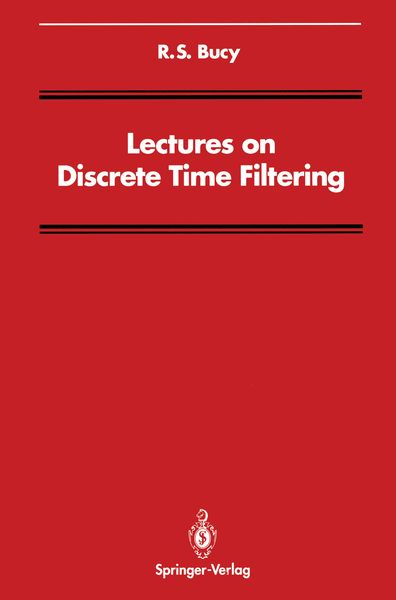
  • Produktbild: Lectures on Discrete Time Filtering
  • Produktbild: Lectures on Discrete Time Filtering

Lectures on Discrete Time Filtering

49,99 €

inkl. gesetzl. MwSt., Versandkostenfrei


Beschreibung

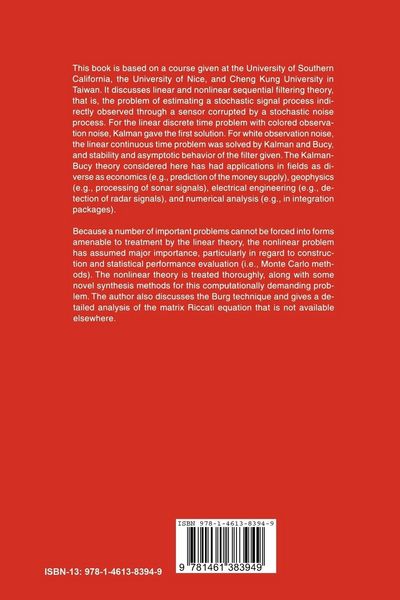
The theory of linear discrete time filtering started with a paper by Kol mogorov in 1941. He addressed the problem for stationary random se quences and introduced the idea of the innovations process, which is a useful tool for the more general problems considered here. The reader may object and note...

Beschreibung

The theory of linear discrete time filtering started with a paper by Kol mogorov in 1941. He addressed the problem for stationary random se quences and introduced the idea of the innovations process, which is a useful tool for the more general problems considered here. The reader may object and note that Gauss discovered least squares much earlier; however, I want to distinguish between the problem of parameter estimation, the Gauss problem, and that of Kolmogorov estimation of a process. This sep aration is of more than academic interest as the least squares problem leads to the normal equations, which are numerically ill conditioned, while the process estimation problem in the linear case with appropriate assumptions leads to uniformly asymptotically stable equations for the estimator and the gain. The conditions relate to controlability and observability and will be detailed in this volume. In the present volume, we present a series of lectures on linear and nonlinear sequential filtering theory. The theory is due to Kalman for the linear colored observation noise problem; in the case of white observation noise it is the analog of the continuous-time Kalman-Bucy theory. The discrete time filtering theory requires only modest mathematical tools in counterpoint to the continuous time theory and is aimed at a senior-level undergraduate course. The present book, organized by lectures, is actually based on a course that meets once a week for three hours, with each meeting constituting a lecture.

Produktdetails

Einband

Taschenbuch

Erscheinungsdatum

08.11.2011

Abbildungen

XV, 156 p.

Herausgeber C.S. Burrus

Produktdetails

Einband

Taschenbuch

Erscheinungsdatum

08.11.2011

Abbildungen

XV, 156 p.

Herausgeber C.S. Burrus
Verlag Springer Us
Seitenzahl

156

Maße (L/B/H)

23,5/15,5/1 cm

Gewicht

277 g

Auflage

Softcover reprint of the original 1st ed. 1994

Sprache

Englisch

ISBN

978-1-4613-8394-9

Herstelleradresse

Springer-Verlag KG
Sachsenplatz 4-6
1201 Wien
AT

Email: ProductSafety@springernature.com

Noch keine Bewertungen vorhanden

Verfassen Sie die erste Bewertung zu diesem Artikel

Helfen Sie anderen Kundinnen und Kunden durch Ihre Meinung.

Kundinnen und Kunden meinen

Bewertungen (0)

  • Produktbild: Lectures on Discrete Time Filtering
  • Produktbild: Lectures on Discrete Time Filtering
  • 1 Review.- 1 Review of Concepts in Probability.- 2 Random Noise Generation.- 1 Random Noise Generation.- 2 Cholesky Decomposition.- 3 Uses of the Pseudo Inverse.- 4 Signal Models.- 5 Sensor Model.- 3 Historical Background.- 1 Background Material.- 2 Historical Developments for Filtering.- 3 Development of Innovations.- 4 Sequential Filter Development.- 4 Sequential Filtering Theory.- 1 Summary of the Sequential Filter.- 2 The Scalar Autonomous Riccati Equation.- 3 Linearizing the Riccati Equation.- 5 Burg Technique.- 1 Background Material.- 6 Signal Processing.- 1 The Burg Technique.- 2 Signal Processing.- 3 Burg Revisited (Rouché’s Theorem).- 7 Classical Approach.- 1 Classical Steady-State Filtering.- 8 A Priori Bounds.- 1 A Priori Bounds for the Riccati Equation.- 2 Information and Filtering.- 3 Nonlinear Systems.- 9 Asymptotic Theory.- 1 Applications of the Theory of Filtering.- 2 Asymptotic Theory of the Riccati Equation.- 3 Steady-State Solution to Riccati.- 10 Advanced Topics.- 1 Invariant Directions.- 2 Nonlinear Filtering.- 11 Applications.- 1 Historical Applications.- 12 Phase Tracking.- 1 The Phase Lock Loop.- 2 Phase Demodulation.- 13 Device Synthesis.- 1 Device Synthesis for Nonlinear Filtering.- 2 Radar Filtering Application.- 14 Random Fields.