KI-Beratung Beta

Gutscheinbedingungen

**Gültig bis 11.11.2026 auf Spielzeug, Schreibwaren, Filme, Geschenke & Trends, Musik, tolino eReader & Zubehör, Hörbücher und Hörbuch-Downloads, nicht preisgebundene Bücher und Kalender online auf thaalia.live und in der Thalia App. Einzelne Artikel können ausgeschlossen sein. Aufgrund der Buchpreisbindung sind deutschsprachige Bücher und eBooks ausgenommen. Zusätzlich ausgenommen sind Abos & Flatrates, Games, Geschenkkarten/-boxen, Shelfies, Software, Zeitschriften sowie einzelne Artikel von tonies®. Pro Einkauf einmal einlösbar. Click & Collect nur bei Onlinevorabzahlung möglich. Keine Barauszahlung. Nicht kombinierbar mit anderen Aktionen und Gutscheinen. Gutschein wird auf max. 500€ Bestellwert angerechnet. Nicht gültig für Versandkosten und Services.

  • Produktbild: Structural Complexity II
  • Produktbild: Structural Complexity II
Band 22 - 11%

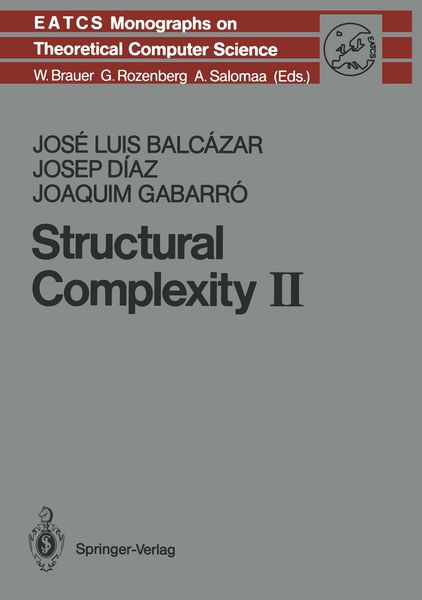
Structural Complexity II

11% sparen

106,99 € UVP 120,99 €

inkl. gesetzl. MwSt., Versandkostenfrei


Beschreibung

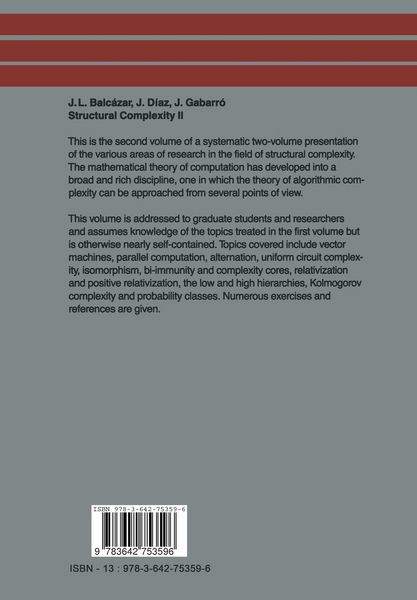
This is the second volume of a two volume collection on Structural Complexity. This volume assumes as a prerequisite knowledge about the topics treated in Volume I, but the present volume itself is nearly self-contained. As in Volume I, each chapter of this book ends with a section entitled "Bibliographical...

Beschreibung

This is the second volume of a two volume collection on Structural Complexity. This volume assumes as a prerequisite knowledge about the topics treated in Volume I, but the present volume itself is nearly self-contained. As in Volume I, each chapter of this book ends with a section entitled "Bibliographical Remarks", in which the relevant references for the chapter are briefly commented upon. These sections might also be of interest to those wanting an overview of the evolution of the field, as well as relevant related results which are not included in the text. Each chapter includes a section of exercises. The reader is encouraged to spend some time on them. Some results presented as exercises are occasionally used later in the text. A reference is provided for the most interesting and for the most useful exercises. Some exercises are marked with a • to indicate that, to the best knowledge of the authors, the solution has a certain degree of difficulty. Many topics from the field of Structural Complexity are not treated in depth, or not treated at all. The authors bear all responsibility for the choice of topics, which has been made based on the interest of the authors on each topic. Many friends and colleagues have made suggestions or corrections. In partic ular we would like to express our gratitude to Richard Beigel, Ron Book, Rafael Casas, Jozef Gruska, Uwe Schoning, Pekka Orponen, and Osamu Watanabe.

Produktdetails

Einband

Taschenbuch

Erscheinungsdatum

13.12.2011

Abbildungen

IX, 283 p.

Verlag Springer Berlin

Produktdetails

Einband

Taschenbuch

Erscheinungsdatum

13.12.2011

Abbildungen

IX, 283 p.

Verlag Springer Berlin
Seitenzahl

283

Maße (L/B/H)

24,2/17/1,7 cm

Gewicht

524 g

Auflage

Softcover reprint of the original 1st ed. 1990

Sprache

Englisch

ISBN

978-3-642-75359-6

Herstelleradresse

Springer-Verlag KG
Sachsenplatz 4-6
1201 Wien
AT

Email: ProductSafety@springernature.com

Noch keine Bewertungen vorhanden

Verfassen Sie die erste Bewertung zu diesem Artikel

Helfen Sie anderen Kundinnen und Kunden durch Ihre Meinung.

Kundinnen und Kunden meinen

Bewertungen (0)

  • Produktbild: Structural Complexity II
  • Produktbild: Structural Complexity II
  • 1 Vector Machines.- 1.1 Introduction.- 1.2 Vector Machines: Definition and Basic Properties.- 1.3 Elementary Matrix Algebra on Vector Machines.- 1.4 Relation Between Vector Machines and Turing Machines.- 1.5 Exercises.- 1.6 Bibliographical Remarks.- 2 The Parallel Computation Thesis.- 2.1 Introduction.- 2.2 An Array Machine: the APM.- 2.3 A Multiprocessor Machine: the SIMDAG.- 2.4 A Tree Machine: the k-PRAM.- 2.5 Further Parallel Models.- 2.6 Exercises.- 2.7 Bibliographical Remarks.- 3 Alternation.- 3.1 Introduction.- 3.2 Alternating Turing Machines.- 3.3 Complexity Classes for Alternation.- 3.4 Computation Graphs of a Deterministic Turing Machine.- 3.5 Determinism Versus Nondeterminism for Linear Time.- 3.6 Exercises.- 3.7 Bibliographical Remarks.- 4 Uniform Circuit Complexity.- 4.1 Introduction.- 4.2 Uniform Circuits: Basic Definitions.- 4.3 Relationship with General-Purpose Parallel Computers.- 4.4 Other Uniformity Conditions.- 4.5 Alternating Machines and Uniformity.- 4.6 Robustness of NC and Conclusions.- 4.7 Exercises.- 4.8 Bibliographical Remarks.- 5 Isomorphism and NP-completeness.- 5.1 Introduction.- 5.2 Polynomial Time Isomorphisms.- 5.3 Polynomial Cylinders.- 5.4 Sparse Complete Sets.- 5.5 Exercises.- 5.6 Bibliographical Remarks.- 6 Bi-Immunity and Complexity Cores.- 6.1 Introduction.- 6.2 Bi-Immunity, Complexity Cores, and Splitting.- 6.3 Bi-Immune Sets and Polynomial Time m-Reductions.- 6.4 Complexity Cores and Polynomial Time m-Reductions.- 6.5 Levelability, Proper Cores, and Other Properties.- 6.6 Exercises.- 6.7 Bibliographical Remarks.- 7 Relativization.- 7.1 Introduction.- 7.2 Basic Results.- 7.3 Encoding Sets in NP Relativized.- 7.4 Relativizing Probabilistic Complexity Classes.- 7.5 Isolating the Crucial Parameters.- 7.6 Refining Nondeterminism.- 7.7Strong Separations.- 7.8 Further Results in Relativizations.- 7.9 Exercises.- 7.10 Bibliographical Remarks.- 8 Positive Relativizations.- 8.1 Introduction.- 8.2 A Positive Relativization of the $$P\mathop = \limits^? PSPACE$$ Problem.- 8.3 A Positive Relativization of the $$NP\mathop = \limits^? PSPACE$$ Problem.- 8.4 A Positive Relativization of the $$P\mathop = \limits^? NP$$ Problem.- 8.5 A Relativizing Principle.- 8.6 Exercises.- 8.7 Bibliographical Remarks.- 9 The Low and the High Hierarchies.- 9.1 Introduction.- 9.2 Definitions and Characterizations.- 9.3 Relationship with the Polynomial Time Hierarchy.- 9.4 Some Classes of Low Sets.- 9.5 Oracle-Restricted Positive Relativizations.- 9.6 Lowness Outside NP.- 9.7 Exercises.- 9.8 Bibliographical Remarks.- 10 Resource-Bounded Kolmogorov Complexity.- 10.1 Introduction.- 10.2 Unbounded Kolmogorov Complexity.- 10.3 Resource-Bounded Kolmogorov Complexity.- 10.4 Tally Sets, Printability, and Ranking.- 10.5 Kolmogorov Complexity of Characteristic Functions.- 10.6 Exercises.- 10.7 Bibliographical Remarks.- 11 Probability Classes and Proof-Systems.- 11.1 Introduction.- 11.2 Interactive Proof-Systems: Basic Definitions and Examples.- 11.3 Arthur Against Merlin Games.- 11.4 Probabilistic Complexity Classes and Proof-Systems.- 11.5 Equivalence of AM and IP.- 11.6 Exercises.- 11.7 Bibliographical Remarks.- Appendix: Complementation via Inductive Counting.- 1 Nondeterministic Space is Closed Under Complement.- 2 Bibliographical Remarks.- References.- Author Index.- Symbol Index.