KI-Beratung Beta

Gutscheinbedingungen

**Gültig bis 11.11.2026 auf Spielzeug, Schreibwaren, Filme, Geschenke & Trends, Musik, tolino eReader & Zubehör, Hörbücher und Hörbuch-Downloads, nicht preisgebundene Bücher und Kalender online auf thaalia.live und in der Thalia App. Einzelne Artikel können ausgeschlossen sein. Aufgrund der Buchpreisbindung sind deutschsprachige Bücher und eBooks ausgenommen. Zusätzlich ausgenommen sind Abos & Flatrates, Games, Geschenkkarten/-boxen, Shelfies, Software, Zeitschriften sowie einzelne Artikel von tonies®. Pro Einkauf einmal einlösbar. Click & Collect nur bei Onlinevorabzahlung möglich. Keine Barauszahlung. Nicht kombinierbar mit anderen Aktionen und Gutscheinen. Gutschein wird auf max. 500€ Bestellwert angerechnet. Nicht gültig für Versandkosten und Services.

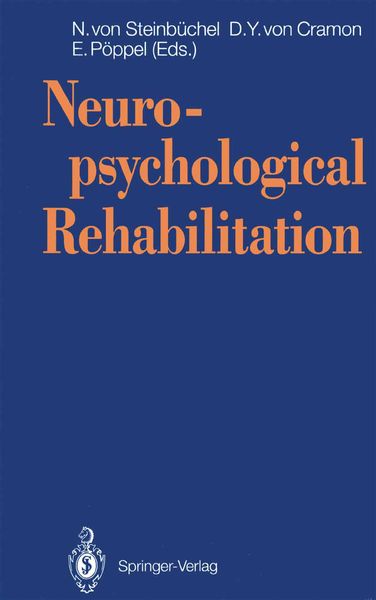
  • Produktbild: Neuropsychological Rehabilitation
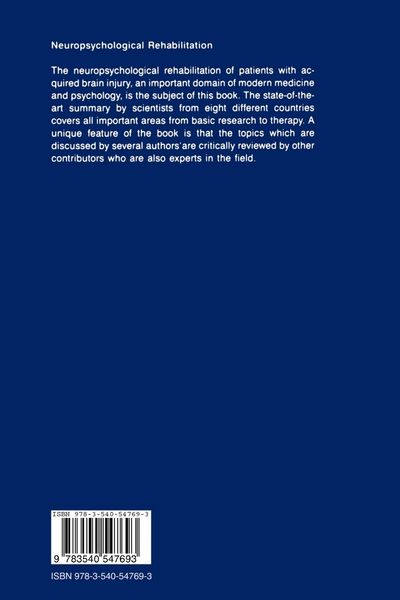
  • Produktbild: Neuropsychological Rehabilitation

Neuropsychological Rehabilitation

99,99 €

inkl. gesetzl. MwSt., Versandkostenfrei


Beschreibung

The neuropsychological rehabilitation of patients with brain in juries presents a new challenge for medicine and psychology. In any society patients who have suffered a stroke or a traumatic brain lesion constitute a large group requiring special therapy; even nowadays only a small group of these patients...

Beschreibung

The neuropsychological rehabilitation of patients with brain in juries presents a new challenge for medicine and psychology. In any society patients who have suffered a stroke or a traumatic brain lesion constitute a large group requiring special therapy; even nowadays only a small group of these patients obtain adequate rehabilitational support. Brain injuries may lead to loss or impair ment of functions like language, sight, memory, attention, emo tional control, or movement, and such impairments are usually ac companied by handicaps in the patient's daily life. Every attempt should be made to improve functional competence and the pa tient's capacity to cope with their disability and handicap. In recent years, the aim of much research in the basic sciences has been to gain insight into the mechanisms of restitution of function, partly by trying to understand the pathophysiological mechanisms that are initiated by a traumatic event. However, in spite of this broad research initiative into recovery of function and the possibilities of cognitive remediation, our knowledge is still rather limited, with respect to both the neurobiological mecha nisms that may underlie functional plasticity and the factors that may account for neuropsychological rehabilitation. In spite of these shortcomings, we would like to stress that progress can only be expected if an intense research effort is made to unite the con cepts and results from the basic sciences with the practical demands of neuropsychological rehabilitation.

Portrait

How can persons who have suffered accidental brain injury best be rehabilitated? The present status of neuropsychological rehabilitation is summarized in this book by specialists from eight countries.

Produktdetails

Einband

Taschenbuch

Erscheinungsdatum

06.08.1992

Abbildungen

XVI, 264 p. 7 illus.

Herausgeber Nicole v. Steinbüchel + weitere

Produktdetails

Einband

Taschenbuch

Erscheinungsdatum

06.08.1992

Abbildungen

XVI, 264 p. 7 illus.

Herausgeber
Verlag Springer Berlin
Seitenzahl

264

Maße (L/B/H)

23,5/15,5/1,6 cm

Gewicht

435 g

Auflage

1st edition 1992. 2nd printing

Sprache

Englisch

ISBN

978-3-540-54769-3

Herstelleradresse

Springer-Verlag GmbH
Tiergartenstr. 17
69121 Heidelberg
DE

Email: ProductSafety@springernature.com

Noch keine Bewertungen vorhanden

Verfassen Sie die erste Bewertung zu diesem Artikel

Helfen Sie anderen Kundinnen und Kunden durch Ihre Meinung.

Kundinnen und Kunden meinen

Bewertungen (0)

  • Produktbild: Neuropsychological Rehabilitation
  • Produktbild: Neuropsychological Rehabilitation
  • Basic Hypotheses.- Neuropsychological Rehabilitation from a Theoretical Point of View.- Cortical Representational Plasticity: Some Implications for the Bases of Recovery from Brain Damage.- Biological and Psychosocial Considerations in Recovery from Brain Damage.- Discussion: Environmental and Experiential Factors Play a Key Role in Determining the Outcome of Injury to the Central Nervous System.- Controversial Concepts of Rehabilitation.- A Neurobehavioural Approach to Brain Injury Rehabilitation.- Neuropsychological Rehabilitation and the Problem of Altered Self-Awareness.- Setting up a Neurorehabilitation Unit.- Discussion: Controversial Concepts of Rehabilitation.- Methodology.- Research Design in Neuropsychological Rehabilitation.- Evaluation of Neuropsychological Therapies: The Importance of Measurement.- Discussion: Evaluation in Constructing Neuropsychological Treatments.- Diagnostics.- Psychometric Evaluation of Neuropsychological Test Performances.- Assessment of Mild, Moderate, and Severe Head Injury.- The Amsterdam-Nijmegen Everyday Language Test (ANELT).- Discussion: Brain Damage and Rehabilitation: A Neuropsychological Approach.- Various Approaches for Treatment.- Early Treatment of Stroke in Man.- Minimising Brain Damage from Head Injury by Appropriate Early Management.- Cognitive Neuropsychology and Rehabilitation.- The Personal Level in Cognitive Rehabilitation.- A Family-System Approach to Brain Damage.- Discussion: Various Approaches for Treatment.- Specific Treatment of Specific Deficits.- Impairments of Attention in Brain-Damaged Patients.- Assessment and Management of Memory Problems.- The Influence of Cognitive Remediation Programme on Associated Behavioural Disturbances in Patients with Frontal Lobe Dysfunction.- Post-stroke Depression: Psychological and Biochemical Interactions.- Spontaneous Remission versus Rehabilitation of Aphasia.- Speech Disturbances of Organic and Functional Genesis and Their Therapy.- Therapy of Aphasia — Various Approaches in Comparison.- Discussion: Treatment of Specific Deficits.