KI-Beratung Beta

Gutscheinbedingungen

**Gültig bis 09.11.2026 auf tolino shine color (4016621130473), tolino vision color (4016621130183) und tolino vision color weiß (4016621131456) online auf thaalia.live, in der Thalia App und in allen Thalia Buchhandlungen in Österreich. In den Buchhandlungen nur gültig auf lagernde Ware. Pro Einkauf einmal einlösbar. Nur gültig gegen Vorlage oder im Onlineshop hinterlegter Bonuscard. Infos zur Einlösung in der Buchhandlung sind auf der Bonuscard-Vorteilspreisseite zu finden. Click & Collect nur bei Onlinevorabzahlung möglich. Keine Einlösung bei Scan & Go-Bezahlung. Keine Barauszahlung. Nicht kombinierbar mit anderen Aktionen und Gutscheinen. Nicht gültig für Geschenkkarten, Versandkosten und Services. Nur solange der Vorrat reicht.

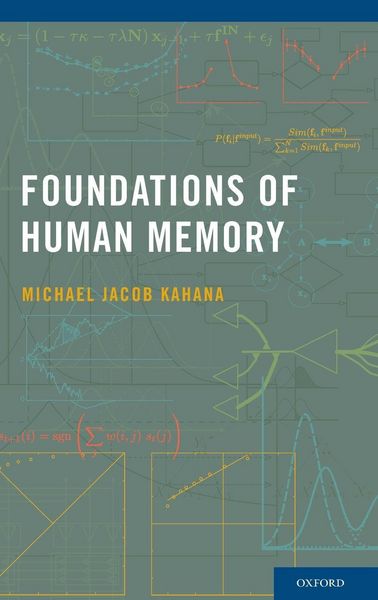
  • Produktbild: Foundations of Human Memory
  • Produktbild: Foundations of Human Memory

Foundations of Human Memory

Aus der Reihe Academic

164,99 €

inkl. gesetzl. MwSt., Versandkostenfrei


Beschreibung

Produktdetails

Einband

Gebundene Ausgabe

Erscheinungsdatum

14.12.2016

Abbildungen

107 line art

Verlag

Oxford University Press

Seitenzahl

364

Maße (L/B/H)

24/16,1/2,4 cm

Gewicht

710 g

Sprache

Englisch

ISBN

978-0-19-533324-4

Beschreibung

Produktdetails

Einband

Gebundene Ausgabe

Erscheinungsdatum

14.12.2016

Abbildungen

107 line art

Verlag

Oxford University Press

Seitenzahl

364

Maße (L/B/H)

24/16,1/2,4 cm

Gewicht

710 g

Sprache

Englisch

ISBN

978-0-19-533324-4

Herstelleradresse

Libri GmbH
Europaallee 1
36244 Bad Hersfeld
DE

Email: gpsr@libri.de

Noch keine Bewertungen vorhanden

Verfassen Sie die erste Bewertung zu diesem Artikel

Helfen Sie anderen Kundinnen und Kunden durch Ihre Meinung.

Kundinnen und Kunden meinen

Bewertungen (0)

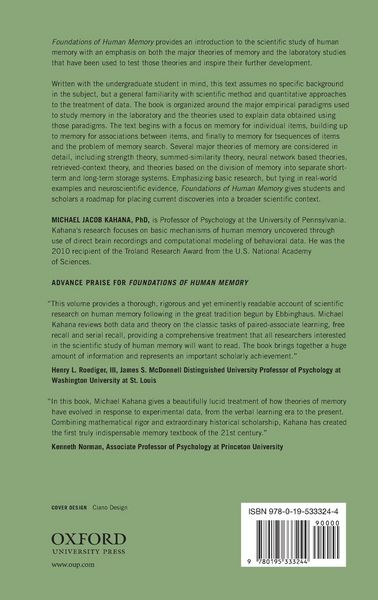
  • Produktbild: Foundations of Human Memory
  • Produktbild: Foundations of Human Memory
    • 1 Introduction

    • 1.1 Historical Background

    • 1.2 Association, Context, and Episodic Memory

    • 1.3 Methods Used in Studying Memory

    • 1.4 The Laws of Repetition and Recency

    • 1.5 Cognitivism

    • 1.6 Organization of the Book

    • 2 Item Recognition

    • 2.1 Strength Theory

    • 2.2 Multiple Sources of Strength?

    • 2.3 Major Findings Concerning Item Recognition

    • 2.4 Sternberg's Procedure

    • 2.5 Summary and Current Directions

    • 2.6 Study Questions

    • 3 Attribute Models

    • 3.1 Attributes

    • 3.2 A Multi-trace Distributed Memory Model

    • 3.3 Similarity Effects

    • 3.4 The Diffusion Model of Reaction Time

    • 3.5 Context Revisited

    • 3.6 Summary and Current Directions

    • 3.7 List-strength Effect

    • 3.8 A Unitrace Attribute Model

    • 3.9 Study Questions

    • 4 Associations and Cued Recall

    • 4.1 Major Associative Tasks

    • 4.2 Encoding and Repetition

    • 4.3 Recency and List Length

    • 4.4 Retrieval Errors

    • 4.5 Retroactive Interference and Recovery

    • 4.6 Proactive Interference

    • 4.7 Context and Interference Theory

    • 4.8 Similarity and Interference

    • 4.9 Unlearning as Inhibition

    • 4.10 Interference Theory: Concluding Remarks

    • 4.11 Item and Associative Information

    • 4.12 Summary and Current Directions

    • 4.13 Study Questions

    • 5 Models of Association

    • 5.1 The Attribute-Similarity Framework

    • 5.2 Neural Network Models

    • 5.3 Summary and Current Directions

    • 5.4 More on Linear Associators

    • 5.5 Project: Cued Recall in a Hopfield Net

    • 5.6 Study Questions

    • 6 Free Recall and Memory Search

    • 6.1 Serial-position Effects

    • 6.2 Retrieval Dynamics

    • 6.3 Semantic Clustering

    • 6.4 Intrusions

    • 6.5 Repetition Effects

    • 6.6 Summary and Current Directions

    • 6.7 Study Questions

    • 7 Models of Free Recall

    • 7.1 Dual-store Memory Search Models

    • 7.2 Testing Dual-Store Models

    • 7.3 Problems for Dual-store Models

    • 7.4 Single-store retrieved-context models

    • 7.5 Testing Retrieved Context Theory

    • 7.6 Summary and Current Directions

    • 7.7 Study Questions

    • 8 Sequence Memory

    • 8.1 Serial Recall and Memory Span

    • 8.2 Serial-Position Effects

    • 8.3 Modality and Suffix Effects: Evidence for a phonological STS?

    • 8.4 Recall Errors

    • 8.5 Associative Asymmetry

    • 8.6 Grouping Effects

    • 8.7 Summary and Current Directions

    • 8.8 Study Questions

    • 9 Theories of Sequence Memory

    • 9.1 Associative Chaining

    • 9.2 Positional Coding

    • 9.3 Eight Critical Findings

    • 9.4 Chaining vs. Positional Coding

    • 9.5 Hierarchical Associative Theory

    • 9.6 Summary and Current Directions

    • References

    • Author Index

    • Index