
KI-Beratung Beta

  • Produktbild: Founding Psychoanalysis Phenomenologically
  • Produktbild: Founding Psychoanalysis Phenomenologically
Band 199

Founding Psychoanalysis Phenomenologically Phenomenological Theory of Subjectivity and the Psychoanalytic Experience

Aus der Reihe Phaenomenologica

148,99 €

inkl. gesetzl. MwSt., Versandkostenfrei


Beschreibung

The present anthology seeks to give an overview of the different approaches to establish a relation between phenomenology and psychoanalysis, primarily from the viewpoint of current phenomenological research. Already during the lifetimes of the two disciplines' founders, Edmund Husserl (1859 - 1938)...

Beschreibung

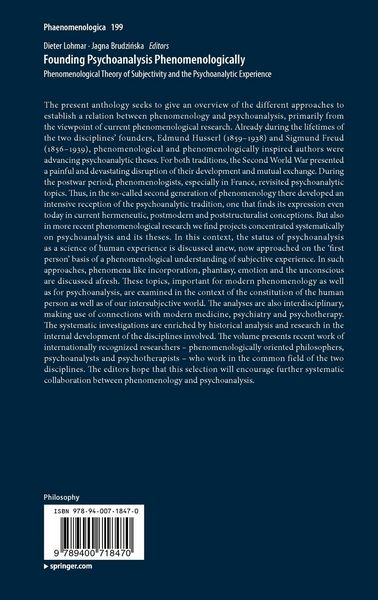
The present anthology seeks to give an overview of the different approaches to establish a relation between phenomenology and psychoanalysis, primarily from the viewpoint of current phenomenological research. Already during the lifetimes of the two disciplines' founders, Edmund Husserl (1859 - 1938) and Sigmund Freud (1856 – 1939), phenomenological and phenomenologically inspired authors were advancing psychoanalytic theses. For both traditions, the Second World War presented a painful and devastating disruption of their development and mutual exchange. During the postwar period, phenomenologists, especially in France, revisited psychoanalytic topics. Thus, in the so-called second generation of phenomenology there developed an intensive reception of the psychoanalytic tradition, one that finds its expression even today in current hermeneutic, postmodern and poststructuralist conceptions. But also in more recent phenomenological research we find projects concentrated systematically on psychoanalysis and its theses. In this context, the status of psychoanalysis as a science of human experience is discussed anew, now approached on the ‘first person’ basis of a phenomenological understanding of subjective experience. In such approaches, phenomena like incorporation, phantasy, emotion and the unconscious are discussed afresh. These topics, important for modern phenomenology as well as for psychoanalysis, are examined in the context of the constitution of the human person as well as of our intersubjective world. The analyses are also interdisciplinary, making use of connections with modern medicine, psychiatry and psychotherapy. The systematic investigations are enriched by historical analysis and research in the internal development of the disciplines involved. The volume presents recent work of internationally recognized researchers – phenomenologically oriented philosophers, psychoanalysts and psychotherapists – who work in the common fieldof the two disciplines. The editors hope that this selection will encourage further systematic collaboration between phenomenology and psychoanalysis

Produktdetails

Einband

Gebundene Ausgabe

Erscheinungsdatum

13.10.2011

Abbildungen

XX, 296 p.

Herausgeber Dieter Lohmar + weitere

Produktdetails

Einband

Gebundene Ausgabe

Erscheinungsdatum

13.10.2011

Abbildungen

XX, 296 p.

Herausgeber
Verlag Springer Netherland
Seitenzahl

296

Maße (L/B/H)

24,1/16/2,2 cm

Gewicht

589 g

Auflage

1. Auflage

Sprache

Englisch

ISBN

978-94-007-1847-0

Herstelleradresse

Springer-Verlag KG
Sachsenplatz 4-6
1201 Wien
AT

Email: ProductSafety@springernature.com

Noch keine Bewertungen vorhanden

Verfassen Sie die erste Bewertung zu diesem Artikel

Helfen Sie anderen Kundinnen und Kunden durch Ihre Meinung.

Kundinnen und Kunden meinen

Bewertungen (0)

  • Produktbild: Founding Psychoanalysis Phenomenologically
  • Produktbild: Founding Psychoanalysis Phenomenologically
  • Phantasieren und Phantasma bei Husserl und Freud, R. Bernet.- Depth phenomenology of the emotive dynamic and the psycho¬analytic experience, J. Brudzińska.- Axiomatics of the flesh, G.F. Duportail,- Body Memory and the Unconscious, T. Fuchs.- Psychoanalysis: Philosophy and/or Science of Subjectivity? Prospects for a Dialogue between Phenomenology, Philosophy of Mind, and Psychoanalysis, P. Giampieri-Deutsch.- Berührungspunkte zwischen der „Philosophie“ Freuds und der Phänomenologie, G. Gödde.- Edmund Husserl and Jacques Lacan. An Ethical Difference in Epistemology? A. Leder.- Psychoanalysis and the logic of thinking without language. How can we conceive of neurotic displacement, denying, inversion etc. as rational actions of the mind? D. Lohmar.- The ‘Unconscious’ in Paranoid Delusional Psychosis: Phenomenology, Neuroscience, Psychoanalysis, A.L. Mishara.- The phenomenological psychology of gender: How trans-sexuality and intersexuality express the general case of self as a cultural object, I.R. Owen.- Self-Deception: Theoretical Puzzles and Moral Implications, S. Rinofner-Kreidl.- Some observations on Husserl and Freud, F,S. Trincia,- Toward a Semantics of the Symptom: The World of Frau D, D. Welton, W. Schüffel.- Psychic Reality. Intentionality between Truth and Illusion, D. Widlöcher.- “The Delirious Illusion of Being in the World”: Toward a Phenomenology of Schizophrenia, O.P. Wiggins, M.A. Schwartz.