
KI-Beratung Beta

Gutscheinbedingungen

**Gültig bis 11.11.2026 auf Spielzeug, Schreibwaren, Filme, Geschenke & Trends, Musik, tolino eReader & Zubehör, Hörbücher und Hörbuch-Downloads, nicht preisgebundene Bücher und Kalender online auf thaalia.live und in der Thalia App. Einzelne Artikel können ausgeschlossen sein. Aufgrund der Buchpreisbindung sind deutschsprachige Bücher und eBooks ausgenommen. Zusätzlich ausgenommen sind Abos & Flatrates, Games, Geschenkkarten/-boxen, Shelfies, Software, Zeitschriften sowie einzelne Artikel von tonies®. Pro Einkauf einmal einlösbar. Click & Collect nur bei Onlinevorabzahlung möglich. Keine Barauszahlung. Nicht kombinierbar mit anderen Aktionen und Gutscheinen. Gutschein wird auf max. 500€ Bestellwert angerechnet. Nicht gültig für Versandkosten und Services.

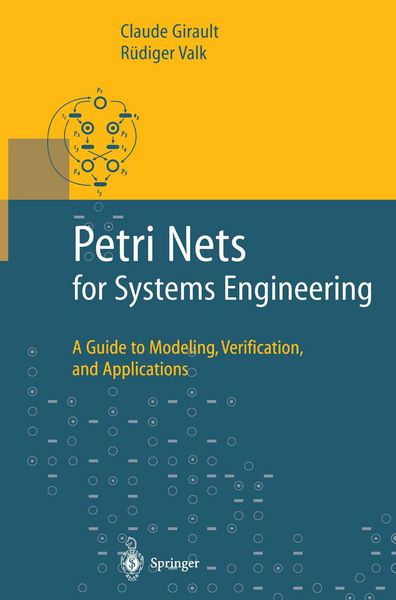
  • Produktbild: Petri Nets for Systems Engineering
  • Produktbild: Petri Nets for Systems Engineering
- 11%

Petri Nets for Systems Engineering A Guide to Modeling, Verification, and Applications

11% sparen

87,99 € UVP 98,99 €

inkl. gesetzl. MwSt., Versandkostenfrei


Beschreibung

Formal methods for the specification and verification of hardware and software systems are becoming more and more important as systems increase in size and complexity. The aim of the book is to illustrate progress in formal methods, based on Petri net formalisms. It contains a collection of examples...

Beschreibung

Formal methods for the specification and verification of hardware and software systems are becoming more and more important as systems increase in size and complexity. The aim of the book is to illustrate progress in formal methods, based on Petri net formalisms. It contains a collection of examples arising from different fields, such as flexible manufacturing, telecommunication and workflow management systems.
The book covers the main phases in the life cycle of design and implementation of a system, i.e., specification, model checking techniques for verification, analysis of properties, code generation, and execution of models. These techniques and their tool support are discussed in detail including practical issues. Amongst others, fundamental concepts such as composition, abstraction, and reusability of models, model verification, and verification of properties are systematically introduced.

Rezension

From the reviews:


"This is an extensive work providing an overview of the current state of the art of the use of Petri nets in systems engineering. … The book has been carefully written avoiding an excess of formulas and technicalities. … This book is suited for those well acquainted with formal modelling of systems and who now want to learn which techniques are available from the perspective of Petri nets." (J.F. Groote, Zentralblatt MATH, Vol. 1024, 2003)

Produktdetails

Einband

Taschenbuch

Erscheinungsdatum

15.12.2010

Abbildungen

XVI, 607 p.

Verlag Springer Berlin

Produktdetails

Einband

Taschenbuch

Erscheinungsdatum

15.12.2010

Abbildungen

XVI, 607 p.

Verlag Springer Berlin
Seitenzahl

607

Maße (L/B/H)

23,5/15,5/3,4 cm

Gewicht

931 g

Auflage

Softcover reprint of hardcover 1st edition 2003

Sprache

Englisch

ISBN

978-3-642-07447-9

Herstelleradresse

Springer-Verlag KG
Sachsenplatz 4-6
1201 Wien
AT

Email: ProductSafety@springernature.com

Noch keine Bewertungen vorhanden

Verfassen Sie die erste Bewertung zu diesem Artikel

Helfen Sie anderen Kundinnen und Kunden durch Ihre Meinung.

Kundinnen und Kunden meinen

Bewertungen (0)

  • Produktbild: Petri Nets for Systems Engineering
  • Produktbild: Petri Nets for Systems Engineering
  • Introduction: Purpose of the Book.- 1. Introduction.- 2. Essential Features of Petri Nets.- 3. Intuitive Models.- 4. Basic Definitions.- 5. Properties.- 6. Overview of the Book.- 8. Modelling and Analysis Techniques by Example.- 9. Techniques.- 10. Methods.- 11. Case Studies.- 12. Conclusion.- 13. Introduction: Issues in Verification.- 14. State-Space-Based Methods and Model Checking.- 15. Structural Methods.- 16. Deductive and Process-Algebra-Based Methods.- 17. Conclusion.- 18. Introduction.- 19. Systems Engineering and Validation.- 20. Net Execution.- 21. Code Generation.- 22. Conclusion.- 23. Introduction.- 24. Flexible Manufacturing Systems.- 25. Workflow Systems.- 26. Telecommunications Systems.- 27. Conclusion.- References.