KI-Beratung Beta

Gutscheinbedingungen

**Gültig bis 11.11.2026 auf Spielzeug, Schreibwaren, Filme, Geschenke & Trends, Musik, tolino eReader & Zubehör, Hörbücher und Hörbuch-Downloads, nicht preisgebundene Bücher und Kalender online auf thaalia.live und in der Thalia App. Einzelne Artikel können ausgeschlossen sein. Aufgrund der Buchpreisbindung sind deutschsprachige Bücher und eBooks ausgenommen. Zusätzlich ausgenommen sind Abos & Flatrates, Games, Geschenkkarten/-boxen, Shelfies, Software, Zeitschriften sowie einzelne Artikel von tonies®. Pro Einkauf einmal einlösbar. Click & Collect nur bei Onlinevorabzahlung möglich. Keine Barauszahlung. Nicht kombinierbar mit anderen Aktionen und Gutscheinen. Gutschein wird auf max. 500€ Bestellwert angerechnet. Nicht gültig für Versandkosten und Services.

  • Produktbild: Algorithmic Game Theory
  • Produktbild: Algorithmic Game Theory
Band 6386

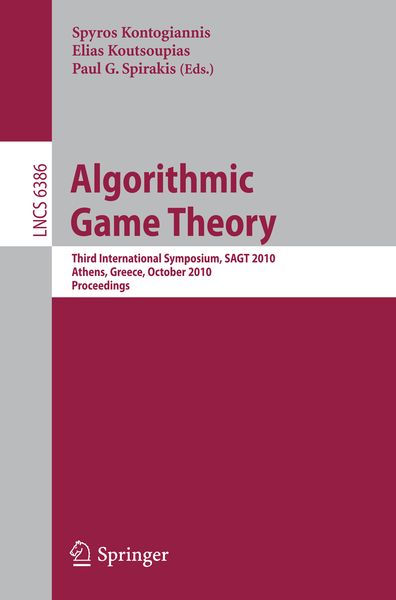
Algorithmic Game Theory Third International Symposium, SAGT 2010, Athens, Greece, October 18-20, 2010, Proceedings

51,99 €

inkl. gesetzl. MwSt., Versandkostenfrei


Beschreibung

Thepresentvolumewasdevotedto thethirdeditionofthe InternationalSym- sium on Algorithmic Game Theory (SAGT), an interdisciplinary scienti?c event intended to provide a forum for researchers as well as practitioners to exchange innovative ideas and to be aware of each other s e?orts and results. SAGT 2010...

Beschreibung

Thepresentvolumewasdevotedto thethirdeditionofthe InternationalSym- sium on Algorithmic Game Theory (SAGT), an interdisciplinary scienti?c event intended to provide a forum for researchers as well as practitioners to exchange innovative ideas and to be aware of each other s e?orts and results. SAGT 2010 took place in Athens, on October 18 20, 2010. The present volume contains all contributed papers presented at SAGT 2010 together with the distinguished invited lectures of Amos Fiat (Tel-Aviv University, Israel), and Paul Goldberg (University of Liverpool, UK). The two invited papers are presented at the - ginning of the proceedings, while the regular papers follow in alphabetical order (by the authors names). In response to the call for papers, the Program Committee (PC) received 61 submissions.Amongthesubmissionswerefour paperswith atleastonecoauthor that was also a PC member of SAGT 2010. For these PC-coauthored papers, anindependent subcommittee (EliasKoutsoupias,PaulG. Spirakis,andXiaotie Deng) made the judgment, and eventually two of these papers were proposedfor inclusion in the Scienti?c Program. For the remaining 57 (non-PC-coauthored) papers, the PC of SAGT 2010 conducted a thorough evaluation (at least 3, and on average 3.9 reviews per paper) and electronic discussion, and eventually selected 26 papers for inclusion in the Scienti?c Program. An additional tutorial, Games Played in Physics , was also provided in SAGT 2010, courtesy of the academic research network Algogames (A??o?a????o) of the University of Patras.

Produktdetails

Einband

Taschenbuch

Erscheinungsdatum

06.10.2010

Abbildungen

VIII, 359 p. 25 illus.

Herausgeber Spyros Kontogiannis + weitere

Produktdetails

Einband

Taschenbuch

Erscheinungsdatum

06.10.2010

Abbildungen

VIII, 359 p. 25 illus.

Herausgeber
Verlag Springer Berlin
Seitenzahl

359

Maße (L/B/H)

2,1/15,4/23,5 cm

Gewicht

573 g

Sprache

Englisch

ISBN

978-3-642-16169-8

Herstelleradresse

Springer Nature Customer Service Center GmbH
Europaplatz 3
69115 Heidelberg
DE
ProductSafety@springernature.com

Noch keine Bewertungen vorhanden

Verfassen Sie die erste Bewertung zu diesem Artikel

Helfen Sie anderen Kundinnen und Kunden durch Ihre Meinung.

Kundinnen und Kunden meinen

Bewertungen (0)

  • Produktbild: Algorithmic Game Theory
  • Produktbild: Algorithmic Game Theory
  • When the Players Are Not Expectation Maximizers.- How Do You Like Your Equilibrium Selection Problems? Hard, or Very Hard?.- A Simplex-Like Algorithm for Fisher Markets.- Nash Equilibria in Fisher Market.- Partition Equilibrium Always Exists in Resource Selection Games.- Mixing Time and Stationary Expected Social Welfare of Logit Dynamics.- Pareto Efficiency and Approximate Pareto Efficiency in Routing and Load Balancing Games.- On Nash-Equilibria of Approximation-Stable Games.- Improved Lower Bounds on the Price of Stability of Undirected Network Design Games.- On the Rate of Convergence of Fictitious Play.- On Learning Algorithms for Nash Equilibria.- On the Structure of Weakly Acyclic Games.- A Direct Reduction from k-Player to 2-Player Approximate Nash Equilibrium.- Responsive Lotteries.- On the Existence of Optimal Taxes for Network Congestion Games with Heterogeneous Users.- Computing Stable Outcomes in Hedonic Games.- A Perfect Price Discrimination Market Model with Production, and a (Rational) Convex Program for It.- The Computational Complexity of Trembling Hand Perfection and Other Equilibrium Refinements.- Complexity of Safe Strategic Voting.- Bottleneck Congestion Games with Logarithmic Price of Anarchy.- Single-Parameter Combinatorial Auctions with Partially Public Valuations.- On the Efficiency of Markets with Two-Sided Proportional Allocation Mechanisms.- Braess’s Paradox for Flows over Time.- The Price of Anarchy in Network Creation Games Is (Mostly) Constant.- Truthful Fair Division.- No Regret Learning in Oligopolies: Cournot vs. Bertrand.- On the Complexity of Pareto-optimal Nash and Strong Equilibria.- 2-Player Nash and Nonsymmetric Bargaining Games: Algorithms and Structural Properties.- On the Inefficiency of Equilibria in Linear BottleneckCongestion Games.- Minimal Subsidies in Expense Sharing Games.