KI-Beratung Beta

Gutscheinbedingungen

**Gültig am 25.11.2026 auf fremdsprachige Bücher online auf thaalia.live und in der Thalia App. Einzelne Artikel können ausgeschlossen sein. Ausgenommen sind preisgebundene Artikel & eBooks. Pro Einkauf einmal einlösbar. Click & Collect nur bei Onlinevorabzahlung möglich. Keine Barauszahlung. Nicht kombinierbar mit anderen Aktionen und Gutscheinen. Gutschein wird auf max. 500€ Bestellwert angerechnet. Nicht gültig für Geschenkkarten, Versandkosten und Services.

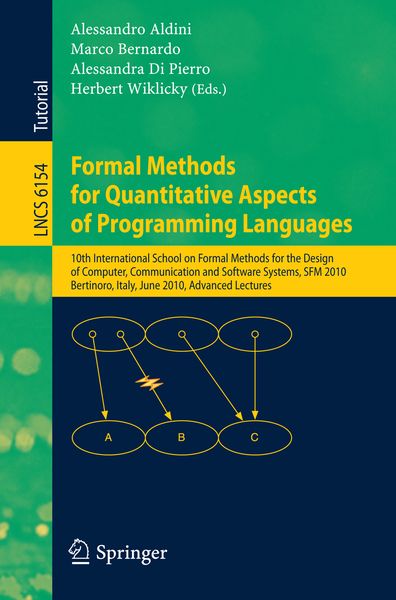
Produktbild: Formal Methods for Quantitative Aspects of Programming Languages
Band 6154

Formal Methods for Quantitative Aspects of Programming Languages 10th International School on Formal Methods for the Design of Computer, Communication and Software Systems, SFM 2010, Bertinoro, Italy, June 21, 2010, Advanced Lectures

51,99 €

inkl. gesetzl. MwSt., Versandkostenfrei


Beschreibung

This volume presents the set of papers accompanying some of the lectures of the 10th International School on Formal Methods for the Design of Computer, Communication and Software Systems (SFM). Thisseriesofschoolsaddressestheuseofformalmethodsincomputerscience as a prominent approachto the rigorousdesign...

Beschreibung

This volume presents the set of papers accompanying some of the lectures of the 10th International School on Formal Methods for the Design of Computer, Communication and Software Systems (SFM). Thisseriesofschoolsaddressestheuseofformalmethodsincomputerscience as a prominent approachto the rigorousdesign of the above-mentionedsystems. The main aim of the SFM series is to o?er a good spectrum of current research in foundations as well as applications of formal methods, which can be of help for graduate students and young researchers who intend to approach the ?eld. SFM 2010 was devoted to formal methods for quantitative aspects of p- gramminglanguagesandcoveredseveraltopicsincludingprobabilisticandtimed models, model checking, static analysis, quantum computing, real-time and - bedded systems, and security. This volume comprises four articles. The paper by Di Pierro, Hankin, and Wiklicky investigates the relation between the operational semantics of pro- bilistic programming languages and discrete-time Markov chains and presents a framework for probabilistic program analysis inspired by classical abstract interpretation. Broadbent, Fitzsimons, and Kashe? review the mathematical model underlying measurement-based quantum computation, a novel approach to quantum computation where measurement is the main driving force of c- putation instead of the unitary operations of the more traditional quantum c- cuit model. The paper by Malacaria and Heusser illustrates the informati- theoretical basis of quantitative information ?ow by showing the relationship betweenlattices,partitions,andinformation-theoreticalconcepts,aswellastheir applicabilitytoquantifyleakageofcon?dentialinformationinprograms. Finally, Wolter and Reinecke discuss the trade-o? between performance and security by formulating metrics that explicitly express the trade-o? and by showing how to ?nd system parameters that optimize those metrics.

Produktdetails

Einband

Taschenbuch

Erscheinungsdatum

11.06.2010

Abbildungen

VII, 169 p. 31 illus.

Herausgeber Alessandro Aldini + weitere

Produktdetails

Einband

Taschenbuch

Erscheinungsdatum

11.06.2010

Abbildungen

VII, 169 p. 31 illus.

Herausgeber
Verlag Springer Berlin
Seitenzahl

169

Sprache

Englisch

ISBN

978-3-642-13677-1

Herstelleradresse

Springer-Verlag GmbH
Heidelberger Platz 3
14197 Berlin
Deutschland
Email: sdc-bookservice@springer.com
Url: www.springer.com
Telephone: +49 30 827870
Fax: +49 30 8214091

Noch keine Bewertungen vorhanden

Verfassen Sie die erste Bewertung zu diesem Artikel

Helfen Sie anderen Kundinnen und Kunden durch Ihre Meinung.

Kundinnen und Kunden meinen

Bewertungen (0)

  • Produktbild: Formal Methods for Quantitative Aspects of Programming Languages
  • Probabilistic Semantics and Program Analysis.- Measurement-Based and Universal Blind Quantum Computation.- Information Theory and Security: Quantitative Information Flow.- Performance and Security Tradeoff.