KI-Beratung Beta

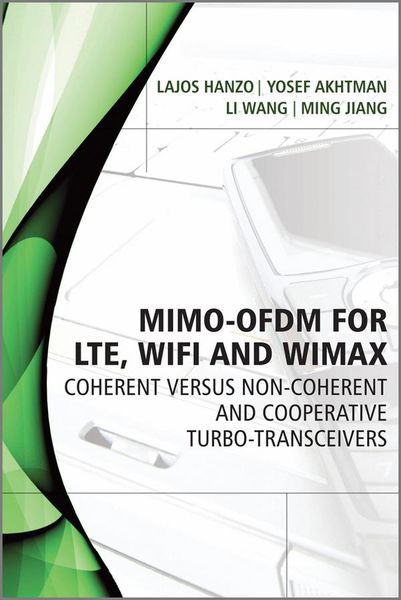
Produktbild: MIMO-OFDM for LTE, Wi-Fi and WiMAX

MIMO-OFDM for LTE, Wi-Fi and WiMAX Coherent Versus Non-coherent and Cooperative Turbo-transceivers

Aus der Reihe Wiley - IEEE

219,99 €

inkl. gesetzl. MwSt., Versandkostenfrei


Beschreibung

MIMO-OFDM for LTE, WIFI and WIMAX: Coherent versus Non-Coherent and Cooperative Turbo-Transceivers provides an up-to-date portrayal of wireless transmission based on OFDM techniques augmented with Space-Time Block Codes (STBCs) and Spatial-Division Multiple Access (SDMA). The volume also offers an in-depth...

Beschreibung

MIMO-OFDM for LTE, WIFI and WIMAX: Coherent versus Non-Coherent and Cooperative Turbo-Transceivers provides an up-to-date portrayal of wireless transmission based on OFDM techniques augmented with Space-Time Block Codes (STBCs) and Spatial-Division Multiple Access (SDMA). The volume also offers an in-depth treatment of cutting-edge Cooperative Communications.
 
This monograph collates the latest techniques in a number of specific design areas of turbo-detected MIMO-OFDM wireless systems. As a result a wide range of topical subjects are examined, including channel coding and multiuser detection (MUD), with a special emphasis on optimum maximum-likelihood (ML) MUDs, reduced-complexity genetic algorithm aided near-ML MUDs and sphere detection. The benefits of spreading codes as well as joint iterative channel and data estimation are only a few of the radical new features of the book.
 
Also considered are the benefits of turbo and LDPC channel coding, the entire suite of known joint coding and modulation schemes, space-time coding as well as SDM/SDMA MIMOs within the context of various application examples. The book systematically converts the lessons of Shannon's information theory into design principles applicable to practical wireless systems; the depth of discussions increases towards the end of the book.
* Discusses many state-of-the-art topics important to today's wireless communications engineers.
* Includes numerous complete system design examples for the industrial practitioner.
* Offers a detailed portrayal of sphere detection.
* Based on over twenty years of research into OFDM in the context of various applications, subsequently presenting comprehensive bibliographies.

Rezension

"This book provides a comprehensive and up-to-date portrayal of wireless transmission based on OFDM techniques augmented with Space-Time Block Codes (STBCs) and Spatial-Division Multiple Access (SDMA) . . . the book also includes an extensive bibliography, as well as both subject and author indexes. (Annotation ©2011 Book News Inc. Portland, OR)." (Booknews, 1 April 2011)
"The book systematically converts the lessons of Shannon s information theory into design principles applicable to practical wireless systems; the depth of discussions increases towards the end of the book.". (4G Wireless Evolution , 26 January 2011)

Produktdetails

Einband

Gebundene Ausgabe

Erscheinungsdatum

08.11.2010

Verlag John Wiley & Sons Inc
Seitenzahl

704

Produktdetails

Einband

Gebundene Ausgabe

Erscheinungsdatum

08.11.2010

Verlag John Wiley & Sons Inc
Seitenzahl

704

Maße (L/B/H)

25,1/17,8/4,1 cm

Gewicht

1315 g

Auflage

1. Auflage

Sprache

Englisch

ISBN

978-0-470-68669-0

Herstelleradresse

Libri GmbH
Europaallee 1
36244 Bad Hersfeld
DE

Email: gpsr@libri.de

Noch keine Bewertungen vorhanden

Verfassen Sie die erste Bewertung zu diesem Artikel

Helfen Sie anderen Kundinnen und Kunden durch Ihre Meinung.

Kundinnen und Kunden meinen

Bewertungen (0)

Die Leseprobe wird geladen.
  • Produktbild: MIMO-OFDM for LTE, Wi-Fi and WiMAX
  • About the Authors.
     
    OtherWiley and IEEE Press Books on Related Topics.
     
    Acknowledgments.
     
    Preface.
     
    List of Symbols.
     
    1 Introduction to OFDM and MIMO-OFDM.
     
    1.1 OFDM History.
     
    1.2 OFDM Schematic.
     
    1.3 Channel Estimation for Multicarrier.
     
    1.5 Signal Detection in MIMO-OFDM Systems.
     
    1.6 Iterative Signal Processing for SDM-OFDM.
     
    1.7 System Model.
     
    1.8 SDM-OFDM System Model.
     
    1.9 Novel Aspects and Outline of the Book.
     
    1.10 Chapter Summary.
     
    2 OFDM Standards.
     
    2.1 Wi-Fi.
     
    2.2 3GPP Long-Term Evolution.
     
    2.3 WiMAX Evolution.
     
    2.4 Chapter Summary.
     
    I Coherently Detected SDMA-OFDM Systems.
     
    3 Channel Coding Assisted STBC-OFDM Systems.
     
    3.1 Introduction.
     
    3.2 Space-Time Block Codes.
     
    3.3 Channel Coded Space-Time Block Codes.
     
    3.4 Channel Coding Aided Space-Time Block Coded OFDM.
     
    3.5 Chapter Summary.
     
    4 Coded Modulation Assisted Multi-User SDMA-OFDM Using Frequency-Domain Spreading.
     
    4.1 Introduction.
     
    4.2 System Model.
     
    4.3 Simulation Results.
     
    4.4 Chapter Summary.
     
    5 Hybrid Multi-User Detection for SDMA-OFDM Systems.
     
    5.1 Introduction.
     
    5.2 Genetical Algorithm Assisted Multi-User Detection.
     
    5.3 Enhanced GA-based Multi-User Detection.
     
    5.4 Chapter Summary.
     
    6 DS-Spreading and Slow Subcarrier-Hopping Aided Multi-User SDMA-OFDM Systems.
     
    6.1 Conventional SDMA-OFDM Systems.
     
    6.2 Introduction to Hybrid SDMA-OFDM.
     
    6.3 Subband-Hopping Versus Subcarrier-Hopping.
     
    6.4 System Architecture.
     
    6.5 Simulation Results.
     
    6.6 Complexity Issues.
     
    6.7 Conclusions.
     
    6.8 Chapter Summary.
     
    7 Channel Estimation for OFDM and MC-CDMA.
     
    7.1 Pilot-Assisted Channel Estimation.
     
    7.2 Decision Directed Channel Estimation.
     
    7.3 A Posteriori FD-CTF Estimation.
     
    7.4 A Posteriori CIR Estimation.
     
    7.5 Parametric FS-CIR Estimation.
     
    7.6 Time-Domain A Priori CIR Tap Prediction.
     
    7.7 PASTD Aided DDCE.
     
    7.8 Channel Estimation for MIMO-OFDM.
     
    8 Iterative Joint Channel Estimation and MUD for SDMA-OFDM Systems.
     
    8.1 Introduction.
     
    8.2 System Overview.
     
    8.3 GA-assisted Iterative Joint Channel Estimation and MUD.
     
    8.4 Simulation Results.
     
    8.5 Conclusions.
     
    8.6 Chapter Summary.
     
    II Coherent versus Non-Coherent and Cooperative OFDM Systems List of Symbols in Part II.
     
    9 Reduced-Complexity Sphere Detection for Uncoded SDMA-OFDM Systems.
     
    9.1 Introduction.
     
    9.2 Principle of Sphere Detection.
     
    9.3 Complexity-Reduction Schemes for SD.
     
    9.4 Comparison of the Depth-First, K-Best and OHRSA Detectors.
     
    9.5 Chapter Conclusions.
     
    10 Reduced-Complexity Iterative Sphere Detection for Channel Coded SDMA-OFDM Systems.
     
    10.1 Introduction.
     
    10.2 Channel Coded Iterative Center-Shifting SD.
     
    10.3 Apriori-LLR-Threshold-Assisted Low-Complexity SD.
     
    10.4 Unity-Rate-Code-Aided Three-Stage Iterative Receiver Employing SD.
     
    10.5 Chapter Conclusions.
     
    11 Sphere Packing Modulated STBC-OFDM and its Sphere Detection.
     
    11.1 Introduction.
     
    11.2 Orthogonal Transmit Diversity Design with Sphere Packing Modulation.
     
    11.3 Sphere Detection Design for Sphere Packing Modulation.
     
    11.4 Chapter Conclusions.
     
    12 Multiple-Symbol Differential Sphere Detection for Cooperative