KI-Beratung Beta

Gutscheinbedingungen

**Gültig bis 11.11.2026 auf Spielzeug, Schreibwaren, Filme, Geschenke & Trends, Musik, tolino eReader & Zubehör, Hörbücher und Hörbuch-Downloads, nicht preisgebundene Bücher und Kalender online auf thaalia.live und in der Thalia App. Einzelne Artikel können ausgeschlossen sein. Aufgrund der Buchpreisbindung sind deutschsprachige Bücher und eBooks ausgenommen. Zusätzlich ausgenommen sind Abos & Flatrates, Games, Geschenkkarten/-boxen, Shelfies, Software, Zeitschriften sowie einzelne Artikel von tonies®. Pro Einkauf einmal einlösbar. Click & Collect nur bei Onlinevorabzahlung möglich. Keine Barauszahlung. Nicht kombinierbar mit anderen Aktionen und Gutscheinen. Gutschein wird auf max. 500€ Bestellwert angerechnet. Nicht gültig für Versandkosten und Services.

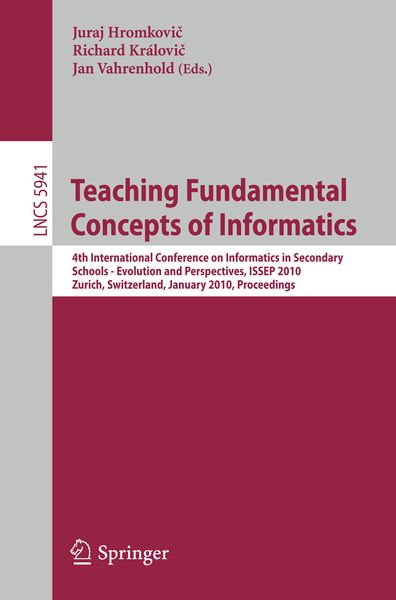
Produktbild: Teaching Fundamental Concepts of Informatics
Band 5941

Teaching Fundamental Concepts of Informatics 4th International Conference on Informatics in Secondary Schools - Evolution and Perspectives, ISSEP 2010, Zurich, Switzerland, January 13-15, 2010, Proceedings

51,99 €

inkl. gesetzl. MwSt., Versandkostenfrei


Beschreibung

The International Conference on Informatics in Secondary Schools: Evolution and Perspective (ISSEP) is an emerging forum for researchers and practitioners in the area of computer science education with a focus on secondary schools. The ISSEP series started in 2005 in Klagenfurt, and continued in 2006...

Beschreibung

The International Conference on Informatics in Secondary Schools: Evolution and Perspective (ISSEP) is an emerging forum for researchers and practitioners in the area of computer science education with a focus on secondary schools. The ISSEP series started in 2005 in Klagenfurt, and continued in 2006 in Vilnius, and in 2008 in Torun. ´ The 4th ISSEP took part in Zurich. This volume presents 4 of the 5 invited talks and 14 regular contributions chosen from 32 submissions to ISSEP 2010. The ISSEP conference series is devoted to all aspects of computer science teaching. In the preface of the proceedings of ISSEP 2006, Roland Mittermeir wrote: “ISSEP aims at educating ‘informatics proper’ by showing the beauty of the discipline, hoping to create interest in a later professional career in c- puting, and it will give answers di?erent from the opinion of those who used to familiarize pupils with the basics of ICT in order to achieve computer lit- acy for the young generation. ” This is an important message at this time, when several countries have reduced teaching informatics to educating about current softwarepackagesthatchangefromyeartoyear. ThegoalofISSEPistosupport teaching of the basic concepts and methods of informatics, thereby making it a subject in secondary schools that is comparable in depth and requirements with mathematics or natural sciences. As we tried to present in our book “Algori- mic Adventures.

Produktdetails

Einband

Taschenbuch

Erscheinungsdatum

08.01.2010

Abbildungen

X, 207 p.

Herausgeber Juraj Hromkovič + weitere

Produktdetails

Einband

Taschenbuch

Erscheinungsdatum

08.01.2010

Abbildungen

X, 207 p.

Herausgeber
Verlag Springer Berlin
Seitenzahl

207

Maße (L/B/H)

23,5/15,5/1,3 cm

Gewicht

341 g

Auflage

2010

Sprache

Englisch

ISBN

978-3-642-11375-8

Herstelleradresse

Springer-Verlag KG
Sachsenplatz 4-6
1201 Wien
AT

Email: ProductSafety@springernature.com

Noch keine Bewertungen vorhanden

Verfassen Sie die erste Bewertung zu diesem Artikel

Helfen Sie anderen Kundinnen und Kunden durch Ihre Meinung.

Kundinnen und Kunden meinen

Bewertungen (0)

  • Produktbild: Teaching Fundamental Concepts of Informatics
  • Sustaining Informatics Education by Contests.- Impasse, Conflict, and Learning of CS Notions.- K-12 Computer Science: Aspirations, Realities, and Challenges.- Perspective on Computer Science Education.- Didactics of Introduction to Computer Science in High School.- Software Design Course for Leading CS In-Service Teachers.- The Effect of Tangible Artifacts, Gender and Subjective Technical Competence on Teaching Programming to Seventh Graders.- The Difficulty of Programming Contests Increases.- Didactic Games for Teaching Information Theory.- Collaborative Initiatives for Promoting Computer Science in Secondary Schools.- Teaching Public-Key Cryptography in School.- Towards a Methodical Approach for an Empirically Proofed Competency Model.- Having Fun with Computer Programming and Games: Teacher and Student Experiences.- Showing Core-Concepts of Informatics to Kids and Their Teachers.- Object-Oriented Modeling of Object-Oriented Concepts.- Programming Camps: Letting Children Discover the Computer Science.- Mission to Mars – A Study on Naming and Referring.- Long-Term Development of Software Projects – Students’ Self-appreciation and Expectations.