KI-Beratung Beta

Produktbild: Foundations of Computational Intelligence
Band 201

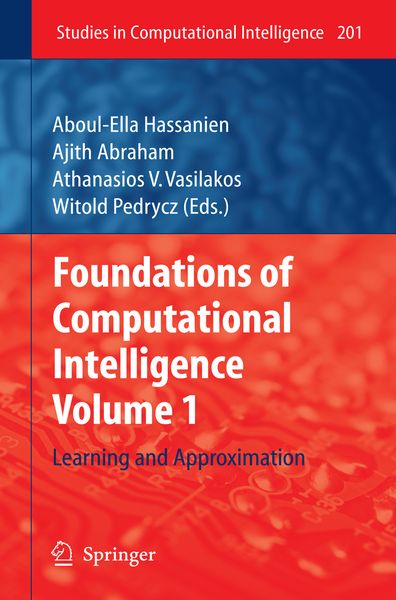
Foundations of Computational Intelligence Volume 1: Learning and Approximation

147,99 €

inkl. gesetzl. MwSt., Versandkostenfrei


Beschreibung

Foundations of Computational Intelligence Volume 1: Learning and Approximation: Theoretical Foundations and Applications Learning methods and approximation algorithms are fundamental tools that deal with computationally hard problems and problems in which the input is gradually disclosed over time. Both...

Beschreibung

Foundations of Computational Intelligence Volume 1: Learning and Approximation: Theoretical Foundations and Applications Learning methods and approximation algorithms are fundamental tools that deal with computationally hard problems and problems in which the input is gradually disclosed over time. Both kinds of problems have a large number of applications arising from a variety of fields, such as algorithmic game theory, approximation classes, coloring and partitioning, competitive analysis, computational finance, cuts and connectivity, inapproximability results, mechanism design, network design, packing and covering, paradigms for design and analysis of approxi- tion and online algorithms, randomization techniques, real-world applications, scheduling problems and so on. The past years have witnessed a large number of interesting applications using various techniques of Computational Intelligence such as rough sets, connectionist learning; fuzzy logic; evolutionary computing; artificial immune systems; swarm intelligence; reinforcement learning, intelligent multimedia processing etc. . In spite of numerous successful applications of C- putational Intelligence in business and industry, it is sometimes difficult to explain the performance of these techniques and algorithms from a theoretical perspective. Therefore, we encouraged authors to present original ideas dealing with the inc- poration of different mechanisms of Computational Intelligent dealing with Lea- ing and Approximation algorithms and underlying processes. This edited volume comprises 15 chapters, including an overview chapter, which provides an up-to-date and state-of-the art research on the application of Computational Intelligence for learning and approximation.

Portrait

Dr. Ajith Abraham is Director of the Machine Intelligence Research (MIR) Labs, a global network of research laboratories with headquarters near Seattle, WA, USA. He is an author/co-author of more than 750 scientific publications. He is founding Chair of the International Conference of Computational Aspects of Social Networks (CASoN), Chair of IEEE Systems Man and Cybernetics Society Technical Committee on Soft Computing (since 2008), and a Distinguished Lecturer of the IEEE Computer Society representing Europe (since 2011).
Dr. Aboul-Ella Hassanien is a Professor in the Faculty of Computers and Information at Cairo University, Egypt, and Visiting Professor at the College of Business Administration, Kuwait University.

Produktdetails

Einband

Gebundene Ausgabe

Erscheinungsdatum

06.05.2009

Abbildungen

XII, 400 p.

Herausgeber Aboul-Ella Hassanien + weitere

Produktdetails

Einband

Gebundene Ausgabe

Erscheinungsdatum

06.05.2009

Abbildungen

XII, 400 p.

Herausgeber
Verlag Springer Berlin
Seitenzahl

400

Maße (B/H)

15,5/23,5 cm

Gewicht

766 g

Sprache

Englisch

ISBN

978-3-642-01081-1

Herstelleradresse

Springer-Verlag GmbH
Heidelberger Platz 3
14197 Berlin
Deutschland
Email: sdc-bookservice@springer.com
Url: www.springer.com
Telephone: +49 30 827870
Fax: +49 30 8214091

Noch keine Bewertungen vorhanden

Verfassen Sie die erste Bewertung zu diesem Artikel

Helfen Sie anderen Kundinnen und Kunden durch Ihre Meinung.

Kundinnen und Kunden meinen

Bewertungen (0)

  • Produktbild: Foundations of Computational Intelligence
  • Function Approximation.- Machine Learning and Genetic Regulatory Networks: A Review and a Roadmap.- Automatic Approximation of Expensive Functions with Active Learning.- New Multi-Objective Algorithms for Neural Network Training Applied to Genomic Classification Data.- An Evolutionary Approximation for the Coefficients of Decision Functions within a Support Vector Machine Learning Strategy.- Connectionist Learning.- Meta-learning and Neurocomputing – A New Perspective for Computational Intelligence.- Three-Term Fuzzy Back-Propagation.- Entropy Guided Transformation Learning.- Artificial Development.- Robust Training of Artificial Feedforward Neural Networks.- Workload Assignment in Production Networks by Multi Agent Architecture.- Knowledge Representation and Acquisition.- Extensions to Knowledge Acquisition and Effect of Multimodal Representation in Unsupervised Learning.- A New Implementation for Neural Networks in Fourier-Space.- Learning and Visualization.- Dissimilarity Analysis and Application to Visual Comparisons.- Dynamic Self-Organising Maps: Theory, Methods and Applications.- Hybrid Learning Enhancement of RBF Network with Particle Swarm Optimization.