KI-Beratung Beta

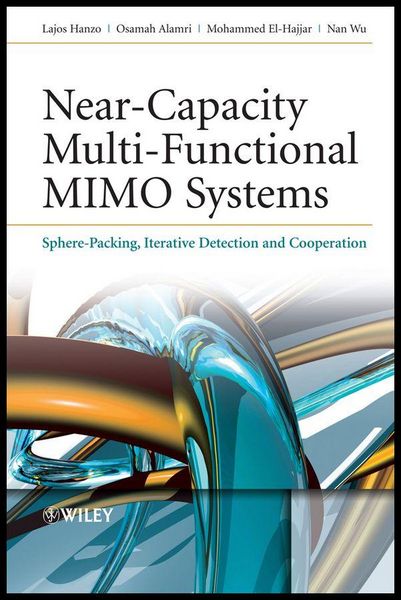
Produktbild: Near-Capacity Multi-Functional MIMO Systems

Near-Capacity Multi-Functional MIMO Systems Sphere-Packing, Iterative Detection and Cooperation

Aus der Reihe Wiley - IEEE

256,99 €

inkl. gesetzl. MwSt., Versandkostenfrei


Beschreibung

Providing an all-encompassing self-contained treatment of Near-Capacity Multi-Functional MIMO Systems , the book starts by categorizing the family of Multiple-Input Multiple-Output (MIMO) schemes as diversity techniques, multiplexing schemes, multiple access arrangements and beam-forming techniques....

Beschreibung

Providing an all-encompassing self-contained treatment of Near-Capacity Multi-Functional MIMO Systems , the book starts by categorizing the family of Multiple-Input Multiple-Output (MIMO) schemes as diversity techniques, multiplexing schemes, multiple access arrangements and beam-forming techniques. Sophisticated coherent and low-complexity non-coherent MIMO receivers dispensing with channel estimation are considered in both classic and cooperation-aided scenarios. It is demonstrated that in the presence of correlated shadow-fading, cooperation-assisted systems may be expected to outperform their non-cooperative counterparts. The book contains a 100-page chapter on the unified treatment of all block codes in the context of high-flexibility, cutting-edge irregular Linear Dispersion Codes (LDC), which approach the MIMO-capacity. The majority of the book's solutions are in the optimum sphere-packing frame-work.

  • Sophisticated amalgam of five year's near-capacity MIMO research
  • Detailed examination of wireless landscape, including the fields of channel coding, spacetime coding and turbo detection techniques
  • Novel tool of Extrinsic Information Transfer Charts (EXIT) used to address recent developments
  • Material presented logically, allowing advanced readers to turn directly to any specific chapter of interest
  • One of the only books to cover these subjects, giving equal weighting to each

Produktdetails

Einband

Gebundene Ausgabe

Erscheinungsdatum

01.07.2009

Verlag John Wiley & Sons Inc
Seitenzahl

752

Produktdetails

Einband

Gebundene Ausgabe

Erscheinungsdatum

01.07.2009

Verlag John Wiley & Sons Inc
Seitenzahl

752

Maße (L/B/H)

25,1/17,3/3 cm

Gewicht

907 g

Sprache

Englisch

ISBN

978-0-470-77965-1

Herstelleradresse

Libri GmbH
Europaallee 1
36244 Bad Hersfeld
DE

Email: gpsr@libri.de

Noch keine Bewertungen vorhanden

Verfassen Sie die erste Bewertung zu diesem Artikel

Helfen Sie anderen Kundinnen und Kunden durch Ihre Meinung.

Kundinnen und Kunden meinen

Bewertungen (0)

  • Produktbild: Near-Capacity Multi-Functional MIMO Systems
  • About the Authors xvii

    Other Wiley-IEEE Press Books on Related Topics xix

    Preface xxi

    Acknowledgments xxiii

    1 Problem Formulation, Objectives and Benefits 1

    Part I Coherent Versus Differential Turbo Detection of Sphere-packing-aided Single-user MIMO Systems 49

    List of Symbols in Part I 51

    2 Space-Time Block Code Design using Sphere Packing 55

    3 Turbo Detection of Channel-coded STBC-SP Schemes 95

    4 Turbo Detection of Channel-coded DSTBC-SP Schemes 125

    5 Three-stage Turbo-detected STBC-SP Schemes 155

    6 Symbol-based Channel-coded STBC-SP Schemes 181

    Part II Coherent Versus Differential Turbo Detection of Single-user and Cooperative MIMOs 207

    List of Symbols in Part II 209

    7 Linear Dispersion Codes: An EXIT Chart Perspective 213

    8 Differential Space-Time Block Codes: A Universal Approach 279

    9 Cooperative Space-Time Block Codes 323

    Part III Differential Turbo Detection of Multi-functional MIMO-aided Multi-user and Cooperative Systems 353

    List of Symbols in Part III 355

    10 Differential Space-Time Spreading 359

    11 Iterative Detection of Channel-coded DSTS Schemes 405

    12 Adaptive DSTS-assisted Iteratively Detected SP Modulation 455

    13 Layered Steered Space-Time Codes 469

    14 DL LSSTS-aided Generalized MC DS-CDMA 501

    15 Distributed Turbo Coding 535

    16 Conclusions and Future Research 553

    A Gray Mapping and AGM Schemes for SP Modulation of Size L=16 595

    B EXIT Charts of Various Bit-based Turbo-detected STBC-SP Schemes 601

    C EXIT Charts of Various Bit-based Turbo-detected DSTBC-SP Schemes 631

    D LDCs' ¿ for QPSK Modulation 647

    E DLDCs' ¿ for 2PAMModulation 651

    F CLDCs' ¿1 and ¿2 for BPSK Modulation 655

    G Weighting Coefficient Vectors ¿ and ¿ 659

    H Gray Mapping and AGM Schemes for SP Modulation of Size L=16 675

    Glossary 679

    Bibliography 685

    Index 707

    Author Index 711