KI-Beratung Beta

Gutscheinbedingungen

**Gültig bis 11.11.2026 auf Spielzeug, Schreibwaren, Filme, Geschenke & Trends, Musik, tolino eReader & Zubehör, Hörbücher und Hörbuch-Downloads, nicht preisgebundene Bücher und Kalender online auf thaalia.live und in der Thalia App. Einzelne Artikel können ausgeschlossen sein. Aufgrund der Buchpreisbindung sind deutschsprachige Bücher und eBooks ausgenommen. Zusätzlich ausgenommen sind Abos & Flatrates, Games, Geschenkkarten/-boxen, Shelfies, Software, Zeitschriften sowie einzelne Artikel von tonies®. Pro Einkauf einmal einlösbar. Click & Collect nur bei Onlinevorabzahlung möglich. Keine Barauszahlung. Nicht kombinierbar mit anderen Aktionen und Gutscheinen. Gutschein wird auf max. 500€ Bestellwert angerechnet. Nicht gültig für Versandkosten und Services.

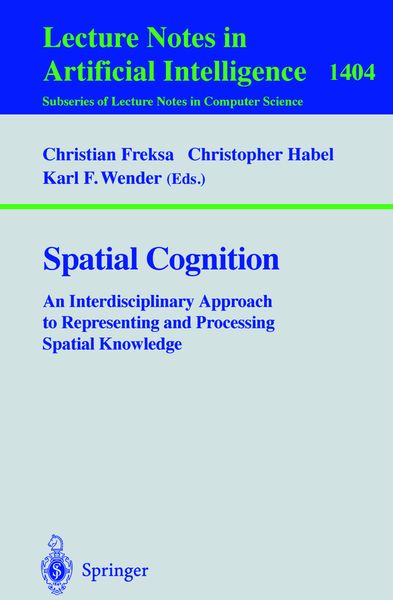
  • Produktbild: Spatial Cognition
  • Produktbild: Spatial Cognition
Band 1404

Spatial Cognition An Interdisciplinary Approach to Representing and Processing Spatial Knowledge

51,99 €

inkl. gesetzl. MwSt., Versandkostenfrei


Beschreibung

Research on spatial cognition is a rapidly evolving interdisciplinary enterprise for the study of spatial representations and cognitive spatial processes, be they real or abstract, human or machine. Spatial cognition brings together a variety of - search methodologies: empirical investigations on human...

Beschreibung

Research on spatial cognition is a rapidly evolving interdisciplinary enterprise for the study of spatial representations and cognitive spatial processes, be they real or abstract, human or machine. Spatial cognition brings together a variety of - search methodologies: empirical investigations on human and animal orientation and navigation; studies of communicating spatial knowledge using language and graphical or other pictorial means; the development of formal models for r- resenting and processing spatial knowledge; and computer implementations to solve spatial problems, to simulate human or animal orientation and navigation behavior, or to reproduce spatial communication patterns. These approaches can interact in interesting and useful ways: Results from empirical studies call for formal explanations both of the underlying memory structures and of the processes operating upon them; we can develop and - plement operational computer models obeying the relationships between objects and events described by the formal models; we can empirically test the computer models under a variety of conditions, and we can compare the results to the - sults from the human or animal experiments. A disagreement between these results can provide useful indications towards the re nement of the models.

Produktdetails

Einband

Taschenbuch

Erscheinungsdatum

25.05.1998

Abbildungen

X, 489 p.

Herausgeber Christian Freksa + weitere

Produktdetails

Einband

Taschenbuch

Erscheinungsdatum

25.05.1998

Abbildungen

X, 489 p.

Herausgeber
Verlag Springer Berlin
Seitenzahl

489

Maße (L/B/H)

23,3/15,5/2,8 cm

Gewicht

755 g

Auflage

1998

Sprache

Englisch

ISBN

978-3-540-64603-7

Herstelleradresse

Springer-Verlag KG
Sachsenplatz 4-6
1201 Wien
AT

Email: ProductSafety@springernature.com

Noch keine Bewertungen vorhanden

Verfassen Sie die erste Bewertung zu diesem Artikel

Helfen Sie anderen Kundinnen und Kunden durch Ihre Meinung.

Kundinnen und Kunden meinen

Bewertungen (0)

  • Produktbild: Spatial Cognition
  • Produktbild: Spatial Cognition
  • Spatial Knowledge Acquisition and Spatial Memory.- Allocentric and Egocentric Spatial Representations: Definitions, Distinctions, and Interconnections.- The Route Direction Effect and its Constraints.- Spatial Information and Actions.- The Impact of Exogenous Factors on Spatial Coding in Perception and Memory.- Judging Spatial Relations from Memory.- Relations between the mental representation of extrapersonal space and spatial behavior.- Representational Levels for the Perception of the Courses of Motion.- Formal and Linguistic Models.- How Space Structures Language.- Shape Nouns and Shape Concepts: A Geometry for ‘Corner’.- Typicality Effects in the Categorization of Spatial Relations.- The Use of Locative Expressions in Dependence of the Spatial Relation between Target and Reference Object in Two-Dimensional Layouts.- Reference Frames for Spatial Inference in Text Understanding.- Mental Models in Spatial Reasoning.- Formal Models for Cognition — Taxonomy of Spatial Location Description and Frames of Reference.- Spatial Representation with Aspect Maps.- A Hierarchy of Qualitative Representations for Space.- Spatial Reasoning with Topological Information.- Navigation in Real and Virtual Worlds.- A Taxonomy of Spatial Knowledge for Navigation and its Application to the Bremen Autonomous Wheelchair.- Human Place Learning in a Computer Generated Arena.- Spatial Orientation and Spatial Memory Within a ‘Locomotor Maze’ for Humans.- Behavioral experiments in spatial cognition using virtual reality.- Spatial orientation in virtual environments: Background considerations and experiments.