KI-Beratung Beta

Gutscheinbedingungen

**Gültig am 20.11.2026 ab einem Mindestbestellwert von 30€ auf Spielzeug, Schreibwaren, Filme, Geschenke & Trends, Musik, tolino eReader & Zubehör, Hörbücher und Hörbuch-Downloads, nicht preisgebundene Bücher und Kalender online auf thaalia.live und in der Thalia App. Einzelne Artikel können ausgeschlossen sein. Aufgrund der Buchpreisbindung sind deutschsprachige Bücher und eBooks ausgenommen. Zusätzlich ausgenommen sind Abos & Flatrates, Games, Geschenkkarten/-boxen, Shelfies, Software, Zeitschriften sowie einzelne Artikel von tonies®. Pro Einkauf einmal einlösbar. Click & Collect nur bei Onlinevorabzahlung möglich. Keine Barauszahlung. Nicht kombinierbar mit anderen Aktionen und Gutscheinen. Gutschein wird auf max. 500€ Bestellwert angerechnet. Nicht gültig für Versandkosten und Services. Preisgebundene Artikel sind vom Mindestbestellwert ausgeschlossen.

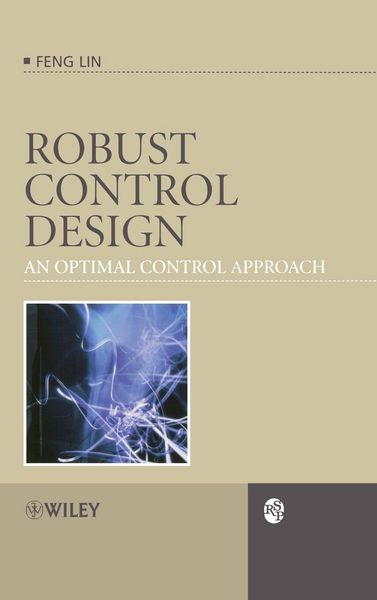
  • Produktbild: Robust Control Design: An Optimal Control Approach
  • Produktbild: Robust Control Design: An Optimal Control Approach

Robust Control Design: An Optimal Control Approach

203,99 €

inkl. gesetzl. MwSt., Versandkostenfrei


Beschreibung

Comprehensive and accessible guide to the three main approaches to robust control design and its applications

Optimal control is a mathematical field that is concerned with control policies that can be deduced using optimization algorithms. The optimal control approach to robust control design differs...

Beschreibung

Comprehensive and accessible guide to the three main approaches to robust control design and its applications

Optimal control is a mathematical field that is concerned with control policies that can be deduced using optimization algorithms. The optimal control approach to robust control design differs from conventional direct approaches to robust control that are more commonly discussed by firstly translating the robust control problem into its optimal control counterpart, and then solving the optimal control problem.

Robust Control Design: An Optimal Control Approach offers a complete presentation of this approach to robust control design, presenting modern control theory in an concise manner. The other two major approaches to robust control design, the H_infinite approach and the Kharitonov approach, are also covered  and described in the simplest terms possible, in order to provide a complete overview of the area. It includes up-to-date research, and offers both theoretical and practical applications that include flexible structures, robotics, and automotive and aircraft control.

Robust Control Design: An Optimal Control Approach will be of interest to those needing an introductory textbook on robust control theory, design and applications as well as graduate and postgraduate students involved in systems and control research. Practitioners will also find the applications presented useful when solving practical problems in the engineering field.

Produktdetails

Einband

Gebundene Ausgabe

Erscheinungsdatum

18.09.2007

Verlag Wiley
Seitenzahl

384

Produktdetails

Einband

Gebundene Ausgabe

Erscheinungsdatum

18.09.2007

Verlag Wiley
Seitenzahl

384

Maße (L/B/H)

23,5/15,7/2,5 cm

Gewicht

702 g

Sprache

Englisch

ISBN

978-0-470-03191-9

Herstelleradresse

Libri GmbH
Europaallee 1
36244 Bad Hersfeld
DE

Email: gpsr@libri.de

Noch keine Bewertungen vorhanden

Verfassen Sie die erste Bewertung zu diesem Artikel

Helfen Sie anderen Kundinnen und Kunden durch Ihre Meinung.

Kundinnen und Kunden meinen

Bewertungen (0)

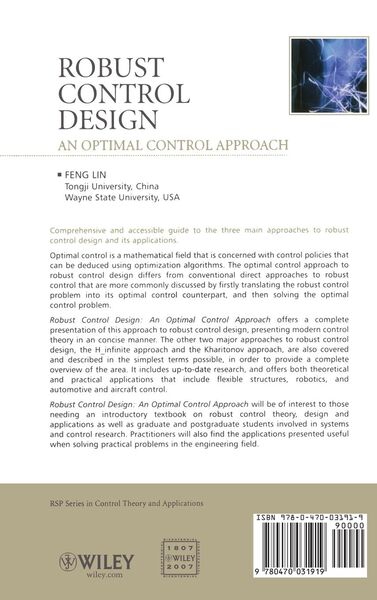
  • Produktbild: Robust Control Design: An Optimal Control Approach
  • Produktbild: Robust Control Design: An Optimal Control Approach
  • Preface.

    Notation.

    1 Introduction.

    1.1 Systems and Control

    1.2 Modern Control Theory

    1.3 Stability

    1.4 Optimal Control

    1.5 Optimal Control Approach

    1.6 Kharitonov Approach

    1.7 H_ and H2 Control

    1.8 Applications

    1.9 Use of This Book

    2 Fundamentals of Control Theory.

    2.1 State Space Model

    2.2 Responses of Linear Systems

    2.3 Similarity Transformation

    2.4 Controllability and Observability

    2.5 Pole Placement by State Feedback

    2.6 Pole Placement Using Observer

    2.7 Notes and References

    2.8 Problems

    3 Stability Theory.

    3.1 Stability and Lyapunov Theorem

    3.2 Linear Systems

    3.3 Routh-Hurwitz Criterion

    3.4 Nyquist Criterion

    3.5 Stabilizability and Detectability

    3.6 Notes and References

    3.7 Problems

    4 Optimal Control and Optimal Observers.

    4.1 Optimal Control Problem

    4.2 Principle of Optimality

    4.3 Hamilton-Jacobi-Bellman Equation

    4.4 Linear Quadratic Regulator Problem

    4.5 Kalman Filter

    4.6 Notes and References

    4.7 Problems 

    5  Robust Control of Linear Systems.

    5.1 Introduction

    5.2 Matched Uncertainty

    5.3 Unmatched Uncertainty

    5.4 Uncertainty in the Input Matrix

    5.5 Notes and References

    5.6 Problems

    6 Robust Control of Nonlinear Systems.

    6.1 Introduction

    6.2 Matched Uncertainty

    6.3 Unmatched Uncertainty

    6.4 Uncertainty in the Input Matrix

    6.5 Notes and References

    6.6 Problems

    7 Kharitonov Approach.

    7.1 Introduction

    7.2 Preliminary Theorems

    7.3 Kharitonov Theorem

    7.4 Control Design Using Kharitonov Theorem

    7.5 Notes and References

    7.6 Problems

    8 H and H2 Control.

    8.1 Introduction

    8.2 Function Space

    8.3 Computation of H2 and H_ Norms

    8.4 Robust Control Problem as H2 and H_ Control

    Problem

    8.5 H2/H_ Control Synthesis

    8.6 Notes and References

    8.7 Problems

    9 Robust Active Damping.

    9.1 Introduction

    9.2 Problem Formulation

    9.3 Robust Active Damping Design

    9.4 Active Vehicle Suspension System

    9.5 Discussion

    9.6 Notes and References

    10 Robust Control of Manipulators.

    10.1 Robot Dynamics

    10.2 Problem Formulation

    10.3 Robust Control Design

    10.4 Simulations

    10.5 Notes and References

    11 Aircraft Hovering Control.

    11.1 Modelling and Problem Formulation

    11.2 Control Design for Jet-borne Hovering 

    11.3 Simulation

    11.4 Notes and References

    Appendix A: Mathematical Modelling of Physical Systems.

    References and Bibliography.

    Index.